
AI-referred traffic is up 130% this holiday. Can an agent actually read your catalog?
AI visitors now convert better than the rest of your traffic—48% better in August—but an agent can only recommend what it can read. Adobe scores the average product page 66% machine-readable. This paper explains what the 130% forecast really measures and gives you a 10-check audit, a four-week plan you can run after code freeze, and a dashboard for Cyber Monday.
Key takeaways
- Adobe forecasts AI-referred retail traffic up 130% this season, but AI clicks are still well under 1% of site traffic. Plan for value per visit, not volume.
- The conversion story flipped in 18 months: AI visitors converted 38% worse than other traffic in March 2025 and 48% better in August 2026.
- Agents send shoppers to your product page; they rarely check out for them. Your PDP now has two readers: the agent that decides whether to recommend you, and the human who buys.
- Product pages are the least machine-readable pages on retail sites, and since July 2026 ChatGPT's shopping picks lean on product feeds. Shopify merchants get much of this by default; Adobe Commerce and Salesforce Commerce Cloud merchants have to act.
- Most fixes are data and configuration, so you can still make them after code freeze. We mark every action "no deploy needed" or "needs deploy".
Executive summary
This season, the shopper who arrives from ChatGPT, Gemini or Perplexity is likely to be your best-converting visitor. Adobe's August 2026 data shows AI-referred visits converting 48% better than other traffic and earning 43% more revenue per visit. Adobe expects that traffic to grow 130% year over year between 1 November and 31 December.
The catch is upstream. Before a shopper clicks, an agent has to find your product, read its price and stock, and trust it enough to recommend it. Most enterprise catalogs make that hard. Prices render in JavaScript that AI crawlers don't run. Feeds drift from the page. Older Google feed connectors are failing quietly because their API was switched off.
Our position: treat agent-readability as a holiday revenue issue, not an SEO side project. Run the 10-check audit on your top 25 SKUs this week. Fix feed and bot-access problems first—they need no code deploy. Measure AI traffic as its own channel from 1 November. Budget now for the rendering fixes in January.
Five numbers that matter
- +130%: forecast growth in AI-referred traffic to US retail sites, 1 November to 31 December 2026 (Adobe, 28 Sep 2026).
- +48%: how much better AI-referred visitors converted than other traffic in August 2026 (Adobe forecast report, Sep 2026).
- 66%: Adobe's average machine-readability score for retail product pages, the lowest of any page type it measured (Adobe, 16 Apr 2026).
- 61.54%: share of tracked ChatGPT Shopping picks drawn from product feeds after 10 July 2026, up from 8.26% (vendor study by Profound, reported by Search Engine Journal, 9 Sep 2026).
- $275.1B: forecast US online holiday spend, up 6.7% (Adobe, 28 Sep 2026).
The 130% headline, and what it actually measures
The 2026 forecast, day by day
Adobe expects US online holiday spend of $275.1 billion from 1 November to 31 December, up 6.7%. Cyber Monday (30 November) should reach $15.1 billion, the first single day over $15 billion. Black Friday (27 November) should bring $12.9 billion. Mobile carries 57.4% of the season, and buy now, pay later adds $21.3 billion.
AI-referred traffic—shoppers clicking a link in an AI tool—is forecast up 130% for the season. Adobe expects Black Friday up 95% and Cyber Monday up 88%. Thanksgiving is put at 141–159%, depending on which Adobe document you read. Independent forecasts point the same way:
- Deloitte (10 Sep 2026) expects e-commerce of $316.1–318.9 billion, up 7.5–8.4%.
- Mastercard SpendingPulse (23 Sep 2026) forecasts online sales up 11%, against 3.6% in stores.
- The NRF (15 Oct 2026) puts total holiday sales at $1.013 trillion, up 4.2%.
Online grows faster than retail overall, and AI referrals grow faster than online. It's the steepest curve in your analytics this season—if you can see it, and if you're in the answers that create it.
Three meanings of "AI traffic"
Three reports can quote 0.3%, 20% and $262 billion for what sounds like the same thing. They're measuring different things:
- AI-referred clicks. A person reads an AI answer and clicks through to your site. A vendor study by SE Ranking across 101,574 websites (18 Jun 2026) puts this at 0.32% of all site traffic in 2026, up from 0.24% in 2025. Adobe's 130% describes this kind of traffic.
- Agent and bot visits. Software reads your pages on someone's behalf: crawlers that build an answer, and agentic browsers that click around for a user. Bot-management vendor HUMAN Security (4 Dec 2025) measured agent traffic to e-commerce sites up 144.7% from its pre-Black Friday baseline to the 29 November peak. Salesforce's 2026 predictions claim 20% of holiday e-commerce traffic will come from AI chat agents.
- AI-influenced sales. Any sale where AI or an agent played a part somewhere in the path. Salesforce (8 Jan 2026), using its own model, says AI and agents influenced $262 billion of global 2025 holiday online sales, about 20%.
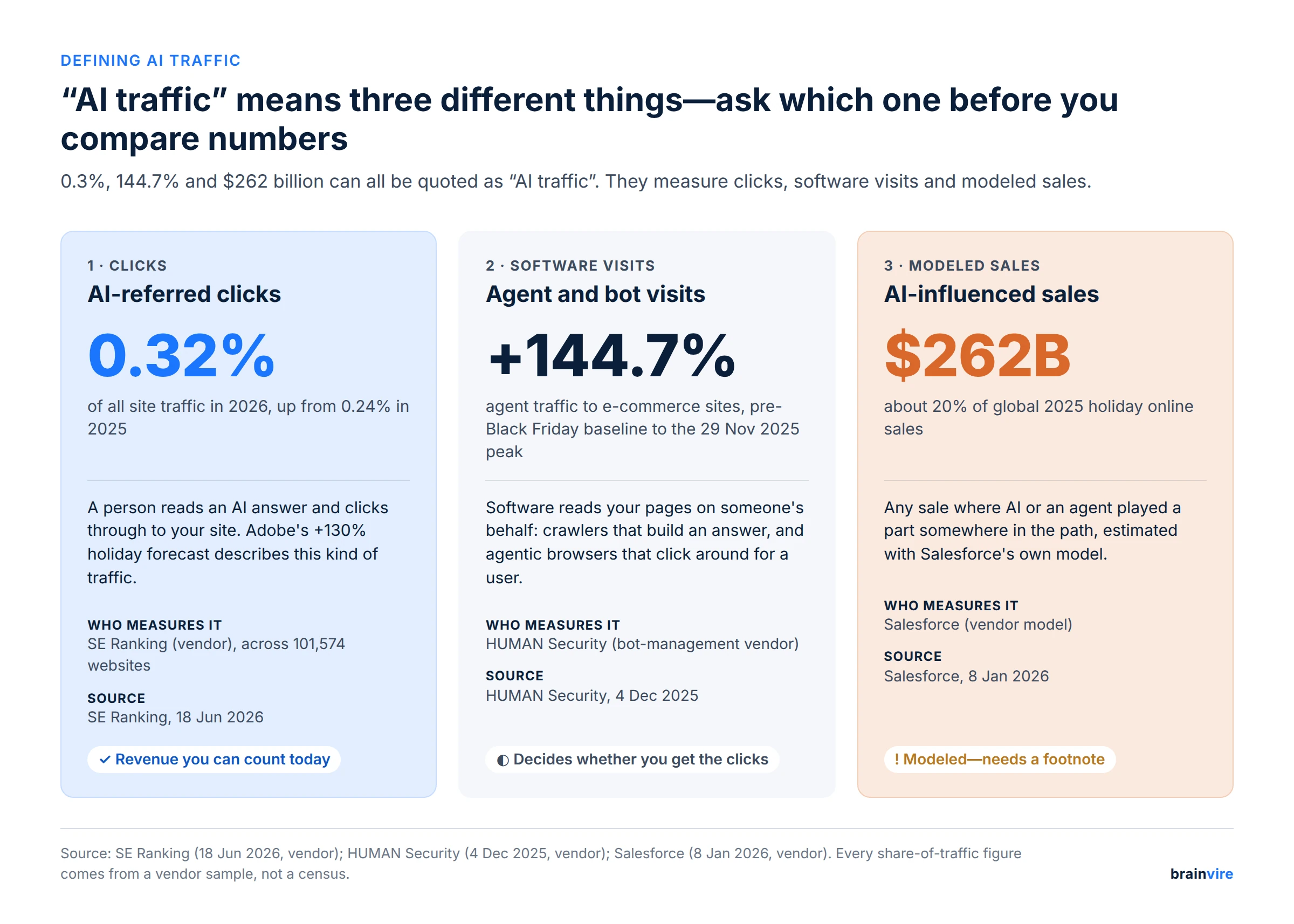
When your board asks how big AI traffic is, ask which of the three they mean. Clicks are revenue you can count today. Agent visits decide whether you get those clicks. Influenced sales are modeled and need a footnote in any business case.
Note
Salesforce's 20% is a prediction, not a measurement, and appears to count agent activity rather than human clicks. Every share-of-traffic figure here comes from a vendor sample, not a census.
The conversion gap flipped in 18 months
From worst visitor to best visitor
This is the most important chart in the paper. Adobe has compared the conversion rate of AI-referred visitors with all other traffic to US retail sites since early 2025. In March 2025, AI visitors converted 38% worse.
Then the sign changed:
- Prime Day 2025: 23% worse (Adobe, 29 Jun 2026).
- Holiday 2025: 31% better, with Thanksgiving at 54% better and Black Friday at 38% better.
- March 2026: 42% better, a record at the time.
- Prime Day 2026: 40% better.
- August 2026: 48% better.
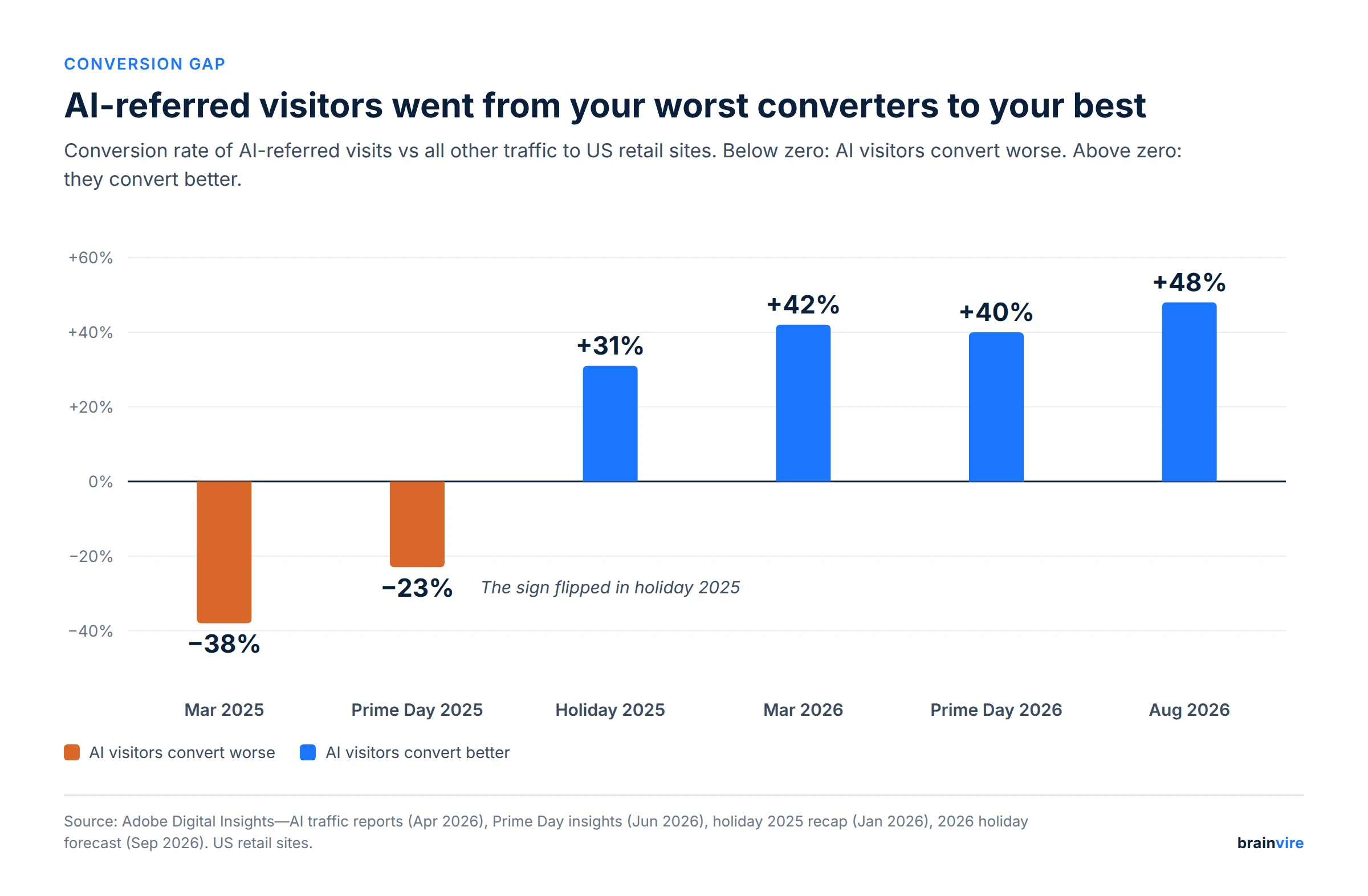
Eighteen months ago, AI referrals were window-shoppers. Now they've already compared options inside the chat, and they click when they're close to buying.
Engagement and revenue per visit
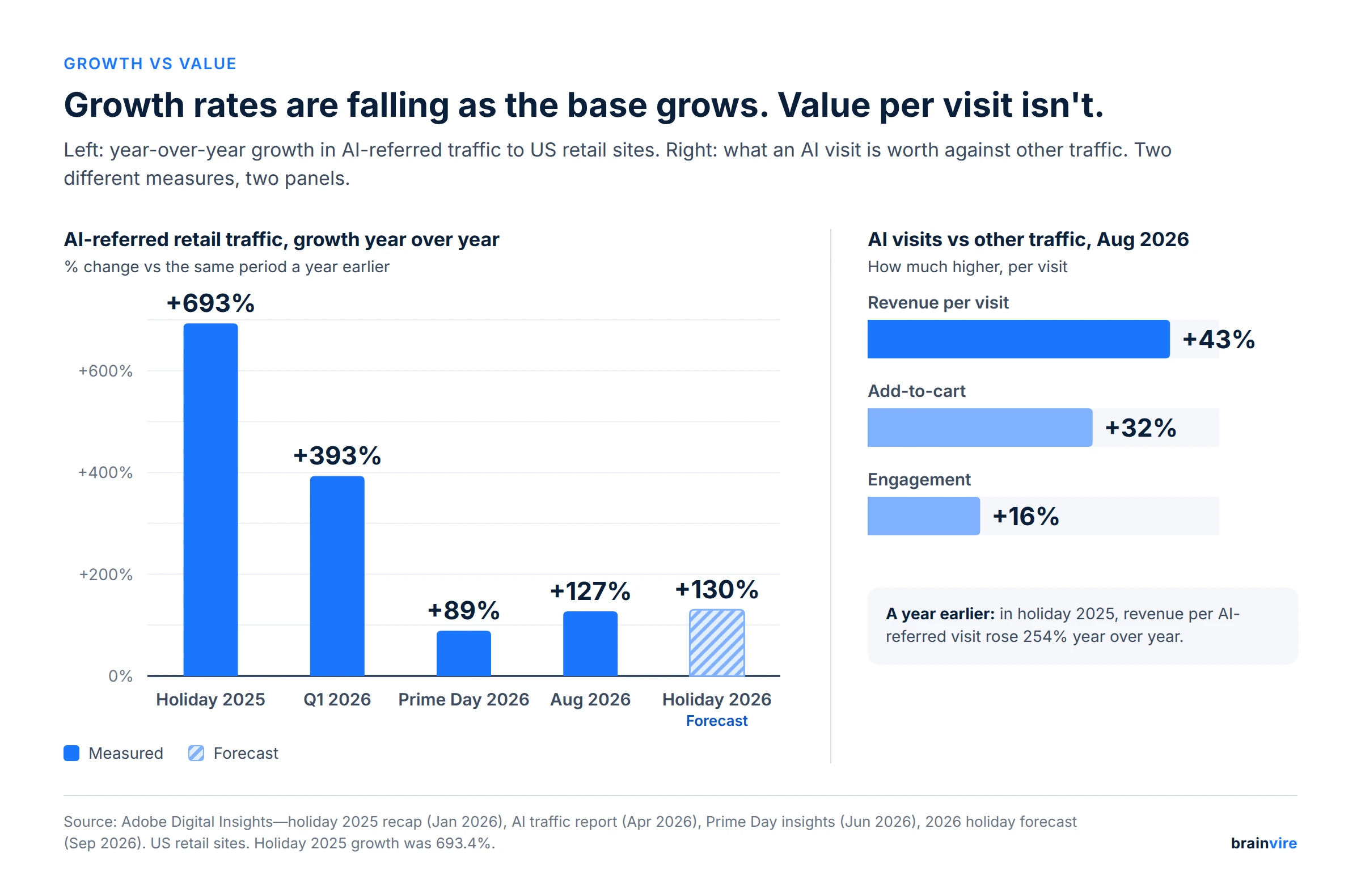
In holiday 2025, Adobe found that AI-referred shoppers spent 45% more time on site, viewed 13% more pages and were 33% less likely to bounce. Revenue per AI-referred visit rose 254% year over year.
By August 2026, AI visits were earning 43% more revenue per visit than other traffic, with 32% higher add-to-cart and 16% higher engagement (Adobe forecast report). Salesforce's data agrees on a different benchmark: AI-search referrals converted 9 times more often than social referrals in holiday 2025.
If your team still reports AI referrals inside "Referral" or "Direct", your highest-value segment is hiding in your noisiest bucket. Fixing that takes an afternoon.
Growth is slowing. Value per visit isn't.
Growth rates are falling, and that's normal. Adobe measured AI traffic to retail up 693.4% in holiday 2025 and 393% in Q1 2026. It was up 89% on Prime Day 2026, 127% in August, and 130% in the holiday forecast. The base is now big enough that triple digits are hard to sustain.
What this means for your budget
Plan for share, not spikes. The useful questions now:
- Of the AI answers in your category, how many include you?
- When they do, is the price right?
- Does the click land somewhere that converts?
Adobe says AI traffic volume "remains modest compared to other major channels". That's the honest limit here: AI referrals won't rescue a weak season. But a channel growing over 100% a year, converting best of all and decided largely by data you control is worth the work.
Agents send shoppers to your page—they rarely check out for them
What happened to in-chat checkout
A year ago, the industry expected agents to complete purchases inside the chat. That hasn't happened yet.
OpenAI moved away from Instant Checkout, its native in-chat buying, in March 2026, as Shopifreaks reported (12 Mar 2026), citing The Information. OpenAI's merchant page now says it plainly: "purchases are completed on merchant-owned websites or apps."
Walmart had listed about 200,000 products in Instant Checkout. MarTech reported (20 Mar 2026), citing WIRED, that in-chat purchases converted at roughly one-third the rate of click-throughs to Walmart.com. Daniel Danker, Walmart's EVP of product and design, called the in-chat experience "unsatisfying". Walmart is now bringing its assistant, Sparky, into ChatGPT and Gemini, with checkout on Walmart.com (Axios, 24 Mar 2026).
Shoppers agree. In PwC's Holiday Outlook (8 Sep 2026; 4,093 US consumers), 29% plan to use AI somewhere in their holiday shopping, but only 4% expect to buy gifts through AI tools. And 64% of AI users who get ideas from AI open a separate tab to buy on a website.
Amazon proves the point from the other side. Its assistant, Rufus, lives inside Amazon's own checkout. PPC Land, reporting Amazon's Q4 2025 results, says Rufus drove nearly $12 billion in incremental annualized sales from more than 300 million users in 2025. Agents close sales best where the checkout already is.
For most retailers this holiday, the agent's job ends at the click. The sale still happens on your product page.
Note
Google is pushing the other way. Its Universal Cart, live in US Search and the Gemini app since 15 Oct 2026, offers checkout with Google Pay at participating stores. The merchant stays the seller of record. In-chat checkout may catch on. It won't carry most of this season's money.
Your product page now has two readers
Your product page now serves two readers:
- The agent reads your page (or your feed) to decide whether to recommend you. It wants unambiguous facts in plain HTML or structured data: price, availability, variants, specs, shipping, returns and reviews.
- The human arrives with high intent and a specific expectation. If the price or stock they were shown doesn't match the page, you lose the sale and some trust. In a vendor survey by Salsify (Jan 2026), 45% of shoppers said they'd returned an online purchase because the information was incorrect or misleading.
The rest of this paper is about the first reader, because that's where most catalogs fail.
Your product page is the least machine-readable page you have
What agents can't see
In April 2026, Adobe ran retail pages through its AI Content Visibility Checker. It scores how much of a page a machine can read (50% means half is out of reach). The results (16 Apr 2026) put returns pages at 82%, contact pages at 81%, FAQs at 80%, customer service at 79% and loyalty at 78%. Homepages averaged 75% (ranging from 54.2% to 82.5%), category pages 74% and store locators 73%. Product pages came last, at 66%.
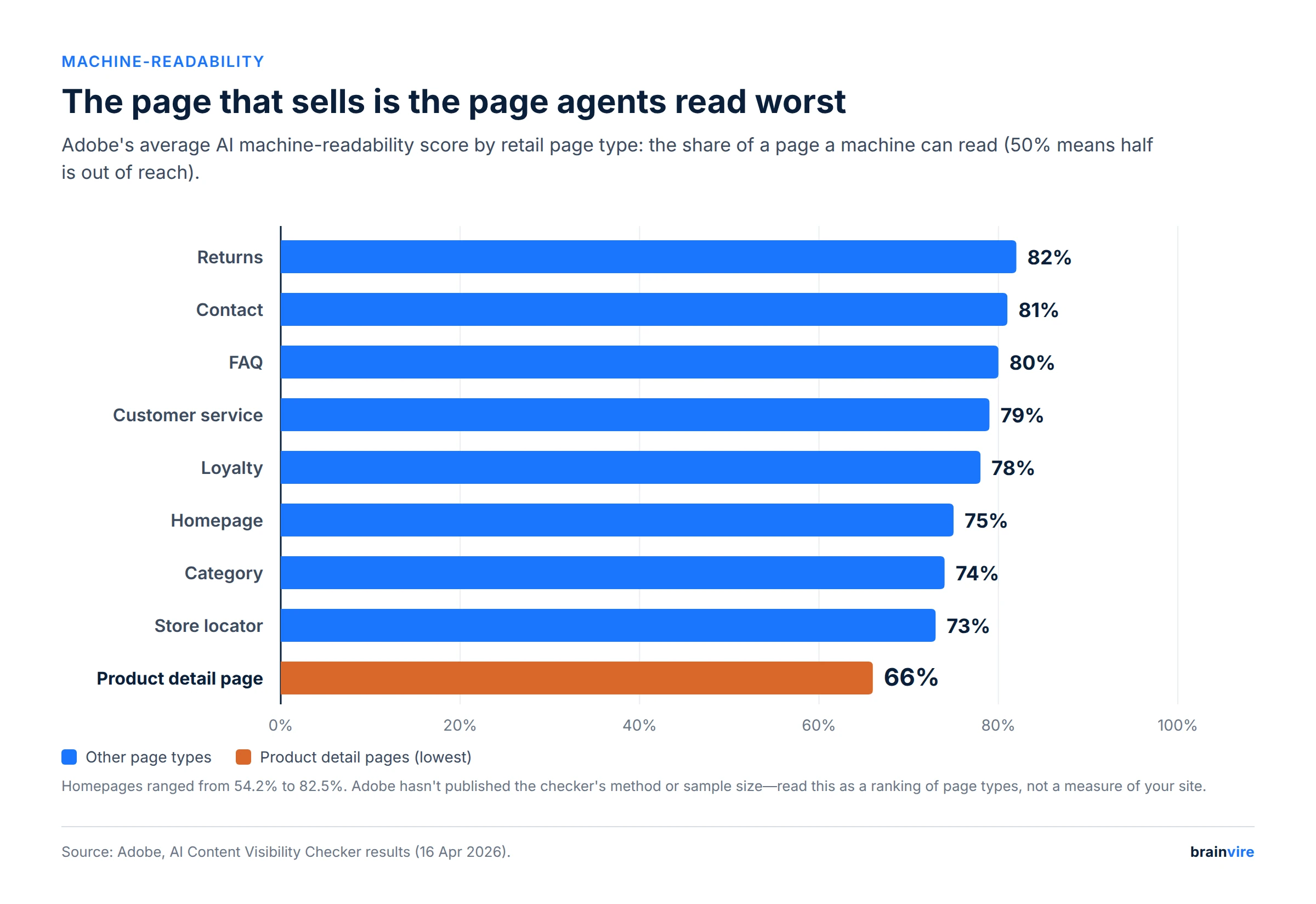
Your returns policy is more legible to an agent than the product you want it to recommend. On a typical PDP, about a third of the content is out of reach—often the live price, variant stock, delivery promise and review summary.
Note
Adobe hasn't published the checker's method or sample size. Treat the scores as a ranking of page types, not a measure of your site. The audit below gives you a direct test.
Why JavaScript-heavy storefronts go dark
The main reason is rendering. When Vercel and MERJ analyzed AI crawler traffic (17 Dec 2024), they found that "none of the major AI crawlers currently render JavaScript": not OpenAI's, not Anthropic's ClaudeBot, not PerplexityBot. Gemini is the exception, because it uses Googlebot's rendering. ChatGPT's and Claude's crawlers also hit missing pages (404s) on roughly 34–35% of fetches, against 8.22% for Googlebot.
Adobe's own analytics documentation agrees. It notes that when an AI fetches a page to answer a prompt, it takes only the raw HTML, without executing JavaScript—and it leaves no hit in your analytics.
Picture a typical enterprise PDP. The HTML shell arrives with a name and a description. Then JavaScript fetches the price, the stock, the review widget and the delivery estimate. A human sees a complete page. An AI crawler sees a product with no price, no stock and no reviews—and moves on to a competitor whose HTML says "in stock, 4.6 stars" in plain text.
Note
The Vercel and MERJ data is from late 2024, and crawlers may have changed. We still treat "visible without JavaScript" as the safe baseline, because no AI platform has documented otherwise.
Headless storefronts, single-page apps and client-side price injection are the most exposed. The fix is server-side rendering of the facts an agent needs—a code change, so a January project for most teams. For the holiday window, the workaround is the feed.
Feeds have overtaken crawling
The July 2026 shift in ChatGPT Shopping
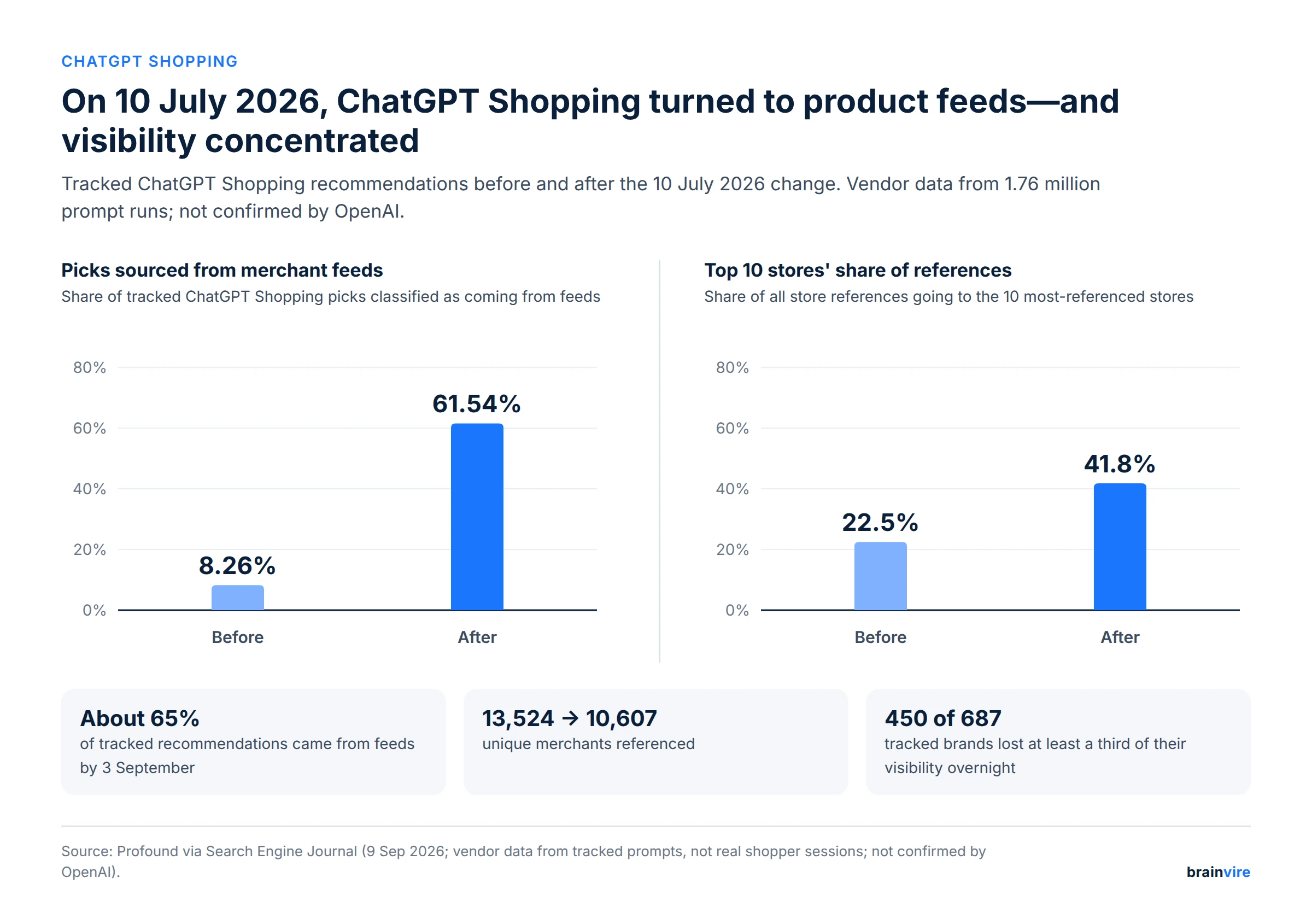
Something changed in ChatGPT Shopping on 10 July 2026. Profound, an AI-visibility vendor, tracked 1.76 million ChatGPT Shopping prompt runs in July. On that day, the share of picks it classified as coming from merchant feeds jumped from 8.26% to 61.54%. By 3 September, feeds supplied about 65% of tracked recommendations.
Visibility also concentrated. The top 10 stores' share of references rose from 22.5% to 41.8%. The number of unique merchants referenced fell from 13,524 to 10,607. Of 687 brands Profound tracked, 450 lost at least a third of their ChatGPT Shopping visibility overnight.
Note
This is one vendor's sample of tracked prompts, not real shopper sessions, and OpenAI hasn't confirmed the change. It does match OpenAI's merchant page, which says feeds give merchants more control and "richer data helps your products surface."
If your products reach ChatGPT only through crawling, you start at a disadvantage. If they arrive through a feed, the feed's accuracy decides how you show up.
Who gets this by default: Shopify, Adobe Commerce, SFCC
Here your platform matters more than your marketing. OpenAI's merchant page says Shopify and Etsy catalogs are already integrated with no setup. Everyone else applies and joins a waitlist; a self-serve platform is promised "later this year". Shopping in ChatGPT is US-only.
- Shopify turned on Shopify Catalog by default and syndicates eligible products to ChatGPT, Microsoft Copilot, Google AI Mode and the Gemini app (Spring '26 Edition, 17 Jun 2026). On Shopify's Q1 2026 earnings call, president Harley Finkelstein said AI-search orders rose nearly 13 times year over year. He added that "traffic from catalog-powered AI searches converts 2x more than traffic from general AI searches" (Marketing Brew, 19 May 2026). That's Shopify's own data, but it's the clearest public evidence that feed data changes conversion, not just visibility.
- Adobe Commerce said in February 2026 that it is "moving towards supporting" Google's Universal Commerce Protocol and OpenAI's Agentic Commerce Protocol, with no dates. This holiday, Adobe Commerce merchants reach ChatGPT through OpenAI's application or a feed provider.
- Salesforce Commerce Cloud announced with OpenAI in October 2025 that Agentforce Commerce catalogs "will appear in ChatGPT", with timing to come "in the coming months". Search Engine Journal reports that feeds can now come through supported providers such as Salesforce and Stripe. Confirm your own org's status with your Salesforce team.
Shopify Plus merchants mostly need to check settings and data quality. Adobe Commerce and SFCC merchants need a named owner for getting the catalog into ChatGPT, because the platform won't do it before Black Friday.
The silent holiday risk: Google's Content API shutdown
Google's AI Mode and Gemini read from the Shopping Graph, which Google says holds more than 60 billion product listings. According to Google figures reported by PPC Land, 2 billion of them are updated every hour. Most products get there through Merchant Center—and many Adobe Commerce, Magento and custom stacks feed Merchant Center through an old API.
Google's Content API for Shopping reached its sunset on 18 August 2026. Since 1 September, requests from connectors without an extension fail at random with HTTP 410 errors, and the failure rate rises over time. Full shutdown follows in early 2027. The replacement is the Merchant API.
A connector that fails at random is worse than one that fails completely. Some price updates land and others don't, so Merchant Center drifts from your site. Google flags the mismatches, and products can drop out of Shopping and AI Mode in peak week. Nobody notices until a merchandiser asks why a hero SKU vanished on Black Friday.
Ask your platform team one question today: does anything in our stack still call the Content API for Shopping? On a hosted platform, Google says the platform partner handles migration. With your own extension or middleware, you own it. The check needs no deploy. The fix might.
What agents actually read—and what to ignore
The signals that matter
No AI platform publishes its ranking formula, but they all publish what they ask for:
- A complete, current feed. OpenAI's product feed spec requires nine fields on every row: item ID, title, description, URL, brand, seller name, image URL, availability and price. It sets no refresh cycle; it tells merchants to update price when a sale starts or ends, and availability when stock changes. Optional fields cover GTIN, returns, shipping and reviews.
- Merchant Center hygiene and depth. Google says retailers who follow its core feed best practices see an average 5% conversion lift the following month (16 Sep 2026). In lululemon's testing, its "conversational attributes" (highlights, details, Q&A) appeared in 50% of relevant AI Mode recommendations. Google's new AI performance insights add an "attribute completeness score" showing which products lack the attributes shoppers search for.
- Crawler access. OpenAI's crawler documentation separates OAI-SearchBot, which decides whether you appear in ChatGPT search answers, from GPTBot, which collects training data. You can allow one and block the other. Robots.txt changes take about 24 hours.
- Machine-readable policies. Returns windows, shipping costs and holiday cutoffs belong in the feed and structured data, not only on policy pages.
- Proof. In Syndigo's vendor survey (19 Aug 2026; 8,736 adults in six countries, run by YouGov), ratings and reviews (53%) and product descriptions (52%) ranked above discounts (49%) as purchase factors. And 83% said they'd likely leave a page missing the details they wanted. For an agent, a review count it can't read doesn't exist.
An agent chooses on facts it can verify. Every missing or stale attribute is a reason to recommend someone else.
What not to waste time on
llms.txt. It's been sold as "robots.txt for AI". An evidence review (Sep 2026) says it does almost nothing for visibility:
- An Ahrefs study of 137,210 domains found 97% of llms.txt files received zero requests.
- SE Ranking found no correlation between having the file and being cited by AI.
- Google's AI optimization guide says Google Search ignores the file.
Don't spend holiday engineering hours on it.
Schema for its own sake. Google says directly that "structured data isn't required for generative AI search", though it recommends keeping it. Our reading: Product and Offer markup still matters for agents reading raw HTML. But schema can't fix a feed that says "in stock" when the warehouse disagrees. Accuracy comes before markup coverage.
Blocking everything. Some teams block AI crawlers wholesale without knowing it. Since 1 July 2025, Cloudflare asks every new domain whether to allow AI crawlers at sign-up, and more than 1 million customers had already used its one-click AI block. Blocking training crawlers is a legitimate choice. Blocking the search crawlers that put you in shopping answers is usually an accident.
The agent-readability audit: 10 checks, 100 points
Here's the audit we'd run on any catalog before Black Friday, built from the evidence above. Run it on your top 20 revenue SKUs plus 5 long-tail SKUs; each check takes under 30 minutes. Score each check 0–3, then multiply by its weight divided by 3.
| # | Check | Weight | How to test | What "good" looks like | Deploy? |
|---|---|---|---|---|---|
| 1 | AI crawler access | 12 | Check robots.txt and CDN/WAF rules for OAI-SearchBot, PerplexityBot, Googlebot and Bingbot; request 5 PDPs as each. | Search crawlers get a 200. Any training-crawler block is deliberate. | No deploy needed |
| 2 | PDP facts without JavaScript | 12 | View the raw HTML. Look for price, availability, variants, key specs and review summary. | All five in the initial HTML. | Needs deploy to fix |
| 3 | Product structured data | 10 | Rich Results Test on 10 PDPs: Product/ProductGroup, Offer, GTIN, brand, rating, returns, shipping. | Zero errors; GTIN on 95%+ of SKUs. | Usually needs deploy |
| 4 | Price and stock parity | 12 | For 20 SKUs, compare feed, markup, page and cart. | 100% match; sale prices in feeds within an hour. | No deploy needed |
| 5 | Merchant Center health and API | 10 | Check disapprovals in Diagnostics and which Google API your connector calls. | Under 2% disapproved; Merchant API; zero 410s. | Check: no deploy. Migration: may need one |
| 6 | Attribute depth | 10 | Attribute completeness score; fill rate of the top 10 attributes per category; highlights and Q&A. | 90%+ fill on top SKUs; highlights and Q&A on the top 100. | No deploy needed |
| 7 | ChatGPT feed coverage | 8 | Shopify: Catalog on. Others: application filed or feed provider connected. Run 10 category prompts. | Products appear with the correct price. | No deploy needed |
| 8 | Machine-readable policies | 8 | Returns, shipping costs and holiday cutoffs in feed and markup, matching policy pages. | Explicit, current, consistent. | Feed: no deploy. Markup: needs deploy |
| 9 | Reviews and proof | 8 | Review count and rating in feed and raw HTML; recency. | 10+ reviews on top SKUs, machine-visible. | Feed: no deploy. HTML: needs deploy |
| 10 | Hand-off and measurement | 10 | Click through from an AI answer: right variant, live price, guest checkout. AI channel in analytics. | Clean landing; AI channel reported daily. | No deploy needed |
Bands: 80–100 is agent-ready. 60–79 means agents can find you but leak sales on bad data. Below 60 means you're largely invisible to non-Google agents.
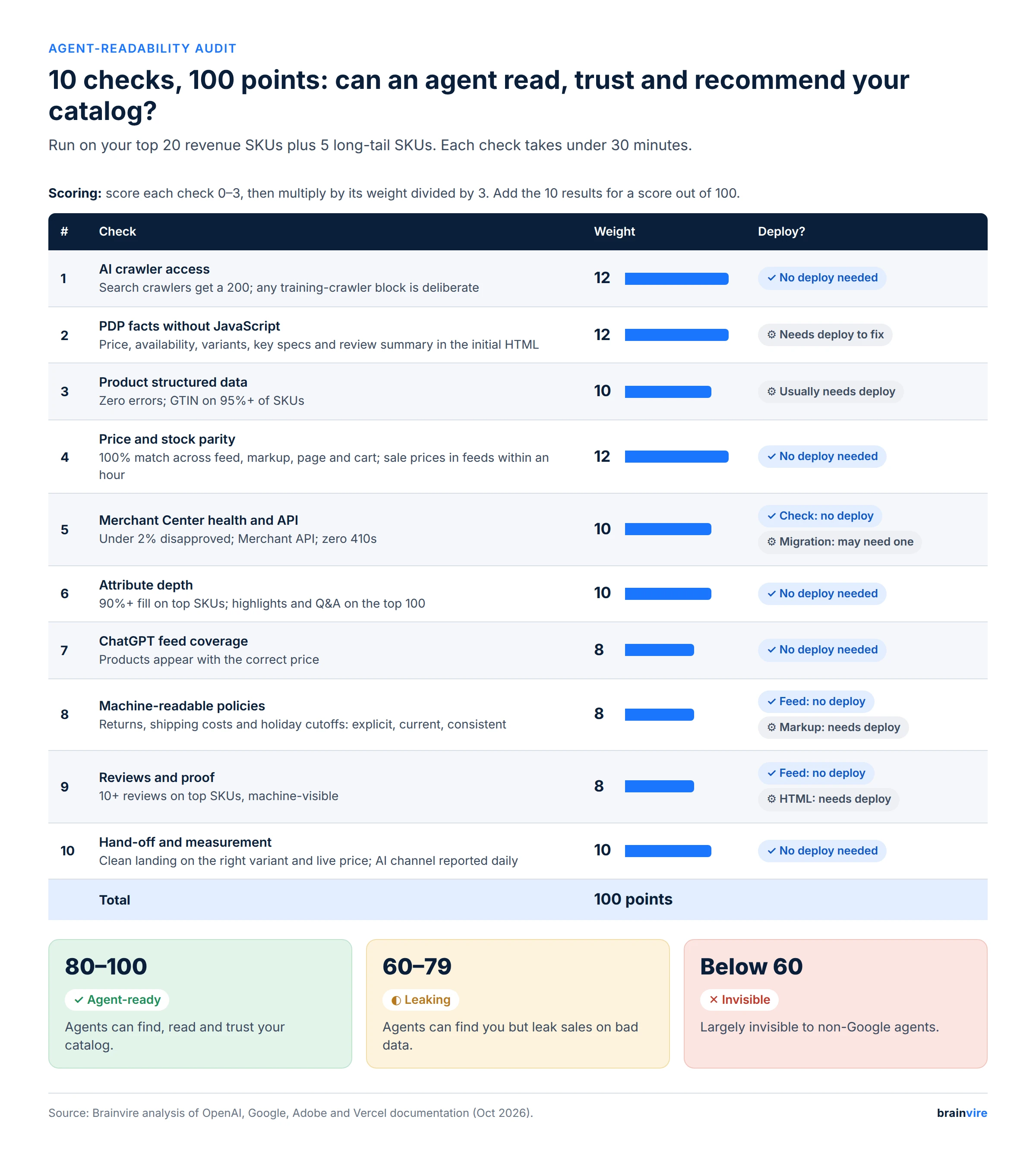
The evidence points to checks 2, 4 and 6—rendering, parity and attribute depth—as where most catalogs will lose points. Two of the three can be fixed without a deploy. If you'd like a second pair of eyes, Brainvire's Adobe Commerce, Shopify Plus and Salesforce Commerce Cloud teams run this audit in a working session with your catalog and platform owners.
Platform playbooks
Each step is tagged no deploy needed or needs deploy. If your freeze has started, do the first kind now and schedule the second for January.
Adobe Commerce and Magento
- Confirm your Google connector is on the Merchant API (no deploy needed to check). If the extension or middleware that feeds Merchant Center calls the Content API, it's already getting random 410 errors. Get the vendor's Merchant API version, or request a temporary extension from Google while you migrate (needs deploy).
- Raise feed frequency for promo SKUs (no deploy needed). Move Black Friday SKUs to at least hourly price and stock updates, with a mismatch report.
- Add conversational attributes through supplemental feeds (no deploy needed). Merchandising can maintain highlights, details and Q&A in a Merchant Center supplemental feed without touching the catalog.
- Get into ChatGPT Shopping (no deploy needed). File OpenAI's merchant application or route a feed through a provider that supports its spec, mapping your attributes to the nine required fields plus GTIN, return days and reviews.
- Check what your storefront renders on the server (needs deploy to fix).
- Luma and Hyvä themes render most PDP content on the server, but configurable-product prices, swatches and review widgets often load with JavaScript.
- PWA Studio storefronts render most content in the browser, out of AI crawlers' sight.
- Edge Delivery Services storefronts use drop-in components; confirm whether your PDP pre-renders price and JSON-LD.
- January fix order: server-render price, availability and review summary, then add Product, Offer and ProductGroup markup.
If you're planning an Adobe Commerce PaaS to SaaS migration, put agent-readability in the requirements now. Rendering choices are cheaper to make once.
Shopify Plus
- Check the toggles (no deploy needed). Confirm Shopify Catalog is on and which Agentic Storefronts channels (ChatGPT, Copilot, AI Mode, Gemini) are enabled in Admin.
- Fill category metafields (no deploy needed). Catalog can only standardize what's there. Map product metafields to Shopify's standard taxonomy attributes—material, fit, compatibility—for top sellers.
- Find apps that inject prices or stock in the browser (needs deploy to fix). Discount, bundling, currency and B2B pricing apps often rewrite prices with JavaScript, so Catalog may show a different price from the shopper's. Test the top 20 SKUs.
- Expose reviews to machines (may need deploy). Many review apps render client-side. Check whether the rating and count appear in raw HTML and structured data.
Salesforce Commerce Cloud
- Ask Salesforce for your ChatGPT status (no deploy needed). Confirm whether your org can feed ChatGPT through Agentforce Commerce now, or should apply to OpenAI directly.
- Check your Google feed path (no deploy needed). Whether it's a cartridge, a feed provider or custom jobs, confirm it has moved off the Content API.
- Check rendering (needs deploy to fix). SFRA renders on the server, so HTML usually carries price and stock. PWA Kit supports server-side rendering on Managed Runtime, but personalized prices and inventory are often fetched after load. Run audit check 2 on both.
AEM-fronted and headless storefronts
- Run the raw-HTML test on every template (no deploy needed). Headless builds vary most: some server-render everything, others ship an empty shell. Fetch PDP, category and search pages with JavaScript off.
- Feed first, rendering second (no deploy needed). If the HTML is thin, make sure Merchant Center and your ChatGPT feed carry everything the page can't show.
- Server-render product facts (needs deploy). Use server-side or incremental static rendering for price, availability and reviews, then hydrate personalization on top—the pattern in our headless AEM commerce accelerator. It's the January fix.
Four weeks to Black Friday: the freeze-safe plan
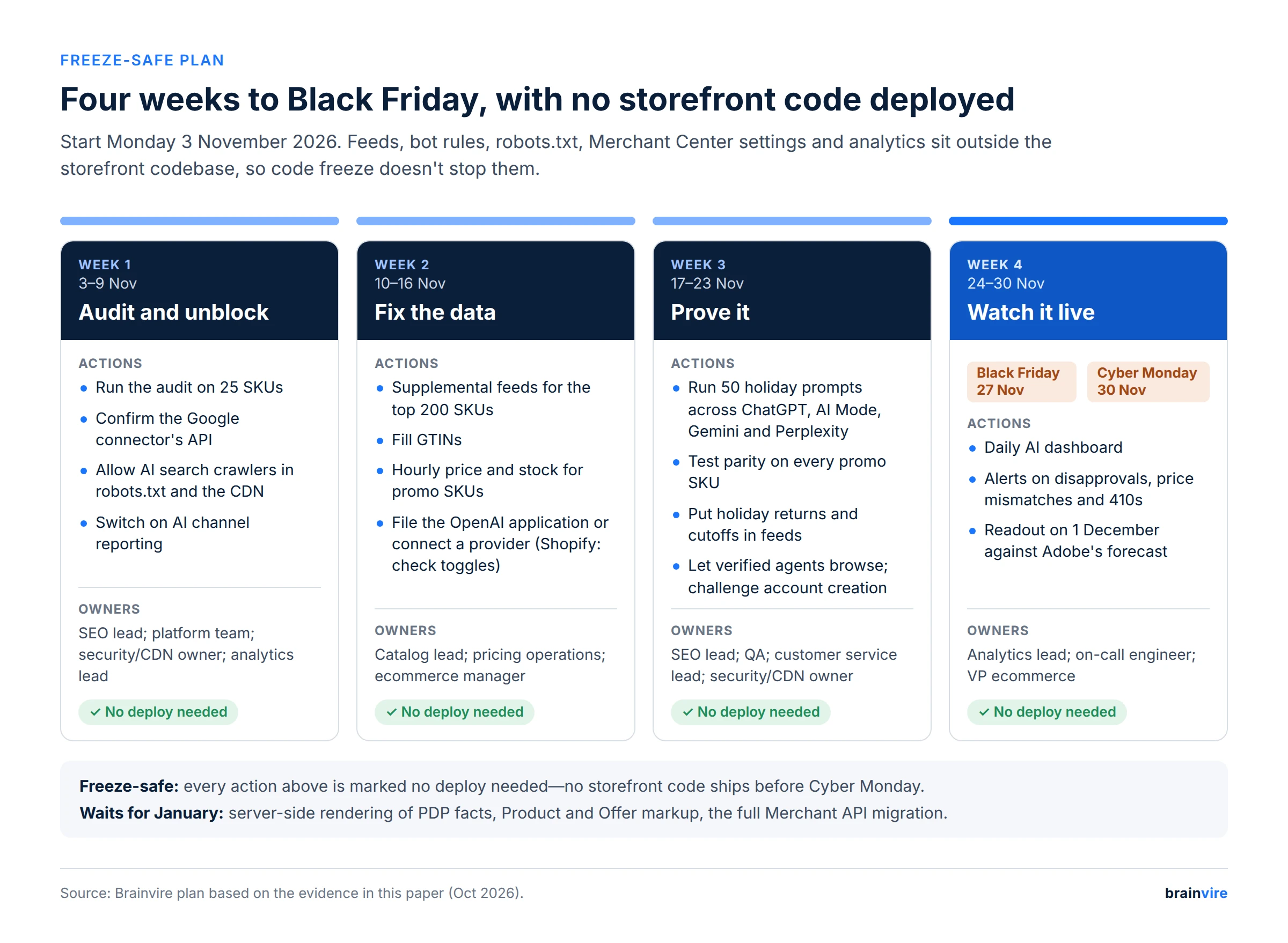
Many enterprise teams freeze code in early November. That doesn't stop this work: feeds, bot rules, robots.txt, Merchant Center settings and analytics sit outside the storefront codebase. The plan assumes you start on Monday 3 November and ship no storefront code before Cyber Monday.
| Week | Focus | Actions | Owner | Deploy? |
|---|---|---|---|---|
| 1 (3–9 Nov) | Audit and unblock | Run the audit on 25 SKUs. Confirm the Google connector's API. Allow AI search crawlers in robots.txt and the CDN. Switch on AI channel reporting. | SEO lead; platform team; security/CDN owner; analytics lead | No deploy needed |
| 2 (10–16 Nov) | Fix the data | Supplemental feeds for the top 200 SKUs. Fill GTINs. Hourly price and stock for promo SKUs. File the OpenAI application or connect a provider (Shopify: check toggles). | Catalog lead; pricing operations; ecommerce manager | No deploy needed |
| 3 (17–23 Nov) | Prove it | Run 50 holiday prompts across ChatGPT, AI Mode, Gemini and Perplexity. Test parity on every promo SKU. Put holiday returns and cutoffs in feeds. Let verified agents browse; challenge account creation. | SEO lead; QA; customer service lead; security/CDN owner | No deploy needed |
| 4 (24–30 Nov) | Watch it live | Daily AI dashboard. Alerts on disapprovals, price mismatches and 410s. Readout on 1 December against Adobe's forecast. | Analytics lead; on-call engineer; VP ecommerce | No deploy needed |
What waits for January
These need code and shouldn't be rushed into a peak-season release:
- Server-side rendering of price, availability and review summary on PDPs.
- Product, Offer and ProductGroup markup through the theme or front end.
- The full Merchant API migration, if you're on a temporary Google extension.
- A PIM attribute model that makes conversational attributes part of product onboarding.
- Your position on agentic checkout protocols (Google's UCP and OpenAI's ACP) by platform.
What we would do
- Today: ask whether anything in your stack still calls Google's Content API for Shopping. It's the one item that can quietly cost you sales this season.
- This week: check robots.txt and CDN rules for AI search crawlers, and switch on AI channel reporting so 1 November has a baseline.
- Before 16 November: load supplemental feeds for your top 200 SKUs and get your catalog into ChatGPT, through Shopify Catalog, a feed provider or OpenAI's application.
- Before Thanksgiving: run the prompt panel and the parity test. Fix data, not code.
- In January: fund server-side rendering of product facts, finish the Merchant API move, and set your agentic checkout position. Rendering is the structural fix; everything before it is a holiday bridge.
Measuring it on Cyber Monday
AI traffic is easy to miss. Set up three layers before 1 November.
Layer 1: referred clicks in analytics.
- GA4. On 13 May 2026, Google added a native "AI Assistant" channel to GA4's default channel group (Google Analytics Help, via TechWyse). It sets the medium "ai-assistant" for referrers such as ChatGPT, Gemini and Claude. It isn't retroactive and Google hasn't published the full list, so add a custom channel above Referral with a source regex for chatgpt.com, perplexity.ai, gemini.google.com, copilot.microsoft.com and claude.ai.
- Adobe Analytics. The Referrer type dimension includes "Conversational AI tools".
Layer 2: dark traffic. ChatGPT appends utm_source=chatgpt.com to many links, and the tag survives when the referrer is stripped. Many AI visits still arrive with no referrer: 70.6% in one vendor's sample (Clickport, citing Loamly, Feb 2026). An unexplained rise in Direct traffic to deep product URLs is often AI traffic in disguise.
Layer 3: what analytics can't see.
- Clicks from Google's AI Mode count in Search Console's Web totals, with no separate filter (PPC Land, 17 Jun 2025).
- Agent fetches that build an answer don't fire your tag at all. Use server logs segmented by user agent for crawler activity.
- Use Merchant Center's AI performance insights for share of voice in AI Mode and Gemini.
| KPI | Where it comes from | Benchmark to compare against |
|---|---|---|
| AI-referred sessions, growth on last year | GA4 AI Assistant channel plus custom regex; Adobe referrer type | Adobe forecast: Black Friday +95%, Cyber Monday +88%, season +130% |
| AI share of sessions | Same | About 0.32% of all site traffic in a 2026 vendor sample (SE Ranking) |
| AI conversion rate against site average | Analytics | +48% (Adobe, Aug 2026); +31% (Adobe, holiday 2025) |
| Revenue per AI visit against site average | Analytics | +43% (Adobe, Aug 2026) |
| Bounce rate, AI against all traffic | Analytics | 33% less likely to bounce (Adobe, holiday 2025) |
| Feed disapprovals and 410 errors | Merchant Center Diagnostics; connector logs | Your threshold: under 2% disapproved; zero 410s |
| Price and stock mismatches | Parity script on promo SKUs | Zero |
| Share of voice in AI Mode | Merchant Center AI performance insights | Your own trend from 1 November |
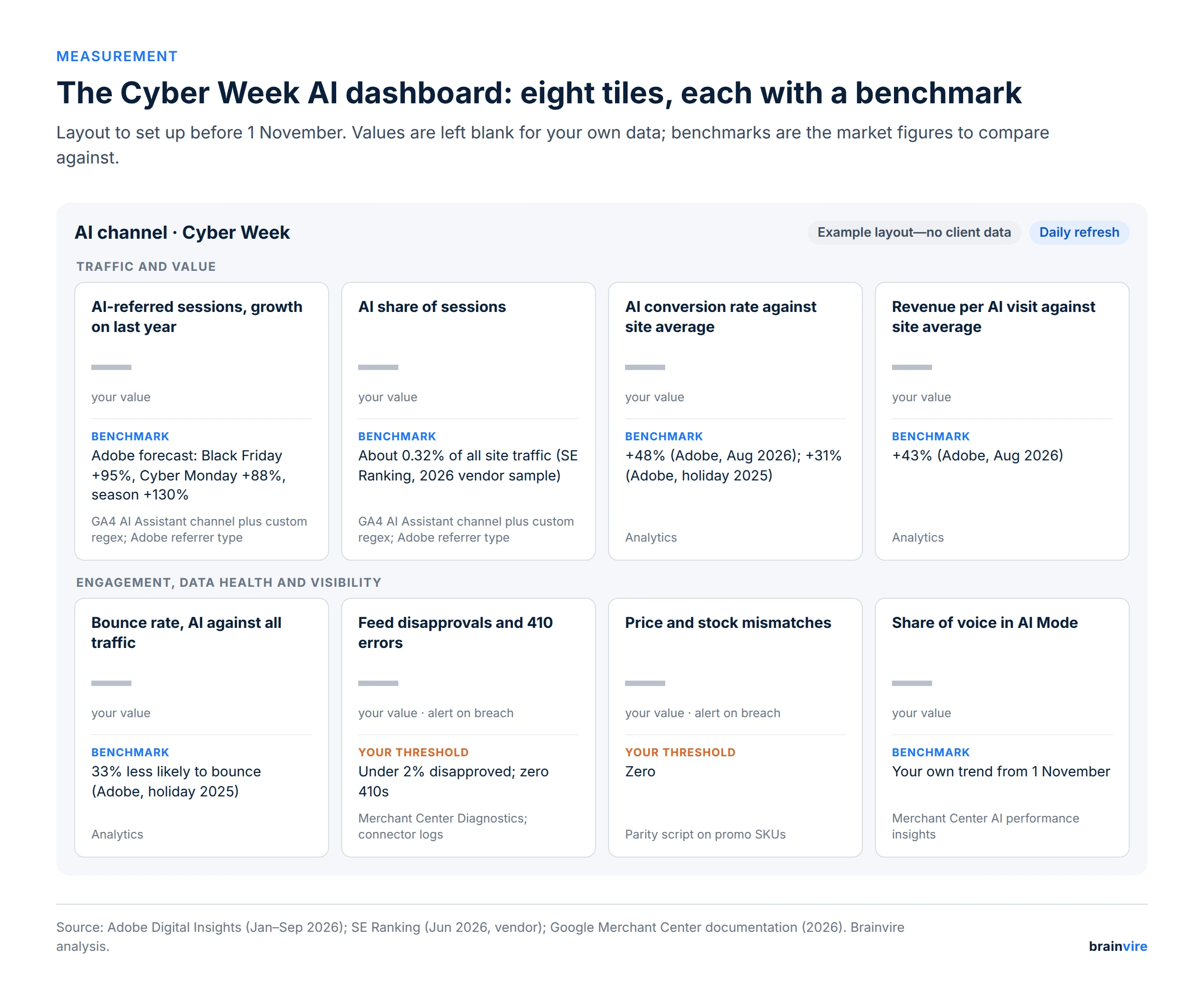
If your AI conversion rate comes in below the site average while Adobe's market data shows it 40–48% above, the problem probably isn't the shopper. It's what the agent told them, or where it sent them.
Beyond the US, and the January agenda
ChatGPT Shopping is US-only for now. Google says its new checkout capabilities are rolling out in the US, with Australia and Canada expected early next year (16 Sep 2026). That doesn't mean GCC and Southeast Asian shoppers aren't using AI:
- GCC: In a vendor survey by Tabby of more than 20,000 shoppers in Saudi Arabia and the UAE (Nov 2025), 43% use AI to help make purchase decisions. Only 30% fully trust its recommendations.
- Southeast Asia: Research by impact.com, Cube and Dentsu (24 Jul 2026; 2,400 consumers) found 24% of shoppers in six markets use generative AI while shopping. The figure is 34% in Vietnam, 31% in Indonesia and 14% in Singapore.
For White Friday in the Gulf and year-end sales in Southeast Asia, the shopping features differ but the reader is the same. Arabic and local-language attributes, prices in local currency and correct delivery promises per country are the regional version of checks 2, 4 and 6.
In January, compare your AI channel against Exhibit 8 and fund the rendering work. For where agentic checkout is heading, see our primer on agentic commerce.
Frequently asked questions
Should we block GPTBot?
That's a business decision, and blocking it won't remove you from ChatGPT search. OpenAI's documentation separates GPTBot, which collects training data, from OAI-SearchBot, which decides whether you appear in ChatGPT search answers. You can block the first and allow the second. What you shouldn't do is block both by accident through a CDN default. Check robots.txt and your bot-management rules side by side.
Does llms.txt help?
Not for shopping visibility, on current evidence. An Ahrefs study of 137,210 domains found 97% of llms.txt files received no requests. SE Ranking found no link between having the file and being cited (evidence review, Sep 2026). Google says Search ignores it. If your platform creates one automatically, leave it. Don't spend holiday engineering time on it.
We're on Adobe Commerce. Can we get into ChatGPT Shopping?
Yes, but not automatically. OpenAI integrates Shopify and Etsy catalogs by default. Other merchants apply through OpenAI's merchant page and join a waitlist, or send a feed through a supported provider. Adobe has committed to OpenAI's protocol without dates. For this holiday, map your catalog to OpenAI's nine required fields, add GTINs and review data, and file the application this week.
How do we see AI traffic in GA4?
Start with the native AI Assistant channel Google added on 13 May 2026. Then add a custom channel above Referral that matches AI referrers by source regex, because Google hasn't published its full list. Watch Direct traffic to deep product URLs for AI visits with no referrer. Remember that Google AI Mode clicks show up inside Google organic, not as AI.
Is this only a US issue?
The checkout and shopping features are mostly US-first. ChatGPT Shopping is US-only, and Google's new checkout capabilities are rolling out in the US first. But shoppers elsewhere already use AI to research purchases: 43% in Saudi Arabia and the UAE in a Tabby vendor survey, and 24% across six Southeast Asian markets. The data work in this paper pays off in every region.
An agent can only recommend what it can read
The 130% is coming either way. What you control is whether the agent can read your price, trust your stock and find your reviews—and whether the page it sends shoppers to says the same thing.
Most of that is data, and data can change after code freeze. Our Adobe Commerce, Shopify Plus and Salesforce Commerce Cloud teams at Brainvire build exactly this layer: feeds, rendering and the analytics that prove it worked. Enterprise AI, made simple.
About this paper: as of 16 October 2026. Method: primary sources first (Adobe, Google, OpenAI, Deloitte, Mastercard, PwC); vendor data and vendor-run surveys are labeled as such in the text. We'll update the figures if Adobe, Google or OpenAI publish changes before Black Friday.
Sources
- Adobe (Business Wire). "Adobe: U.S. Holiday Shopping Season to Hit Record $275.1 Billion Online, Rising 6.7% YoY." 28 Sep 2026. https://www.businesswire.com/news/home/20260928285775/en/Adobe-U.S.-Holiday-Shopping-Season-to-Hit-Record-$275.1-Billion-Online-Rising-6.7-YoY
- Adobe Digital Insights. "2026 Holiday Forecast" (report PDF). Sep 2026. https://business.adobe.com/assets/resources/holiday-shopping-report/2026/pdf/2026-adobe-digital-insights-holiday-forecast.pdf
- Adobe. "Adobe: Holiday Shopping Season Drove a Record $257.8 Billion Online with Consumers Embracing Generative AI Tools." 7 Jan 2026. https://news.adobe.com/news/2026/01/adobe-holiday-shopping-season
- Adobe for Business. "AI traffic surges across industries, retail sees biggest gains." Jan 2026. https://business.adobe.com/blog/ai-driven-traffic-surges-across-industries
- Adobe for Business. "AI traffic surge: retail sites not machine-readable." 16 Apr 2026. https://business.adobe.com/au/blog/ai-traffic-surge-retail-sites-not-machine-readable
- Adobe for Business. "AI shoppers convert 40% better as Prime Day hits $26.4B." 29 Jun 2026. https://business.adobe.com/blog/2026-prime-day-insights
- Adobe Experience League. "Analyze traffic from AI chatbots." Accessed Oct 2026. https://experienceleague.adobe.com/en/docs/analytics/technotes/ai-traffic
- Adobe for Business. "Adobe Commerce commits to agentic commerce standards." 18 Feb 2026. https://business.adobe.com/blog/adobe-commerce-commits-to-agentic-commerce-standards
- Deloitte. "Deloitte Forecasts Holiday Retail Sales to Reach $1.70 Trillion to $1.71 Trillion." 10 Sep 2026. https://www.deloitte.com/us/en/about/press-room/deloitte-forecasts-holiday-retail-sales.html
- Mastercard. "2026 holiday shopping forecast." 23 Sep 2026. https://www.mastercard.com/gb/en/news-and-trends/stories/2026/2026-holiday-shopping-forecast.html
- Retail TouchPoints. "Will 2026 Holiday Sales Reach $1 Trillion? NRF Says Yes." 15 Oct 2026. https://www.retailtouchpoints.com/news/will-2026-holiday-sales-reach-1-trillion-nrf-says-yes/621759
- PwC. "Holiday Outlook 2026." 8 Sep 2026. https://www.pwc.com/us/en/industries/consumer-markets/library/holiday-outlook-trends.html
- Salesforce. "AI and agents account for $262 billion of 2025 holiday spend." 8 Jan 2026. https://www.salesforce.com/news/stories/2025-holiday-shopping-data/
- Salesforce. "2026 Holiday Predictions." 20 Jul 2026. https://www.salesforce.com/blog/holiday-retail-predictions-2026/
- SE Ranking. "Analysis of top AI search engines" (101,574 websites). 18 Jun 2026. https://seranking.com/blog/ai-traffic-research-study/
- HUMAN Security. "Why AI agent traffic jumped 144% on Black Friday." 4 Dec 2025. https://www.humansecurity.com/learn/blog/agentic-commerce-traffic-black-friday-cyber-monday/
- Shopifreaks. "OpenAI pivots from Instant Checkout to an app-based shopping model inside ChatGPT." 12 Mar 2026. https://www.shopifreaks.com/openai-pivots-from-instant-checkout-to-an-app-based-shopping-model-inside-chatgpt/
- OpenAI. "Power product discovery in ChatGPT" (merchants page). Accessed Oct 2026. https://chatgpt.com/merchants/
- MarTech. "Walmart says ChatGPT checkout converted 3x worse than its own website." 20 Mar 2026. https://martech.org/walmart-says-chatgpt-checkout-converted-3x-worse-than-its-own-website/
- Axios. "Retailers split on AI checkout options amid mixed results." 24 Mar 2026. https://www.axios.com/2026/03/24/ai-shopping-walmart-gap-chatgpt-gemini-checkout
- PPC Land. "Amazon's AI shopping assistant drove $12 billion in sales for 2025." 7 Feb 2026. https://ppc.land/amazons-ai-shopping-assistant-drove-12-billion-in-sales-for-2025/
- Google. "Google's new Universal Cart launches today in the U.S." 15 Oct 2026. https://blog.google/products-and-platforms/products/shopping/universal-cart-launch/
- Google. "Boost your holiday sales with these agentic commerce updates." 16 Sep 2026. https://blog.google/products-and-platforms/products/shopping/google-shopping-updates-holiday-shopping/
- Salsify. "Consumer Research 2026" press release. 21 Jan 2026. https://www.salsify.com/press-release-salsify-consumer-research-2026-daily-online-shopping-plunges-shoppers-return-to-certainty-of-stores
- Vercel. "The rise of the AI crawler." 17 Dec 2024. https://vercel.com/blog/the-rise-of-the-ai-crawler
- Search Engine Journal. "ChatGPT Shopping results lean hard on product feeds" (Profound data). 9 Sep 2026. https://www.searchenginejournal.com/chatgpt-shopping-results-lean-hard-on-product-feeds/589000/
- Digital Applied. "Shopify Spring '26 Edition: agentic commerce arrives." 17 Jun 2026. https://www.digitalapplied.com/blog/shopify-spring-2026-edition-agentic-commerce-ucp-catalog
- Marketing Brew. "Shopify is pushing forward with agents and AI." 19 May 2026. https://www.marketingbrew.com/stories/shopify-is-pushing-forward-with-agents-and-ai
- Salesforce and OpenAI (Business Wire). "Salesforce and OpenAI Partner Across Enterprise Work and Commerce." 14 Oct 2025. https://www.businesswire.com/news/home/20251014617162/en/CORRECTING-and-REPLACING-Salesforce-and-OpenAI-Partner-Across-Enterprise-Work-and-Commerce
- PPC Land. "Google's Heiko Hotz pitches 60 billion listings as fuel for shopping agents." 27 Sep 2026. https://ppc.land/googles-heiko-hotz-pitches-60-billion-listings-as-fuel-for-shopping-agents/
- Google for Developers. "Content API for Shopping: deprecation and sunset." Accessed Oct 2026. https://developers.google.com/shopping-content/guides/sunset
- OpenAI. "Product feed spec." Accessed Oct 2026. https://developers.openai.com/commerce/product-feeds/spec
- Google Merchant Center Help. "Insights for AI-powered shopping experiences." 27 May 2026. https://support.google.com/merchants/answer/17117204
- OpenAI. "Overview of OpenAI crawlers." Accessed Oct 2026. https://developers.openai.com/api/docs/bots
- Syndigo. "State of Product Experience 2026." 19 Aug 2026. https://syndigo.com/news/state-of-product-experience-2026-proof-beats-price
- Agent Experience. "Does llms.txt work? The evidence." Sep 2026. https://agentexperience.tech/insights/state-of-llms-txt/
- Google Search Central. "AI optimization guide." Updated 10 Jul 2026. https://developers.google.com/search/docs/fundamentals/ai-optimization-guide
- Cloudflare. "Cloudflare just changed how AI crawlers scrape the internet-at-large." 1 Jul 2025. https://www.cloudflare.com/press/press-releases/2025/cloudflare-just-changed-how-ai-crawlers-scrape-the-internet-at-large/
- TechWyse. "Google Analytics adds native AI Assistant channel to GA4's default channel group" (citing Google Analytics Help, 13 May 2026). 2026. https://www.techwyse.com/news/platform-updates/google-analytics-ai-assistant-channel-ga4-default-channel-group
- Clickport. "Why ChatGPT traffic shows as Direct in GA4." 23 Apr 2026, updated 18 Sep 2026. https://clickport.io/blog/chatgpt-direct-traffic-ga4
- PPC Land. "Google AI Mode now counts toward Search Console totals." Jun 2025. https://ppc.land/google-ai-mode-now-counts-toward-search-console-totals/
- Tabby. Ultimate Middle East Shopping Survey 2026 (newsroom release). Survey Nov 2025. https://tabby.ai/en-AE/newsroom/shopping-survey-2026
- eCommerceNews Asia. "AI becomes product discovery tool in Southeast Asia" (impact.com, Cube, Dentsu). 24 Jul 2026. https://ecommercenews.asia/story/ai-becomes-product-discovery-tool-in-southeast-asia
Related reading
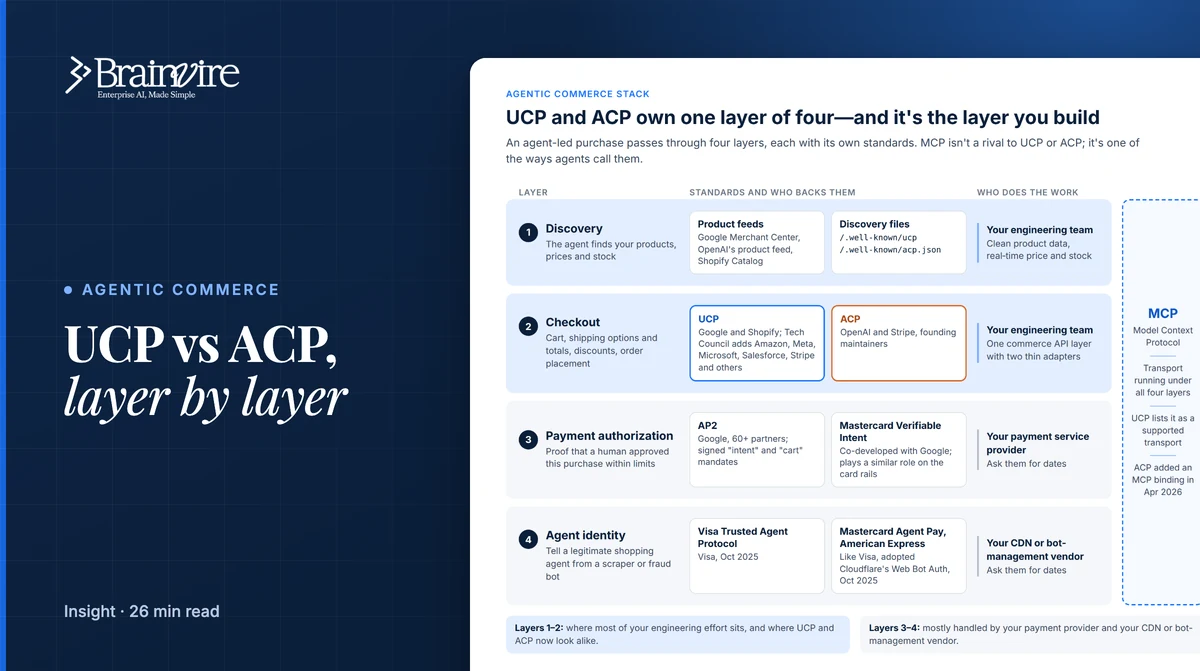 Two checkouts are coming to your store: UCP vs ACP, explained for commerce leadersOctober 16, 2026 · 26 min read
 Ecommerce business models: who buys and how the money comes inJuly 1, 2022 · 12 min read
 The ecommerce challenges hiding in your shipping, returns and platform billsJune 21, 2023 · 12 min read