Three critical Magento flaws, three separate fixes: the October 2026 patch guide
Last verified 22 October 2026, 06:30 UTC against Adobe, php.net, NVD and Sansec.
Patch PHP now
PHP2Shell is a critical vulnerability in PHP itself, the language every Magento and Adobe Commerce store runs on. The PHP project rates it 9.2 out of 10, and attacks were reported about six hours before the fix shipped on 21 October 2026. Adobe's Commerce patches don't fix it. Upgrade PHP to 8.5.12, 8.4.27, 8.3.36 or 8.2.35 and restart PHP-FPM (or Apache, for mod_php) today.
Severity at a glance
| Threat | What it is | Severity (out of 10) | Attacks seen? | Fix |
|---|---|---|---|---|
| PHP2Shell CVE-2026-109618, CVE-2026-109619 |
Flaw in PHP itself; affects every Magento and Adobe Commerce store until PHP is updated | 9.2 (CVSS 4.0, PHP project) 9.8 (CVSS 3.1, NVD) |
Yes, reported before the fix (21 Oct) | PHP 8.5.12, 8.4.27, 8.3.36 or 8.2.35, then restart PHP-FPM (or Apache for mod_php). Today |
| StyleSmuggler CVE-2026-75650 |
Flaw in Magento's email template engine | 10.0 (CVSS 3.1) | Yes, since 4 Sep; on CISA's exploited list | Hotfix VULN-39341, then rotate keys and credentials |
| BlockStrap CVE-2026-103849 |
Second flaw in the same template engine | 10.0 (CVSS 3.1) | Not confirmed as of 22 Oct, 06:30 UTC | October APSB26-153 isolated patch |
Key takeaway
PHP2Shell is a PHP vulnerability rated 9.2 out of 10 that affects every Magento and Adobe Commerce store until PHP is updated, and attacks were reported before the fix. Upgrade PHP and restart PHP-FPM today. In parallel, apply the StyleSmuggler hotfix (VULN-39341), rotate your encryption key once PHP is upgraded, then install the October APSB26-153 patch. None of these fixes includes the others.
TL;DR
- PHP2Shell (CVE-2026-109618 and CVE-2026-109619, rated 9.2 out of 10) is in PHP itself, so it affects every Magento and Adobe Commerce store until PHP is updated. Fix it today: PHP 8.5.12, 8.4.27, 8.3.36 or 8.2.35, then restart every PHP worker.
- StyleSmuggler (CVE-2026-75650, CVSS 3.1 10.0) was exploited before Adobe patched it on 7 September. Fix: hotfix VULN-39341, then rotate your encryption key and every credential it protected.
- BlockStrap (CVE-2026-103849, CVSS 3.1 10.0) was fixed in Adobe Commerce APSB26-153 on 13 October. No attacks are confirmed yet. Fix: the October isolated patch for your release line.
- Order: PHP upgrade and restart today; in parallel, the hotfix, then key rotation once PHP is upgraded, then the October patch. Then verify everything and check for compromise.
- "We're on the latest Composer version" isn't enough. Adobe shipped the October fixes as patch files, not Composer packages, so a clean install is still vulnerable.
Most months, an Adobe Commerce security update is one bulletin, one patch and one maintenance window. This fall is different.
The most urgent of the three isn't a bug in Magento's code. It's in PHP, the language every Magento and Adobe Commerce store runs on. PHP2Shell is rated 9.2 out of 10, attacks were reported before the fix shipped on 21 October, and Adobe's Commerce patches don't touch it.
Two critical Magento flaws had already landed since early September. One was attacked before any fix existed. The other is rated 10.0, and researchers reproduced four working attack routes within a day. Each of the three needs its own fix, and the fixes don't include each other.
Black Friday is five weeks away. Most teams want a code freeze before then. This guide gives you one page to check exposure, one checklist and the commands that prove each fix is in place.
Is my Magento or Adobe Commerce store affected?
Yes, unless you've applied all three fixes since 7 September. Every supported release line from 2.4.4 to 2.4.9 was exposed to both Magento flaws. Every PHP version that serves web requests was exposed to PHP2Shell.
The question that matters is what "fixed" takes on your line.
Affected products: Adobe Commerce and Magento Open Source, line by line
| Release line | StyleSmuggler exposed? | BlockStrap exposed? | PHP Adobe supports | Does php.net still fix it? | Minimum safe state | Adobe support status |
|---|---|---|---|---|---|---|
| 2.4.9 | Yes, until VULN-39341 | Yes, until October patch | 8.5 | Yes: 8.5.12 | 2.4.9 + 2-4-9-oct-2026.zip + VULN-39341 + PHP 8.5.12 |
Standard support to 31 May 2029 |
| 2.4.8 | Yes | Yes | 8.4, 8.3 | Yes: 8.4.27, 8.3.36 | 2.4.8-p5 + 2-4-8-p5-oct-2026.zip (revised 14 Oct, documented 16 Oct) + VULN-39341 + PHP 8.4.27 or 8.3.36 |
Standard support to 31 May 2028 |
| 2.4.7 | Yes | Yes | 8.3, 8.2 | Yes: 8.3.36, 8.2.35 | 2.4.7-p10 + 2-4-7-p10-oct-2026.zip + VULN-39341 + PHP 8.3.36 or 8.2.35 |
Standard support to 31 May 2027 |
| 2.4.6 | Yes | Yes | 8.2, 8.1 | 8.2 yes (8.2.35); 8.1 no | 2.4.6-p15 + 2-4-6-p15-oct-2026.zip + VULN-39341 + PHP 8.2.35 |
Extended support to 31 Aug 2027. Magento Open Source 2.4.6 has no BlockStrap patch from Adobe |
| 2.4.5 ⚠ beyond extended support | Yes | Yes | 8.1 only | No | 2.4.5-p17 + 2-4-5-p17-oct-2026.zip + VULN-39341. PHP2Shell can't be fully fixed on PHP 8.1 |
Security-only fixes to 31 May 2027 (Adobe Commerce only) |
| 2.4.4 ⚠ beyond extended support | Yes | Yes | 8.1 only | No | 2.4.4-p18 + 2-4-4-p18-oct-2026.zip + VULN-39341. Same PHP problem |
Security-only fixes to 31 May 2027 (Adobe Commerce only) |
| Adobe Commerce B2B 1.5.3, 1.5.2, 1.4.2, 1.3.4, 1.3.3 | Yes | Yes, plus CVE-2026-92909 (CVSS 3.1 9.8, no login) | Same as the core line | — | The matching B2B file in the October ZIP, applied after the core files | Follows the core line |
Sources: APSB26-146, APSB26-153, Adobe KB ka-49323, system requirements, lifecycle policy, php.net.
Three notes on the table:
- "Minimum safe state" assumes you're on the latest security release for your line. Adobe's October patch also requires every earlier monthly isolated patch, applied in release order (KB ka-49323). If you're behind, you're applying more than one patch.
- 2.4.4 and 2.4.5 still get isolated security fixes from Adobe until 31 May 2027. But the only PHP version Adobe lists for them is 8.1, and php.net stopped issuing releases for 8.1. The PHP team published source-code backports for 7.4, 8.0 and 8.1, which only helps teams that build PHP themselves.
- Magento Open Source can only download the October isolated patches for 2.4.7 and later. Adobe's knowledge base says so directly. On Open Source 2.4.6 and older, your options are an upgrade or a community backport.
When did StyleSmuggler, BlockStrap and PHP2Shell happen?
The three issues landed between 4 September and 21 October 2026. StyleSmuggler saw active exploitation first and was patched three days later. PHP2Shell was attacked hours before its fix shipped. All times are UTC.
| Date | What happened | Source |
|---|---|---|
| 23 Aug | First unsuccessful StyleSmuggler probes seen | Sansec |
| 4 Sep, 22:20 | First confirmed StyleSmuggler exploitation | Sansec |
| 5 Sep | Sansec discloses StyleSmuggler as an unpatched zero-day | Sansec |
| 7 Sep, ~20:20 | Adobe publishes APSB26-146 (priority 1, "exploited in the wild") and hotfix VULN-39341 | APSB26-146; time per Sansec |
| 8 Sep | CISA adds CVE-2026-75650 to its Known Exploited Vulnerabilities catalog. Cloud patches v1.1.21 ships the fix | CISA KEV, Adobe |
| 14 Sep | Sansec's StyleSmuggler research last updated | Sansec |
| 21 Sep | Adobe's hotfix notes, which include the key and credential rotation steps, last updated | Adobe KB |
| 13 Oct | Adobe publishes APSB26-153: 11 fixes, priority 2, no known exploits. Cloud patches v1.1.22 | APSB26-153 |
| 14 Oct | Adobe replaces the 2.4.8-p5 patch ZIP, per Sansec. Mage-OS 3.6.0 ships the fix | Sansec |
| 15 Oct | Sansec reports four working BlockStrap attack routes within 24 hours, and no attacks on live stores | Sansec |
| 16 Oct | Adobe documents the revised 2.4.8-p5 patch and its "UNKNOWN" status | Adobe KB ka-50927 |
| 19 Oct | Cloud patches v1.1.23 ships the revised 2.4.8-p5 patch | Adobe |
| 20 Oct | php.net pre-announces a critical release for 21 Oct, 14:00 | php.net |
| 21 Oct, 07:43 | Cloudflare reports early PHP2Shell attacks, before any fix exists | Sansec |
| 21 Oct, 14:00 | PHP 8.5.12, 8.4.27, 8.3.36 and 8.2.35 released. The Remi repository can't ship them that day | php.net |
| 22 Oct, 06:30 | At verification: BlockStrap has no confirmed attacks and isn't in CISA's catalog. Neither PHP flaw is in the catalog yet | NVD, CISA |
What are the StyleSmuggler, BlockStrap and PHP2Shell critical vulnerabilities?
One is a flaw in PHP itself, which every Magento store runs on, and two are flaws in Magento's email template engine. All three allow unauthenticated remote code execution: an attacker can run their own code on your store server without logging in. Here's each one in the terms a leadership team needs.
PHP2Shell (CVE-2026-109618 and CVE-2026-109619): a PHP vulnerability that affects every Magento and Adobe Commerce store until PHP is updated
What it is. PHP2Shell is Sansec's name for an exploit that chains two memory-safety flaws in the PHP engine into a remote code execution vulnerability. One leaves request memory in a broken state after an out-of-memory error, and the other lets state from one request leak into the next request on the same worker.
What an attacker can do. Run code on any server that uses PHP to answer web requests, with no login. php.net says this covers PHP-FPM, Apache with mod_php, php-cgi, FrankenPHP and LiteSpeed. Researchers confirmed unauthenticated code execution against Magento 2.4.9, according to Sansec. This isn't a Magento bug, so no Magento patch fixes it.
Severity and exploitation. The PHP project rates both flaws 9.2 out of 10 (CVSS 4.0). NVD separately scores both CVSS 3.1 9.8 (CVE-2026-109618, CVE-2026-109619). Sansec cites Cloudflare seeing early attacks at 07:43 UTC on 21 October, about six hours before the fix shipped.
Affected versions. php.net lists fixed versions, not a vulnerable range. Sansec says the vulnerable code dates to PHP 5.4. PHP 8.1 and older get no new releases from the PHP project.
What to do today. Patch PHP right away; don't wait for the Magento fixes. The upgrade doesn't depend on any Magento patch, so your hosting or DevOps team can start now.
The fix. PHP 8.5.12, 8.4.27, 8.3.36 or 8.2.35, released 21 October 2026 at 14:00 UTC. php.net is clear that upgrading is the only complete fix. Its interim settings only reduce exposure. Restart every PHP worker after upgrading. Running workers keep the old code in memory until they restart.
If your servers use the Remi repository, common on Red Hat-family Linux, php.net said it would not have updates on 21 October. Switch to your distribution's packages or build from source.
How to verify the fix is applied (for engineers):
# Version of the PHP command-line binary. It must be one of the fixed versions or later.
php -v

# Reload PHP-FPM so workers pick up the new build (service name varies; this is Sansec's example).
systemctl reload php8.3-fpm
php -v only shows the command-line binary. Confirm the version that PHP-FPM is actually serving, through your hosting panel or a request handled by FPM.
StyleSmuggler (CVE-2026-75650)
What it is. Magento builds some emails from templates that can include small instructions. StyleSmuggler let an attacker slip their own instructions into that process and have the server run them.
What an attacker can do. Run malicious PHP code on your server, with no login. Sansec documented attackers planting a Rust backdoor and a PHP web shell. A web shell is a hidden page that gives the attacker a remote control panel for your server.
Severity and exploitation. CVSS 3.1 10.0, the maximum CVSS score, rated critical by Adobe. Adobe confirms it was actively exploited in the wild, and CISA lists it as a known exploited vulnerability. Sansec traced the first successful attack to 4 September, three days before the patch.
How the attack works. It runs in two stages. First, the attacker gets PHP code written to a file, for example a failure report that Magento writes to var/report/. Second, a crafted GraphQL request uses the styles properties of a template to evaluate that injected code. Sansec found the code runs when Magento sends its "Payment Transaction Failed Reminder" email, even if nobody opens it.
Affected versions. Adobe lists the following versions as affected: Adobe Commerce 2.4.4 to 2.4.9, Adobe Commerce B2B 1.3.3 to 1.5.3, and Magento Open Source 2.4.6 to 2.4.9, all "-2026-aug and earlier."
The fix. Adobe's hotfix VULN-39341, downloaded from repo.magento.com/patch/ and applied as a Composer patch. The file depends on your patch level: VULN-39341-composer-patches.zip covers the latest security release on each line, and older patch levels have their own ZIPs (Adobe hotfix notes). Adobe then tells you to rotate your encryption key and associated credentials.
How to verify the fix is applied (for engineers):
# Adobe documents this check for Cloud (Quality Patches Tool). Expect "Applied" next to VULN-39341.
# On-premises: confirm with php vendor/bin/patch-status or your patch log.
vendor/bin/magento-patches -n status | grep -E "39341|Status"
BlockStrap (CVE-2026-103849)
What it is. A second way into the same email template engine, found after the StyleSmuggler fix. The September hotfix signs trusted template instructions, but attacker data inside a child template could still get signed and re-read one level up.
What an attacker can do. An unauthenticated attacker can execute arbitrary code on the server. Exploitation requires no user interaction, according to NVD. Adobe classes it as CWE-1336, improper neutralization of special elements used in a template engine.
Severity and exploitation. CVSS 3.1 10.0, critical. No in-the-wild exploitation has been confirmed as of 22 October 2026, 06:30 UTC. Adobe released the fix on 13 October and says it isn't aware of exploits. It isn't in CISA's catalog either. But Sansec reproduced four working attack routes within 24 hours and expects threat actors to do the same. Adobe's priority rating for the update is 2, meaning install within 30 days. Sansec disputes that rating.
Other fixes in the same bulletin. APSB26-153 fixed 11 vulnerabilities, and three more are critical with no login required. CVE-2026-92909 is an authorization flaw in Adobe Commerce B2B that allows arbitrary code execution (CVSS 3.1 9.8). Two stored cross-site scripting flaws allow privilege escalation (CVSS 3.1 9.3). The other six, all but one requiring login, include two more code-execution flaws, privilege escalation, an arbitrary file system write and security feature bypasses.
Affected versions. Adobe Commerce 2.4.4 to 2.4.9, Adobe Commerce B2B 1.3.3 to 1.5.3, and Magento Open Source 2.4.6 to 2.4.9, all "-2026-sep and earlier."
The fix. The October isolated patch for your release line: 2-4-9-oct-2026.zip, 2-4-8-p5-oct-2026.zip, 2-4-7-p10-oct-2026.zip, 2-4-6-p15-oct-2026.zip, 2-4-5-p17-oct-2026.zip or 2-4-4-p18-oct-2026.zip. Adobe calls the fixed state "2026-oct", for example 2.4.8-2026-oct. There's no Composer package for it. Adobe published these fixes as isolated patch files only.
Each ZIP can hold several files, one per component (core, Adobe Commerce, B2B, Page Builder). Apply each file that matches something you have installed, in release order. On 2.4.8-p5, Adobe revised the core file without renaming it (replaced 14 October per Sansec, documented 16 October), so download it again (KB ka-50927).
How to verify the fix is applied (for engineers):
# BlockStrap fix present? 0 means the fix is missing.
grep -c resolveDeferredDirectives vendor/magento/framework/Filter/Template.php

# Adobe's Commerce Version Tool, run from the Adobe Commerce project root: lists applied and missing patches, plus PROTECTED/VULNERABLE per CVE.
# The tool ships in the July 2026 isolated patch; apply that first if the command is missing.
php vendor/bin/patch-status

# 2.4.8-p5 only: 0 means you still have the original file. Re-download and apply the revised one.
grep -c QUOTED_LOCAL_PART_PATTERN vendor/magento/framework/Validator/EmailAddress.php
The first and third checks come from Sansec; the second from Adobe. On Mage-OS, check vendor/mage-os/framework/Filter/Template.php instead.
In what order should you apply the Magento security patches?
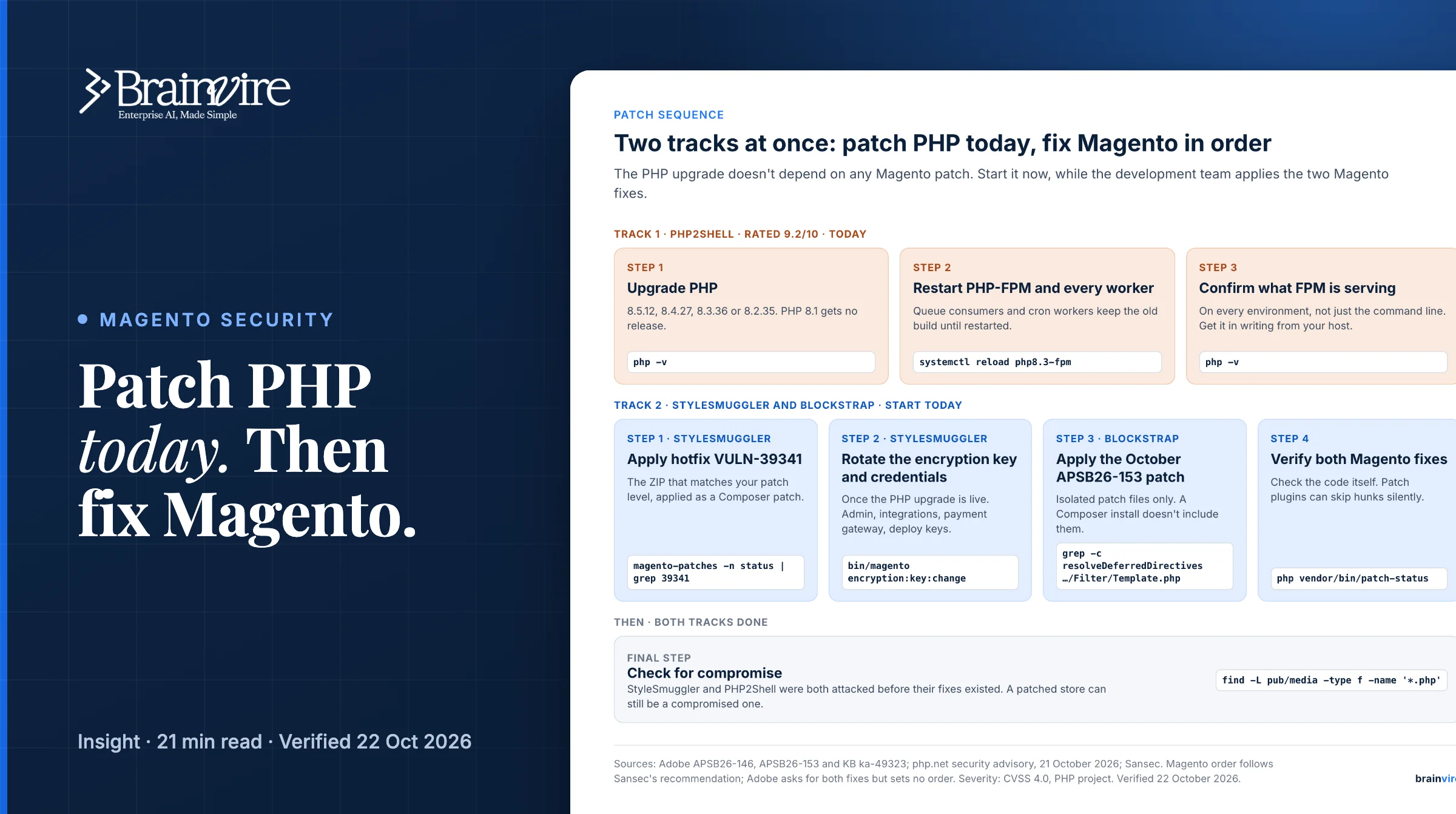
Run two tracks at once: upgrade PHP today, and apply the two Magento fixes in order. The PHP upgrade doesn't depend on any Magento patch, so it shouldn't wait behind them. On the Magento side, Adobe asks for the September hotfix "in addition" to the October update but doesn't set an order. Sansec recommends the hotfix first, and notes the October patch then applies cleanly with harmless line offsets.
Test in staging before production. Keep the PHP test short, since attacks are already reported. Plan one maintenance window for the Magento track; Adobe notes that rotating the key ends all customer and admin sessions.
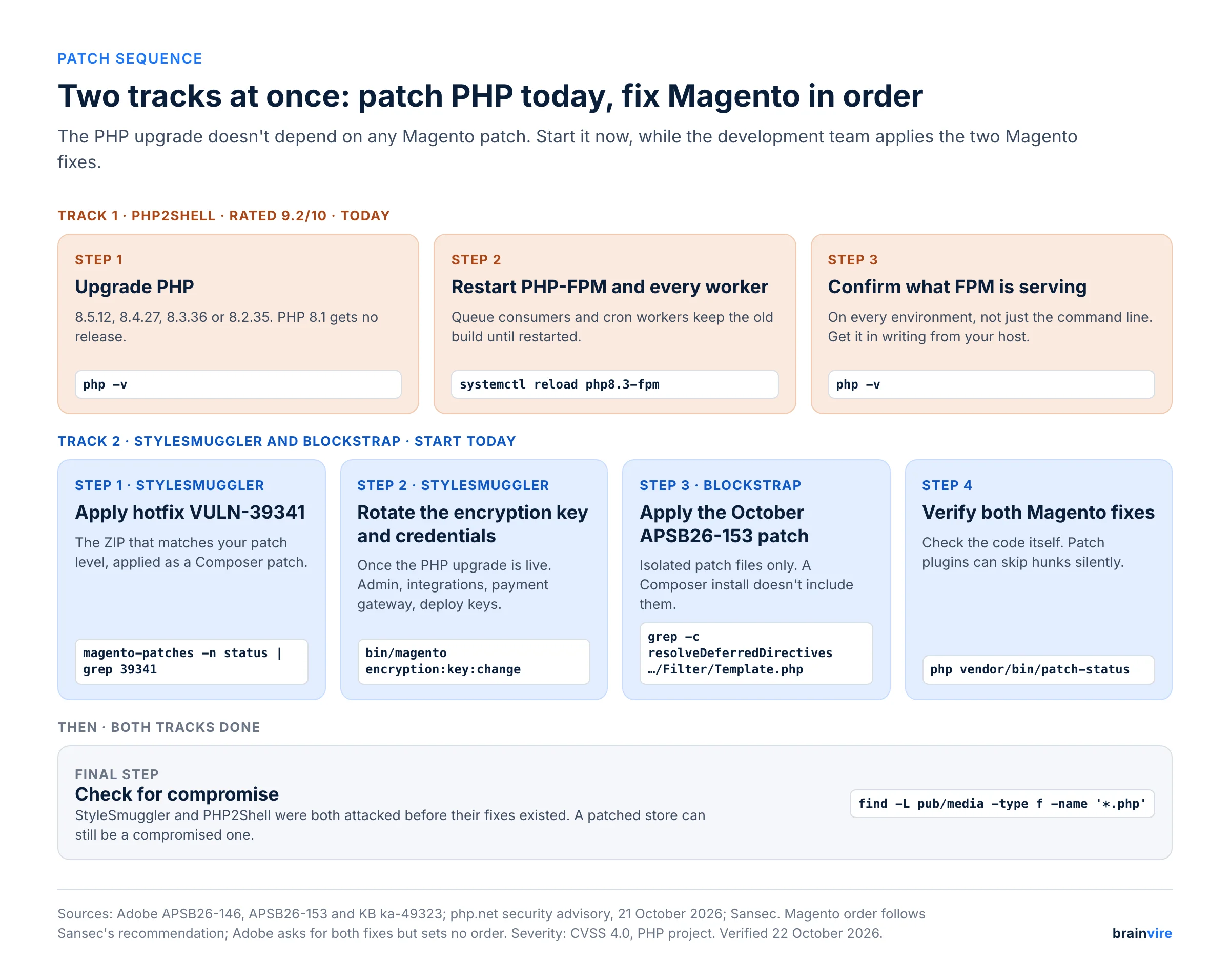
Before you start: back up, then record your installed version, patch level and the monthly isolated patches already in place (php vendor/bin/patch-status).
Track 1: PHP (server or hosting team, today)
- Upgrade PHP to 8.5.12, 8.4.27, 8.3.36 or 8.2.35, whichever matches your branch. If you're on PHP 8.1, there's no release to install. Plan the move to a supported branch, which may mean a Magento upgrade first.
- Restart PHP-FPM (or Apache, for mod_php) and every long-running PHP process, including queue consumers and cron workers.
- Confirm the version PHP-FPM is serving on every environment, not just the command line.
Track 2: Magento (development team, start today)
- Apply the StyleSmuggler hotfix (VULN-39341). Use the ZIP that matches your patch level, applied as a Composer patch. Verify it shows "Applied."
-
Rotate your encryption key and credentials. We recommend doing this once the PHP upgrade is live, so the new credentials aren't exposed through the PHP flaw. Sansec notes that one of the two PHP flaws can leak secrets such as passwords, session tokens and API keys from server memory. Follow Adobe's sequence: maintenance mode on, cron off, run
bin/magento encryption:key:change, then rotate:- admin passwords
- REST, SOAP and GraphQL integration tokens
- OAuth client secrets
- payment gateway API credentials, at the provider
- database credentials and Fastly credentials
- SSH and deploy keys, and service account credentials
- API keys for shipping, tax and other extensions
Then flush the cache, turn cron back on and turn maintenance mode off. On 2.4.8 and later, the Admin screen for this is gone, so use the command line (Adobe).
-
Apply the October APSB26-153 isolated security patches. Apply each matching component file in release order, after any missing earlier months. On 2.4.8-p5, use the re-downloaded revised file.
- Verify both Magento fixes with the commands above. Don't trust a green deploy log alone.
Then: check for compromise
Run the post-patch compromise check below once both tracks are done. StyleSmuggler was exploited before its fix existed, and PHP2Shell attacks were reported before its fix, so a patched store can still be a compromised one.
What's different on Adobe Commerce on cloud infrastructure, on-premises and Magento Open Source?
| Step | Adobe Commerce on Cloud | Adobe Commerce on-premises | Magento Open Source |
|---|---|---|---|
| StyleSmuggler fix | Shipped in Cloud patches v1.1.21 (8 Sep). Update ece-tools, which pulls in the Cloud patches package, then redeploy | Apply the VULN-39341 ZIP | Apply the VULN-39341 ZIP (2.4.6 to 2.4.9) |
| October fix | Cloud patches v1.1.22 (13 Oct), revised in v1.1.23 (19 Oct). Don't also apply the isolated file; Adobe warns of installation failures | Apply the October isolated patch | Apply the October isolated patch; 2.4.7 and later only |
| Key and credential rotation | Your job. Use ece-tools cron:disable/enable; database and Fastly credentials need a support ticket; redeploy afterward |
Your job | Your job |
| PHP runtime | Unconfirmed. We found no Adobe statement on Cloud PHP images. Get written confirmation from Adobe Support for production and staging | You or your host | You or your host |
Nothing here is automatic. Adobe doesn't say any of these fixes apply themselves on Cloud. The Cloud patches package installs with ece-tools, so you have to update it and deploy.
What are teams getting wrong with these patches?
The most common mistake is believing a clean Composer install means a patched store. We see seven versions of the same problem: a fix that looks applied but isn't, or one fix mistaken for all three.
- Running
composer installand calling it done. Adobe didn't publish Composer packages for the October fixes. A fresh install still has the vulnerable base code. - Applying October but skipping September. The October patch doesn't include the StyleSmuggler hotfix, and Adobe doesn't list the hotfix as a prerequisite for it. You need both.
- Patching Magento but not PHP. PHP2Shell lives in the runtime, so a fully patched Magento codebase on PHP 8.3.35 is still exposed.
- Upgrading PHP without restarting workers. PHP-FPM workers and queue consumers keep running the old build until they restart. Check what the web server is actually serving, not just the command line.
- Skipping encryption key rotation. If an attacker read your encryption key during the StyleSmuggler window, the hotfix doesn't take it back. Adobe also warns that rotating the key alone doesn't invalidate credentials already stolen, so rotate those at the source too.
- Waiting on the Remi repository. On 21 October, php.net said Remi wouldn't have the update that day. Teams that run
dnf updateand see nothing new may believe they're current. - Assuming your host patched PHP. Managed hosts move at different speeds, and some pin PHP versions per site. Get the running version in writing, for production and staging.
One more trap from Sansec: Composer patch plugins can skip a failed hunk without failing the build. So can deploy scripts that end in || true. That's why the verification commands check the code itself.
How do you check whether your store was already compromised?
Run the checks below on every store that was online between 4 September and the day you applied the hotfix. Patching closes the door. It doesn't tell you whether someone came in first.
Successful exploitation left traces on affected stores, and you can look for them. Every command below comes from Sansec's StyleSmuggler research, which lists the full indicators of compromise. These are StyleSmuggler indicators: Sansec hasn't published indicators for PHP2Shell, so treat any secret that sat in server memory before your PHP upgrade as exposed.
1. Look for PHP files where none should be. Attackers hid a web shell in the product image cache, under pub/media/catalog/product/cache/. Magento never stores PHP files in media.
find -L pub/media -type f -name '*.php'
2. Look for disguised processes. The backdoor ran under names that imitate system processes: [kworker/u:8:0], fc-cache and chronyd.
ps -eo pid,comm,args | grep -iE 'kworker|fc-cache|chronyd'
3. Look for persistence in cron and hidden files.
crontab -l | grep -i gvfsd
ls -la ~/.local/share/.gvfsd/ ~/.cache/fontconfig/fc-cache /tmp/.kw_* /tmp/.cache_* /tmp/.gvfsd-* /tmp/.fc-*/fc-cache /tmp/fc-cache /tmp/.chrony-*/chronyd 2>/dev/null
4. Look for traces in logs and reports.
grep -r 'crontab command not allowed' /var/log/
grep -ril 'x_trace_' var/report/
5. Check what your checkout loads. Sansec found a skimmer, code that copies card details as customers type, stored in the design/head/includes setting in core_config_data. Review that setting in the Admin or database for scripts you don't recognize.
6. Check core files and admin users. Sansec also found a cookie-triggered backdoor added to vendor/magento/framework/App/View.php. Compare core files against a clean copy of your version to spot malicious code, and review the admin user list for accounts nobody created.
7. Check outbound connections. The backdoor talked to its controllers over TLS and over UDP port 123, disguised as time-sync traffic. Sansec lists the domains and IP addresses to block and search for.
If any check finds something, treat the store as compromised. Isolate it, preserve the evidence and bring in incident response before you clean anything. Rotating credentials before the attacker is out only gives them the new ones.
Why does this matter beyond IT?
Because the timing, the payment rules and the PHP lifecycle all land on the business side of the house. Here's the version for the CFO and the board.
Peak season. Black Friday falls on 27 November 2026 and Cyber Monday on 30 November. Most merchants freeze code in early November. That leaves roughly two weeks to apply three fixes, rotate credentials and test.
Card payments. PCI DSS v4.0.1 requirement 6.3.3 expects critical security patches within one month of release (PCI Security Standards Council). Adobe's own lifecycle page warns that running PHP past end of life puts PCI compliance at risk (Adobe). Your acquirer and your qualified security assessor will ask about both.
Breach notification. All 50 US states have breach notification laws, and payment card data and other sensitive data usually trigger them. A skimmer that ran during the StyleSmuggler window is a notification question, not just a cleanup job.
End-of-life PHP. Stores on 2.4.4 and 2.4.5 can't fully fix PHP2Shell, because the only PHP version Adobe supports for them gets no release from php.net. Adobe's policy is that it doesn't fix third-party dependencies that reach end of life. Until those stores move to a supported line, they carry a known runtime risk. PHP 8.2 joins that list on 31 December 2026, so 2.4.6 and 2.4.7 teams on 8.2 should plan now.
What should you ask your agency or hosting provider this week?
Ask for evidence, not reassurance. Send these questions as written. Every answer should come back with output or a screenshot, not a "yes."
- Which release line and patch level is each of our environments on: production, staging and any others?
- Is the StyleSmuggler hotfix VULN-39341 applied everywhere? Please send the
magento-patchesstatus output. - Did we rotate the encryption key and every credential on Adobe's list after the hotfix? Who rotated the payment gateway credentials at the provider?
- Is the October APSB26-153 patch applied? Please send the
patch-statusoutput and theresolveDeferredDirectivescheck. - If we're on 2.4.8-p5, was the revised October file applied (Adobe KB ka-50927)?
- Which PHP version is PHP-FPM serving right now, on each environment? When were the workers last restarted?
- If we're on PHP 8.1 or older, what's the plan and the date to move to a supported version?
- Did anyone run the post-compromise checks for the StyleSmuggler window? What did they find?
- What's our code-freeze date for Black Friday, and is all of this done before it?
Magento security patch FAQ
Does the October 2026 Magento patch include the StyleSmuggler fix?
No. Adobe's October isolated patch for APSB26-153 doesn't include the CVE-2026-75650 hotfix, and Adobe says to apply that hotfix separately. Install VULN-39341 first, then the October patch, as Sansec recommends.
Is Magento 2.4.6 still safe?
Adobe Commerce 2.4.6 can be made safe today. Apply 2.4.6-p15, the October isolated patch and VULN-39341, and run PHP 8.2.35, not 8.1. Magento Open Source 2.4.6 has no October patch from Adobe, so plan an upgrade to 2.4.7 or later.
Do I need to rotate encryption keys after the StyleSmuggler patch?
Yes. Adobe's hotfix notes tell merchants to rotate the encryption key and every credential it protected. Rotate those credentials at their source too, such as your payment provider, because a new key doesn't invalidate data an attacker already read.
Will Adobe patch PHP for Adobe Commerce Cloud?
Adobe hasn't published a statement on PHP2Shell for Cloud that we could find as of 22 October 2026. Adobe's lifecycle policy says it doesn't fix end-of-life third-party dependencies such as old PHP versions. Ask Adobe Support to confirm in writing which PHP build your production and staging environments run.
Is running composer install enough to patch Magento in October 2026?
No. Adobe published the October fixes as isolated patch files, not Composer packages, so a clean install still has the vulnerable code. Apply the patch file for your release line, then verify with grep -c resolveDeferredDirectives.
Is BlockStrap being exploited in the wild?
Not as of 22 October 2026, 06:30 UTC. Adobe says it isn't aware of exploits, and CISA hasn't listed it. Sansec built four working attack routes within a day of the patch, so treat it as urgent anyway.
Which PHP versions fix PHP2Shell?
PHP 8.5.12, 8.4.27, 8.3.36 and 8.2.35, released 21 October 2026. PHP 8.1 and older get no new release. Restart PHP-FPM and other PHP workers after upgrading, or they keep running the old code.
Does PHP2Shell affect Magento if my Magento code is fully patched?
Yes. PHP2Shell is a vulnerability in PHP itself, rated 9.2 out of 10, and every Magento and Adobe Commerce store runs on PHP. Magento patches can't fix it, so upgrade PHP and restart PHP-FPM right away. Researchers confirmed unauthenticated code execution against Magento 2.4.9, according to Sansec.
What is APSB26-153?
APSB26-153 is Adobe's 13 October 2026 security bulletin for Adobe Commerce, Adobe Commerce B2B and Magento Open Source. It fixes 11 vulnerabilities, including BlockStrap (CVE-2026-103849, CVSS 3.1 10.0) and a B2B flaw (CVE-2026-92909, CVSS 3.1 9.8). Adobe rated it priority 2.
How do I know if my store was hacked through StyleSmuggler?
Look for PHP files in pub/media, disguised processes named kworker, fc-cache or chronyd, and odd cron entries. Also check checkout scripts and core files for changes. Sansec publishes the full indicator list, and any hit means you should bring in incident response.
How can Brainvire help?
If you'd rather not run this alone, it's work our Adobe Commerce team does for clients. We can audit patch status across your environments, upgrade PHP first and apply the two Magento fixes in parallel. We also rotate credentials, run the post-compromise review and plan the move off end-of-life PHP and Magento lines. We're an Adobe Gold Solution Partner.
Change log
- 22 October 2026, 08:59 UTC: Highlighted PHP2Shell's severity at the top and split the checklist into two parallel tracks, so the PHP upgrade starts today. No facts changed.
- 22 October 2026: Published. Verified against Adobe APSB26-146, APSB26-153 and KB articles ka-49323 and ka-50927, php.net, NVD, CISA KEV and Sansec.
About this article: written by Hiren Raval, Head of eCommerce and ERP at Brainvire, an Adobe Gold Solution Partner. Facts are current as of 22 October 2026, 06:30 UTC. We used primary sources only for technical facts: Adobe's security bulletins and knowledge base, php.net, NVD, CISA and Sansec. We'll update this page and its change log as they publish new information.