
Odoo ERP for Construction & Engineering: one system for the whole operation
Odoo does not ship a construction application. It ships Project, Timesheets, Purchase, Inventory and analytic accounting, which together cost a job while it is still running. Brainvire configures that, then builds the few pieces Odoo never shipped.
Project, Timesheets, Purchase, Inventory and Accounting on one database, with an analytic account behind every job, so labor, material, plant and subcontract cost land where they belong.
General contractors, specialty trades, engineering and maintenance firms that bid work, run it across sites, and need cost against contract before a job closes.
Odoo has no construction application. Progress billing, retainage and pay applications are custom work, scoped in writing first. So is subcontractor compliance, outside UK CIS.
Small implementations 8 to 12 weeks, mid-market 12 to 24 weeks, multi-entity rollouts 6 to 12 months.
/ Before you change anything
Does your operation look like any of this?
Patterns we see where estimating, the site and the ledger keep separate versions.
You learn what a job made after it closes
Labor comes off a spreadsheet, material off a supplier statement, and they meet weeks after the crew left.
Every application for payment is rebuilt by hand
Someone works out percentage complete by hand and retypes it into a template nothing else sees.
Subcontract cost arrives late and unmatched
An invoice arrives with no order behind it, and nobody can say what was approved or held back.
Nobody can say what is on site
Material goes direct to the job, machines move on a phone call, and nobody trusts the stock figure.


Trusted by enterprise Odoo teams worldwide






/ The work itself
What does Brainvire actually configure in Odoo for a contractor?
Odoo ships a working Project, Purchase, Inventory and Accounting suite, and no construction application. The value is in the configuration, and in being straight about the rest. More on Project and Timesheets.
| Odoo default | What Brainvire changes | Why it matters |
|---|---|---|
| A project with no financial trail | Analytic accounting on, an account per job, and the profitability dashboard reading expected, to invoice and invoiced beside cost | Cost against contract is a screen, not a rebuild |
| Hours summarized on a Friday | Timesheets against the task, cost on the employee record, and a service product per way you sell: fixed fee, time and material or milestone lines | Labor lands on the job daily, and bills as sold |
| No progress billing and no retainage | Odoo ships neither. Milestones and down payments cover staged fees. A schedule of values, percentage complete, retention and a pay application are a build | You know up front which part is a build |
| Subcontract orders raised by anyone | Purchase Agreements on, so commitments go out as a blanket order or a call for tenders. For AMASCO LLC we added requisitions that pass approval first | Committed cost is agreed before it is invoiced |
| Stock counted only in the yard | A stock location per active site, so material issued to a job is a transfer not a write-off, with landed costs on receipts and machines as equipment that Planning (Enterprise only) schedules | Site material and plant each have a location and a history |
| Compliance kept in a mailbox | Odoo does not track insurance certificates, lien waivers or prequalification, so we build the register, alerts and approval block in Studio, signed through Sign. Both are Enterprise only | A subcontractor without cover cannot be issued an order |
| Subcontractor bills matched by eye | Three-way matching through bill control, checking the bill against the order and what arrived | A subcontractor is paid for what was delivered |
Feature names follow the Odoo 18 documentation. Planning, Field Service, Studio, Sign and Accounting are Odoo Enterprise applications and are not in Odoo Community.
/ Automation, where it pays
Where does automation earn its place on a contracting business?
Four places it pays for itself.
Subcontractor bills read, not typed
Supplier and subcontractor invoices are digitized into draft bills, with vendor, dates, taxes and lines filled in, then routed for approval.
Inbound orders checked by an agent
For American Lighting, a US lighting manufacturer, we built an agentic workflow that finds the purchase order among ticket attachments, reads it in any format and matches customer, address and SKU to existing business records.
Shifts filled from roles, not memory
Planning roles are defined against the work you sell, shifts go to employees or equipment, and Auto Plan fills an open shift by role.
Records captured where the work is
Field Service tasks and worksheets are completed on a phone at the site. With no network Odoo needs help: for Vancouver Fire we integrated an offline app.
What has to connect to a contractor’s ERP?
Odoo does not replace every system a contractor runs.E-commerce
Most contractors do not sell online. Where a business has a materials arm, the storefront reads Odoo’s stock directly, not a nightly copy.
 and more
ERP Systems
Leaving Sage, QuickBooks or an older system need not lose history. We map accounts, suppliers, open jobs and commitments, then reconcile before cut-over, as Vancouver Fire did off Sedona. Not everyone replaces finance: one UAE electrical contractor kept SAP and had us sync projects and hours to it daily, on a CRM timesheet build rather than Odoo.
 and more
EDI & Marketplace
This matters to the supply side, not the site. Where a contractor also distributes product, channel orders map into one sales order structure with an exception queue.
 and more
Shipping Gateways
Material reaches a site, not a doorstep. Carrier accounts and labels sit on the delivery order; deliveries to a job are transfers into its stock location.
 and more
Taxation
Work across enough states or emirates and tax treatment follows the site, not head office. Fiscal positions cover most of it; Avalara or TaxJar take over once maintenance is the bigger job.
 and more
Payment Gateways
Contract customers pay on terms and small-works customers on the invoice. Both settle against one receivable, so neither needs a ledger of its own.
 and more
Other Integrations
Estimating tools, CAD and BIM, payroll, telematics and BI dashboards all touch the operation. Each gets a defined interface and a reconciliation.
 and more
/ Delivery
How does an Odoo rollout run in a contracting business?
Small implementations 8 to 12 weeks, mid-market 12 to 24 weeks, multi-entity rollouts 6 to 12 months. Our estimates, not Odoo’s.
Discovery
We sit with an estimator, a project manager and the accountant, walk one live job end to end, and list where cost is recorded.
Design
Analytic structure, cost coding, billing method and the integration map are agreed in writing, and so is what Odoo will not ship.
Build and data
Configuration first, then the custom work, then open jobs, cost to date and commitments loaded into a test database.
Pilot and go-live
One division goes live first, proven by reconciling cost to date against your current system. The rest follow on a period boundary.
/ Scope
What makes a construction scope bigger or smaller?
A typical engagement covers Project, Purchase, Inventory and Accounting for one division and contract type.
How you get paid
Fixed price, remeasured, cost plus and time and material each need their own billing setup. Progress billing sits on top.
How many places at once
Each active site adds a stock location, a delivery route and people whose hours must reach the right job.
Self-perform or subcontract
Subcontract most of the work and you need commitment control and compliance. Self-perform and you need labor, plant and material.
Companies and joint ventures
Each legal entity adds intercompany rules, a localization and a statutory report. A joint venture adds an analytic plan.
/ Odoo, on the record
Where have we done this for contractors and engineers?
Two named clients, on the record. A third, Jonite in Singapore, is mid-rollout in phases and has no results to show yet.
Vancouver Fire
British Columbia’s fire protection, safety and security firm, established 1948, moved off Sedona onto Odoo. Every customer site became a project, inspection contracts were split from recurring revenue, and a device matrix sizes each visit.
Read the case →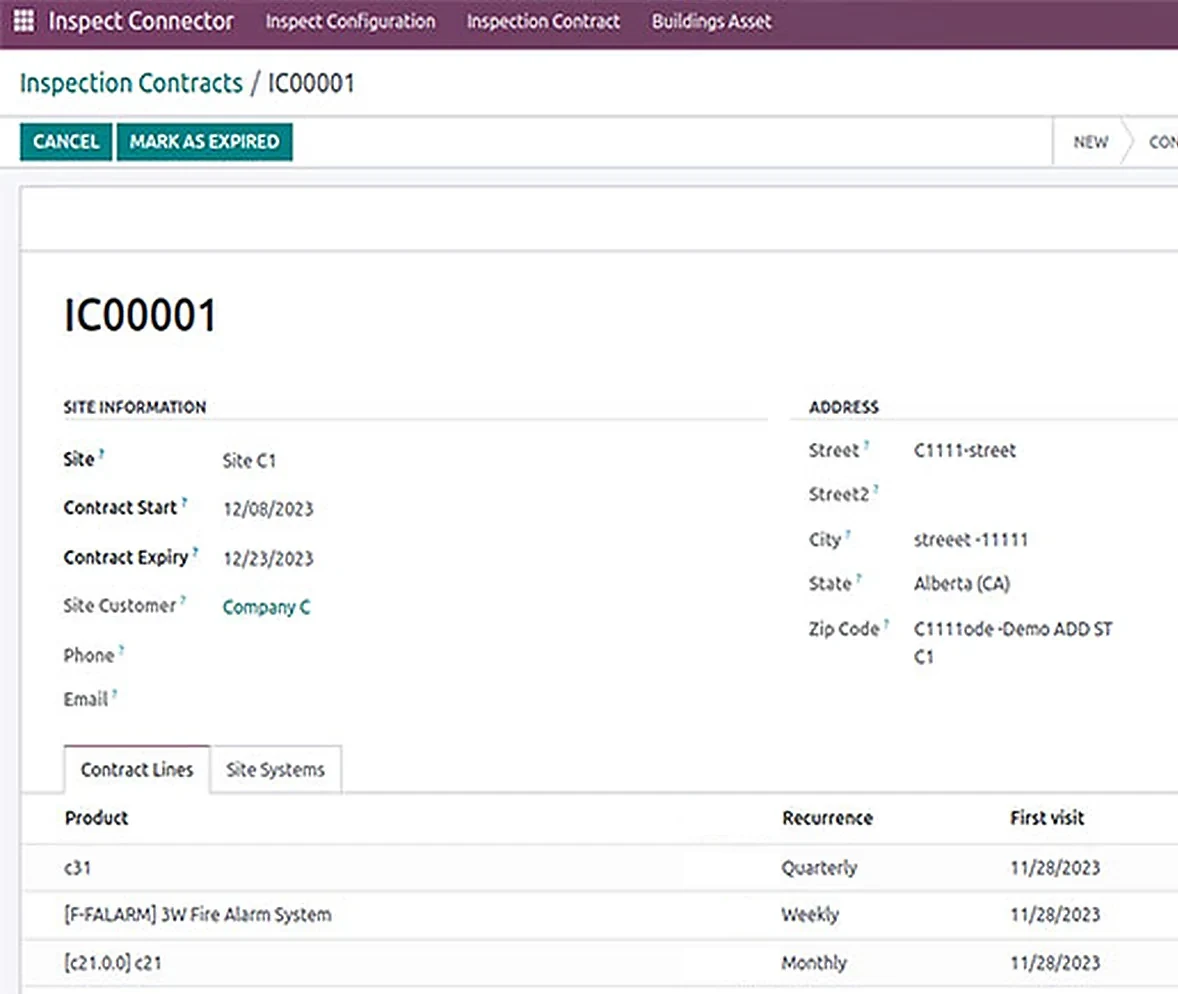
AMASCO LLC
A UAE repairs and maintenance contractor in oil and gas, maritime and shipping. Odoo opens a project on quote acceptance and links the procurement against it, requisitions pass approval, and leftover stock returns to a virtual warehouse.
Read the case →
/ Comparison
Odoo, or a construction-specific ERP?
A construction ERP starts ahead on the contract ledger, Odoo on everything else.
| Criterion | A construction ERP | Odoo |
|---|---|---|
| Pay applications and retainage | Shipped, with a schedule of values and retention per application | Not shipped. Milestones and down payments cover staged fees; the rest is a build |
| Job cost against contract | Built around cost codes and a work-in-progress schedule | Analytic accounts and the profitability dashboard, once cost coding is modeled |
| Subcontractor compliance | Insurance, lien waivers and prequalification tracked as standard | Not shipped. A register, alerts and an approval block are custom |
| Everything that is not the contract | A separate system for CRM, purchasing, stock, field service or the web | One database already runs them, against the same jobs |
| Cost of a change | A vendor request, then a release cycle | Configuration in one place, code only where the gap is genuine |
Choose a construction ERP if pay applications and retainage are the daily job. Choose Odoo if the business is wider than the contract ledger and you would rather build two pieces than integrate six. See also Odoo versus SAP Business One.
/ Questions contractors ask
Odoo for construction and engineering FAQs.
Does Odoo have a construction module?
No. Odoo ships no construction application. The word does appear in the Odoo 18 documentation — the UK localization ships a Construction Industry Scheme module, l10n_uk_reports_cis — but never as an application. A contractor uses Project, Timesheets, Planning, Field Service, Purchase, Inventory, Maintenance and Accounting, with analytic accounting behind every job.
Can Odoo do progress billing and retainage?
Not out of the box. Odoo ships milestone invoicing, down payments and time-and-material billing drawn from timesheets, which cover staged fees. A schedule of values, percentage complete against it, retention withheld per application and a pay-application document are a build, sized during design.
How does Odoo work out what a job made?
Through analytic accounting. An analytic account is opened per job, and costs from timesheets, purchases, vendor bills, expenses and stock moves are distributed onto it. The project profitability dashboard reads every record on that account and shows revenue beside cost in three columns.
How do subcontractors get handled in Odoo?
As suppliers against the job. The order is raised through Purchase, ideally under a purchase agreement, and the bill is matched against the order and what was received. UK contractors also get the Construction Industry Scheme module, which deducts CIS from the labor lines of a subcontractor bill and files the monthly return to HMRC. Beyond that, compliance is the gap: Odoo tracks no insurance certificates or lien waivers, so we build the register.
Can Odoo track material and plant out on site?
Yes, with configuration. Each active site can be its own stock location, so material issued to a job is a transfer rather than a write-off, and landed costs put freight onto the receipt. Machines become equipment records that Planning can schedule alongside people.
Do site crews need a laptop?
No. Field Service tasks and worksheets are completed on a phone at the site, and timesheets go in on the same device. Offline capture is where Odoo stops: for Vancouver Fire, whose technicians inspect buildings with no network, we integrated an offline inspection app instead.
Can one Odoo database run several companies?
Yes. One database holds several legal entities, each with its own fiscal localization, chart of accounts and statutory reporting, with intercompany rules between them. A joint venture is normally modeled as a second analytic plan, so costs read by job and by venture.
How long does a contractor implementation take?
Small implementations run 8 to 12 weeks, mid-market 12 to 24 weeks, and multi-entity rollouts 6 to 12 months. Version upgrades run 3 to 8 weeks. Custom work for progress billing or retainage is estimated separately. These are our estimates, not Odoo figures.
/ Next step
Let’s map your jobs and your billing onto Odoo.
- A senior architect replies within one business day
- Your details are never shared or sold
- An NDA can be signed before we hear any detail
US +1 (631) 897-7276 · Gulf +971-54-737-4253 · Singapore +65-9086-0319 · India +91-22-6116-3300.









Trusted by 2,000+ brands worldwide
“Brainvire has helped our business grow. We feel like it’s a true partnership. They’re always present. It’s been seven great years, looking forward to more.”
Book a working session
Tell us how you bill contracts and how many sites run.