Digital Transformation Challenges for the UAE and How to Solve Them

The UAE has built one of the most ambitious digital agendas on earth. Driven by Vision 2031 and the National Strategy for Advanced Technology, the country routinely benchmarks itself against global digital competitiveness indices. The vision is flawless, and the capital investment is real. Yet, ambition and day-to-day execution live in two different worlds, and the gap between them is where most enterprise transformation programs quietly bleed out.
Across banking, government, retail, and logistics, organizations are hitting the exact same invisible walls: decades-old legacy infrastructure buckling under modern data volumes, a local talent pool struggling to match the dizzying speed of technology, and compliance rules changing faster than internal governance can keep up.
The era of digital experimentation is officially behind us. What follows is an insider look at the exact friction points stalling UAE enterprises today, and the high-impact, real-world blueprints leaders are using to outpace the competition.
What Digital Transformation Actually Means in the UAE Context
‘Digital transformation’ has become such an overused buzzword that its actual value is often lost.
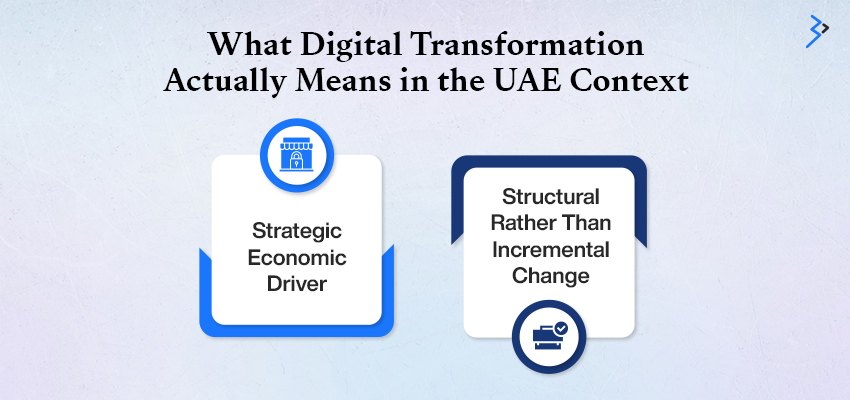
In the UAE, digital transformation is not just about moving systems to the cloud or launching a mobile app. For an economy actively diversifying away from oil dependency, this means fundamentally rethinking how public and private-sector organizations deliver value through data, automation, AI-driven services, and seamless digital experiences.
The UAE’s digital economy already contributes around 9.7% of GDP, with a government target of 19.4% by 2031, according to the Ministry of Economy. That gap does not close with incremental technology upgrades. It closes through genuine structural change, and that’s where organizations consistently run into trouble.
6 Real Challenges of Digital Transformation and Why They Persist
1. Legacy Infrastructure That Refuses to Retire
Most established organizations in the UAE, particularly in banking, insurance, and the government, are running core systems built in a different era. These systems were not designed for API connectivity, real-time data exchange, or cloud-native architectures. They work perfectly well for yesterday’s demands, which is exactly why they are so difficult to replace today.
The issue isn’t that these systems are old; it’s that they paralyze innovation. Every new initiative requires a workaround, creating data inconsistencies and compounding technical debt with every layer added.
The Solution: A phased modernization approach that avoids a high-risk ‘rip and replace’ moment. Wrapping legacy systems in API layers, a strangler fig pattern, lets organizations progressively migrate functionality without disrupting live operations.
The goal is to reduce dependency incrementally while building the modern core in parallel. This requires patience and executive commitment to a multi-year roadmap, not just a quarterly deliverable.
2. Cybersecurity Gaps in a High-Target Region
The UAE’s digital ambitions make it a high-value target. The country ranks among the most cyber-attacked in the Middle East, with financial services and critical infrastructure facing the most persistent threats. Digital transformation inherently expands the attack surface, with more connected systems, more endpoints, and more data moving across more channels.
What makes this especially difficult is the pace of transformation itself. Organizations are deploying new technologies faster than security teams can assess and harden them. Security becomes reactive instead of foundational.
The Solution: Security architecture needs to be embedded into transformation programs from day one, not retrofitted once a breach has occurred. Zero trust frameworks, where no user or device is automatically trusted regardless of network location, are increasingly the baseline expectation for regulated industries in the UAE.
The UAE Cybersecurity Council’s national standards provide a practical framework, but internal governance needs to operationalize it. Third-party security assessments conducted before major deployments, not after, are the difference between secure transformation and expensive remediation.
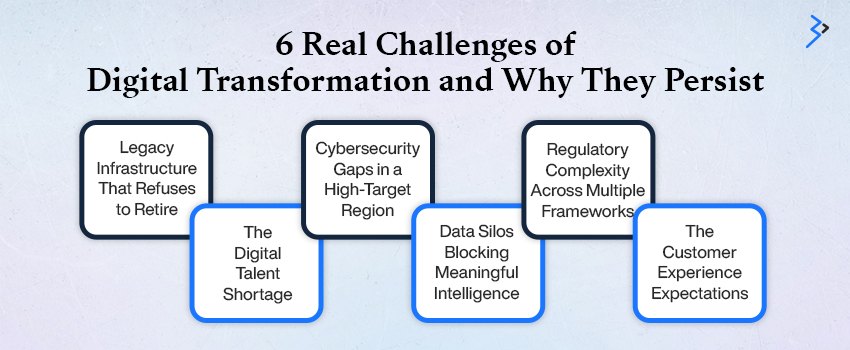
3. The Digital Talent Shortage
The technology skills gap in the UAE is real and well-documented. The country has moved aggressively on visa reform and talent attraction, but demand for cloud architects, data engineers, AI specialists, and cybersecurity professionals is outpacing supply domestically. Organizations compete not just with local employers but with global firms offering remote compensation packages in stronger currencies.
The challenge compounds inside organizations. Technology capability is not just a hiring problem; it is a change management problem. Digital transformation fails when the people expected to use new systems were not involved in designing them and were not adequately trained before deployment.
The Solution: A dual approach is required. Externally, leveraging certified implementation partners who bring specialized expertise for defined transformation workstreams reduces dependency on scarce full-time talent.
Internally, structured upskilling programs, particularly for operational and middle-management teams, determine whether the technology actually gets used or quietly sits underutilized. The UAE government’s investments in programs like the Digital Academy and partnerships with UAEU signal the direction; private-sector organizations need to treat internal capability-building as a capital expenditure, not a training budget line.
4. Data Silos Blocking Meaningful Intelligence
Most organizations in the UAE are not short on data. They are short on connected data. Customer information sits in the CRM. Transaction records live in the ERP. Marketing interactions are tracked on a separate platform. Operational data is in a completely different system, managed by a different team with different governance standards.
The result is that AI, analytics, and personalization initiatives, the headline use cases of every transformation program, cannot deliver on their promise because the underlying data infrastructure is fragmented.
The Solution: Data strategy has to precede technology deployment, not follow it. This means defining a unified data governance framework, establishing data ownership across business units, and investing in integration architecture, whether a modern data platform, a data mesh approach, or a centralized data lake, before committing to AI or analytics tools that depend on clean, connected data.
Technology is rarely the bottleneck; the organizational readiness to govern data as a shared asset is.

5. Regulatory Complexity Across Multiple Frameworks
Operating in the UAE means navigating a layered regulatory environment. UAE federal law, ADGM frameworks, DIFC regulations, emirate-specific mandates, and sector-specific requirements from the CBUAE, MOHAP, and TRA all intersect. Data residency requirements, AI governance guidelines, and the Personal Data Protection Law (PDPL) add another layer that directly affects cloud deployment decisions and data architecture.
For multinational organizations, this complexity is compounded by the need to reconcile UAE requirements with GDPR obligations and other international frameworks simultaneously.
The Solution: Regulatory compliance cannot be treated as a legal team responsibility that sits outside the technology program.
Compliance requirements must be translated into architectural decisions early. Specifically, data residency mandates dictate cloud region selection, consent frameworks govern data ingestion, and audit trail requirements alter core system design.
Organizations that build compliance into the architecture from the start avoid the expensive redesigns that come from treating it as a post-deployment checkbox.
6. Customer Experience Expectations Set by Global Benchmarks
UAE consumers, particularly in Dubai and Abu Dhabi, benchmark their digital experiences against the best in the world. The bar is not regional; it is global. Banking apps are compared to Revolut, while retail experiences are measured against Amazon. Government services are increasingly expected to match the seamlessness of private sector digital products.
The challenge for organizations is that delivering this caliber of experience requires not just the right front-end design but the integrated back-end infrastructure to support it, along with real-time data, consistent personalization, omnichannel continuity, and near-zero downtime tolerance.
The Solution: Customer experience transformation needs to be driven by actual user research in the UAE market, not imported assumptions. Arabic-first design, right-to-left interface considerations, and the specific behaviors of a multicultural, mobile-first user base are not afterthoughts; they are requirements.
Organizations that invest in local UX research and test continuously with actual users outperform those that deploy globally standardized experiences and wonder why engagement metrics lag.
A Practical Comparison: Common Approaches and Their Trade-offs
| Challenge | Short-Term Fix | Sustainable Solution |
|---|---|---|
| Legacy infrastructure | Add integration layers on top | Phased modernization with API-first architecture |
| Cybersecurity gaps | Reactive patching and perimeter defense | Zero trust framework embedded from program inception |
| Talent shortage | Hire contractors for individual projects | Build internal capability alongside certified partner delivery |
| Data silos | Point-to-point integrations between systems | Unified data governance and integration architecture |
| Regulatory complexity | Legal review at the deployment stage | Compliance-by-design embedded in technical architecture |
| Customer experience gaps | Redesign the front-end interface | End-to-end integration with UAE-specific UX research |
The Two Digital Transformation Mistakes Organizations Keep Making
Most transformation programs don’t fail because of bad technology; they fail because of these two overlooked mistakes.
1. Treating Digital Transformation as a Technology Procurement Exercise
The platforms, tools, and vendors are the easy part. The challenging part is the operating model change, the governance structures, the process redesign, the capability building, and the leadership alignment that determines whether the technology delivers value or just adds cost.
Organizations that start with vendor selection instead of business outcomes almost always end up over-invested in tools they underuse.
2. Underestimating the Time It Takes
Genuine transformation in a complex organization, one with legacy systems, distributed teams, regulatory obligations, and real customers depending on operational continuity, takes years, not quarters. Programs scoped to deliver transformation in 90 days are either not actually transforming anything or are setting up for a very visible failure.
The organizations that have made meaningful progress in the UAE built multi-year roadmaps, maintained executive sponsorship across leadership changes, and treated setbacks as information rather than failures.
Winning the Digital Race Demands Execution, Not Just Vision
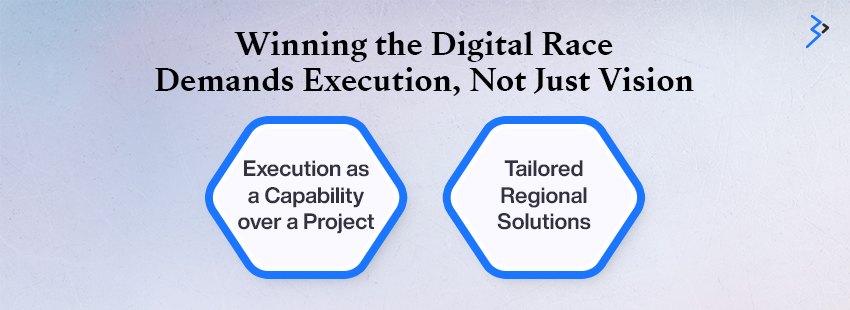
The UAE has built the conditions for transformation that few countries can match. The constraint is not ambition or investment; it is execution maturity. Organizations making genuine progress treat transformation as a capability built over time, not a project delivered by a deadline. They start with data governance before AI, embed security before deployment, and measure success by business outcomes, not systems migrated or platforms deployed.
The challenges here are not unique, but the context is. Regulatory pace, a multicultural customer base, and the scale of the government’s own digital program all shape what good execution looks like.
Brainvire brings certified expertise across cloud migration, data architecture, digital experience platforms, and AI implementation, with deep experience across the UAE and GCC. Contact our experts today to build a transformation program designed for where your organization actually is.
Frequently Asked Questions
What are the biggest digital transformation challenges in the UAE?
The most persistent challenges include legacy infrastructure modernization, cybersecurity readiness, digital talent scarcity, fragmented data architecture, regulatory compliance complexity, and delivering customer experiences that meet benchmarked expectations globally.
How does the UAE’s regulatory environment affect digital transformation?
Organizations must navigate overlapping federal, emirate-specific, and sector-specific frameworks, including the PDPL, CBUAE guidelines, and DIFC/ADGM regulations, which directly affect cloud architecture decisions, data residency, and AI governance.
Is the talent gap in UAE technology a solvable problem?
Yes, through a combination of strategic hiring, certified implementation partners, and structured internal upskilling programs. The UAE government’s talent development investments are accelerating supply, but organizations cannot wait for the market to solve this for them.
How long does digital transformation realistically take?
Meaningful transformation in a complex organization takes 3-5 years. Programs scoped to deliver wholesale change in months either scope too narrowly or underestimate the organizational change required alongside the technology.