
Why Enterprises Need Databricks Consulting Partners to Navigate the Agentic AI Era

The traditional enterprise AI roadmap is reaching its breaking point. For years, executive leaders have chased AI ambition by licensing a model, buying a vendor’s use-case deck, and calling it a strategy. But this approach has quietly exposed a fatal flaw: an ambitious agentic AI plan built on a missing data foundation.
Enterprise leadership teams are rushing to deploy autonomous systems without asking the harder question: Is our data actually ready for an agent to make real-time decisions on our behalf, without a human in the loop at every step?
Unsurprisingly, this disconnect between agentic ambition and data readiness is causing initiatives to stall before ever hitting production. Gartner predicts that over 40% of agentic AI projects will be canceled by the end of 2027, sunk by escalating costs, vague ROI, and inadequate risk controls.
To bridge this gap and build AI that actually holds up in production, enterprise data platforms need to evolve from disconnected pilots to governed, agent-ready foundations. This shift marks the arrival of the agentic data era.
AI agents are redefining enterprise automation, shifting the focus from static dashboards to governed data, autonomous execution, and auditable outcomes. For modern executives, the question is no longer whether to deploy agentic AI, but how to architect the data foundation it requires. Working with the right Databricks consulting partners helps organizations build that foundation on the Databricks Intelligence Platform, tailored to their specific data landscape, governance framework, and business goals.
The Agentic AI Moment Is Real, But Most Enterprises Aren’t Ready for It
Agentic AI is a different category of risk than the generative AI pilots that enterprises ran in 2023 and 2024. A chatbot that gives a wrong answer is embarrassing. An autonomous agent that acts, updates a customer record, approves a transaction, reroutes inventory, triggers a compliance filing, is a different order of exposure entirely. It needs to know which data to trust, which actions it’s permitted to take, and how to prove afterward exactly what it did and why.
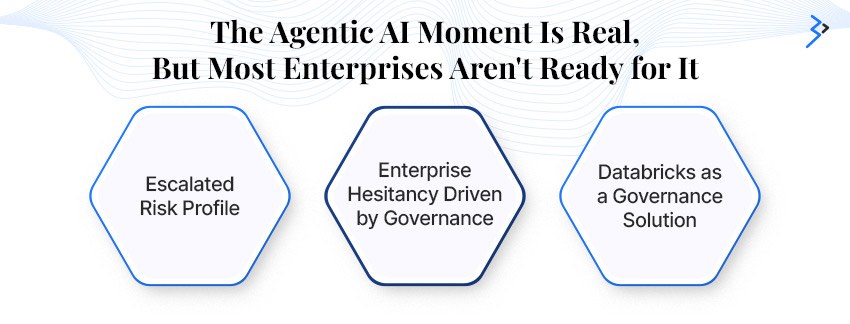
Gartner’s research points to a January 2025 poll of over 3,400 organizations, where only 19% reported significant investment in agentic AI, 42% were investing conservatively, and roughly a third were still on the fence. That tells us that most enterprises sense the opportunity but are hesitant to move, and the hesitation is rarely about the AI model itself.
It’s about governance: who owns the data the agent touches, what happens when it’s wrong, and how you audit an autonomous decision after the fact. This is precisely the gap the Databricks Intelligence Platform was built to close.
What the Databricks Intelligence Platform Actually Brings to the Agentic Era
Databricks has spent the last two years quietly repositioning itself from “the platform where your data engineers run Spark jobs” to the governed backbone for enterprise AI agents. A few data points make the scale of that shift concrete.
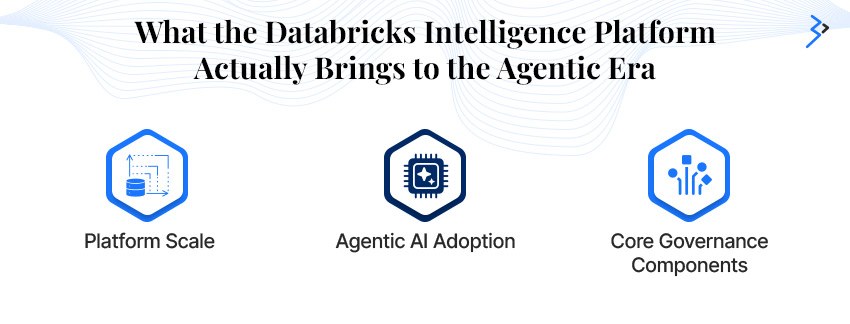
Databricks reports show that more than 15,000 organizations worldwide, including over 60% of the Fortune 500, now run on the Databricks Data Intelligence Platform. On the agent side specifically, Databricks reported more than 100,000 agents built on its Agent Bricks platform, processing over one quadrillion tokens annually.
What ties this together isn’t the model layer, it’s the governance layer underneath it. Three components matter most for enterprise leaders evaluating readiness:
| Component | What It Solves |
|---|---|
| Unity Catalog | Single governed source of truth for data, models, and now agents and tools themselves |
| Agent Bricks | Build, evaluate, and optimize agents directly on governed lakehouse data instead of disconnected sandboxes |
| Unity AI Gateway | Audits every model interaction, enforces usage budgets, and gives compliance teams visibility into what agents are doing, at scale |
According to Atlan, Unity AI Gateway reached general availability in August 2026, which matters because it’s the piece that finally answers the question every CISO asks before signing off on agent deployment: how do we know what it did, and can we stop it if it’s wrong? Without that layer, an agentic AI strategy is really just a collection of impressive demos with no accountability trail behind them.
The First-Time Problem: Why Internal Teams Alone Aren’t Enough
Most internal data teams are excellent at running a lakehouse. Very few have deployed governed, production-grade agentic workflows before, because almost nobody has been doing this for more than a year or two. This isn’t a skills gap born of internal weakness; it’s a skills gap born of the technology being genuinely new.
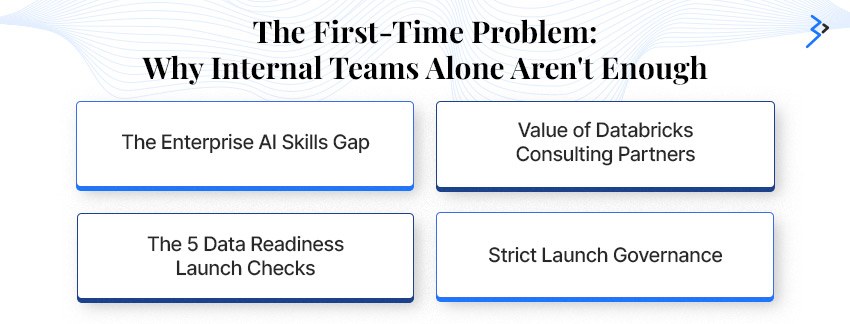
This is where experienced Databricks consulting partners can change the trajectory of a project. The difference between an enterprise that tries to configure Unity Catalog, Agent Bricks, and governance policies from scratch versus one working with a partner who has done it across dozens of environments isn’t a matter of speed alone.
A capable partner brings three things an internal team can’t easily replicate on the first attempt:
- Pattern Recognition across Industries: Experienced partners have already seen how a retail inventory agent, a financial reconciliation agent, and a healthcare intake agent can fail differently, allowing governance boundaries to be designed accordingly.
- Migration and Integration Depth: Most enterprises aren’t starting from a blank lakehouse. They’re consolidating years of fragmented pipelines, legacy warehouses, and shadow BI tools before an agent can be trusted to interact with any of them.
- A Pragmatic Rollout Sequence: Start with one well-scoped, low-risk agent use case, prove governance holds under real conditions, and then expand rather than attempting an enterprise-wide agent rollout on day one.
Before any agent goes live, the data it will rely on should pass five checks:
- Trusted: Every source has a named owner and quality checks, because an agent acts on flawed data as confidently as on good data.
- Permitted: Access boundaries are defined per agent, so it reads and writes only what its role requires. Broad, shared credentials turn a small mistake into a large one.
- Traceable: Lineage shows where each input came from and which decisions it influenced, which makes an audit possible after the fact. If an outcome can’t be explained, it can’t be trusted.
- Current: Freshness expectations are set for each workflow, since stale data leads to stale decisions.
- Reversible: Any automated action can be paused, reviewed, and rolled back if it turns out to be wrong. Every agent needs an off switch and a recovery path before launch.
Enterprises that cannot meet all five are not ready to let an agent act on their behalf, however capable the model is. Treat these checks as a launch gate rather than a formality: if any answer is unclear, the agent waits. Catching gaps early costs far less than discovering them in production, and this is exactly where an experienced partner earns its place on the project.
What Good Databricks Consulting Actually Looks Like
Not every partner labeled a “Databricks consulting partner” operates at the same depth. When evaluating this space, the distinction usually comes down to four things:
| Evaluation Criterion | Why It Matters |
|---|---|
| Governance-first design | Partners who start with Unity Catalog permissions and audit trails, not just model selection, build agents that survive a compliance review |
| Cross-platform integration experience | Enterprise data rarely lives only in Databricks; partners need real experience connecting it to existing ERP, CRM, and commerce systems |
| Production track record, not just pilots | Ask specifically how many agents they’ve moved from sandbox to live production, and what broke along the way |
| Change management alongside the technical build | The best technical rollout still fails if the business teams using the agent’s output don’t trust or understand it |
This is the standard we hold ourselves to at Brainvire. We’ve spent the last several years designing governed environments where the data architecture, access controls, and downstream AI workflows are built to work together from the start, rather than bolting governance on after an agent is already misbehaving in production.
Our engagements begin narrow: identify the one or two workflows where an agent would create measurable value with contained risk, prove the governance model holds, then expand outward. That sequencing, not the sophistication of any single model, is usually what separates the enterprises in Gartner’s surviving 60% from the ones in the canceled 40%.
Governance Is What Makes Automation Worth Deploying
Agentic AI failure isn’t a failure of ambition, it’s what happens when an enterprise hands an autonomous system real decisions before it has a governed foundation underneath it: no single source of truth for the data the agent reads, no audit trail for what it did, no boundary on what it’s allowed to touch.
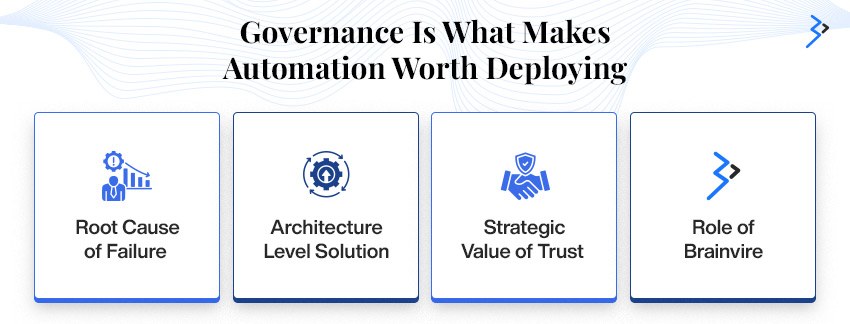
The Databricks Intelligence Platform fixes this at the architecture level: govern data, models, and agents together inside Unity Catalog, and every action downstream, BI, SQL, notebooks, the agent itself, inherits the same trustworthy foundation.
The real return is trust here. When leadership can hand a consequential decision to an agent the same way they’d trust a well-trained employee who knows the boundaries of their role, automation stops being a liability to manage and starts being capacity to deploy.
Brainvire helps enterprises get there without betting the business on an untested first attempt. We design governed Databricks environments where data architecture, access control, and downstream agentic workflows work together from day one. We don’t just implement agents. We help you decide which use case to start with, prove that governance holds under real conditions, and scale without outrunning the trust you’ve built.
Frequently Asked Questions
What does a Databricks consulting partner actually do?
A Databricks consulting partner designs, migrates, and governs an enterprise’s data and AI environment on the Databricks Intelligence Platform, covering everything from Unity Catalog architecture and pipeline migration to deploying and governing production AI agents through Agent Bricks and Unity AI Gateway.
Why can’t our internal data team handle this alone?
Most internal teams are strong at running data infrastructure but have limited hands-on experience deploying governed, production-grade agentic AI, simply because the technology is new across the industry. A partner brings pattern recognition from prior deployments that helps avoid the governance and access-control mistakes that cause most agentic AI projects to stall.
What makes the Databricks Intelligence Platform different for agentic AI specifically?
It unifies data, models, and now AI agents themselves under one governance layer, Unity Catalog, with Agent Bricks for building and evaluating agents and Unity AI Gateway for auditing and controlling what agents do in production. That combination is what allows an agent’s actions to be trusted, tracked, and reversed if needed.
What should we look for when evaluating Databricks consulting partners?
Look for governance-first design rather than model-first design, real experience integrating Databricks with existing enterprise systems, a track record of agents that have actually reached production rather than staying in pilot, and support for the change management needed to get business teams to trust and adopt the outcome.

Related reading
 Databricks Cost Optimization: 10 Tips From a Partner's Playbook to Stop Burning DBUsOctober 20, 2026 · 8 min read
 Beyond the Add-to-Cart Button: A Builder's Guide to Commerce Agents on ClaudeOctober 12, 2026 · 8 min read
 Databricks Metric Views 101: Solving the "Everyone Has a Different Number" ProblemOctober 8, 2026 · 8 min read