
Odoo licensing explained: editions, plans and what drives implementation scope
Two questions get asked as one: what Odoo charges for the software, and what an implementation takes to deliver. This page explains how the editions, plans and hosting options are structured, sends you to Odoo for the figures, and sets out the ten factors that move scope.
Odoo ships in two editions. Community is open source under the LGPL version 3 license and free to license. Enterprise is a paid subscription contracted with Odoo, sold in plan tiers and written per internal user.
Anyone comparing Odoo editions, plans and hosting before committing, or working out why two plans for one company differ so much.
The implementation that licensing sits under runs 8 to 12 weeks for small rollouts, 12 to 24 weeks for mid-market and 6 to 12 months for enterprise. A version upgrade runs 3 to 8 weeks.
On our side an Odoo functional consultant and a solution architect. On yours, whoever owns finance, whoever owns IT, and whoever signs off.
/ Before you sign anything
Which licensing question got answered by accident?
Four decisions that are cheap to make deliberately and expensive to reverse later.
Community was chosen because it was free
Free to license is not free to run. Community leaves out Odoo’s hosting, support, upgrade service and the Enterprise-only apps, so the app list should decide the edition.
The plan tier was picked before the app list
Odoo Studio, multi-company and the external API sit in the top tier. If a second legal entity or one integration is in scope, the tier is already decided.
Nobody separated users from contacts
Odoo counts internal users, portal users and public visitors as three different things. Treating every contact as a user inflates the number.
Hosting was settled by whoever installed it
One custom module rules out Odoo Online for good. That decision is usually made in week two, and it settles who holds the backups.


Trusted by enterprise Odoo teams worldwide






/ The half nobody publishes
What drives the scope of an Odoo implementation?
The license question has a short answer. This one does not, and it is where two plans for one company diverge.
| The scope driver | What has to be established | What it changes |
|---|---|---|
| How many people will log in | Internal users counted by role, kept apart from portal users, a different type with view access | The license is written for a user count, and training follows it |
| How many legal entities | Each company, the countries it files in, and whether the group consolidates, under multi-company rules | Multi-company is a top-tier feature; entities multiply configuration and testing |
| How many apps go live first | A phase-one list drawn from a mapped process, with the other Odoo applications sequenced | No extra subscription line, but each app adds configuration, testing and training |
| How much history has to move | Which objects import, how many years come with them, and who cleanses them | Usually the largest single task, and the one that slips |
| What Odoo has to talk to | Each system, the direction of the flow, how often it runs, who owns reconciliation | The external API is a top-tier feature, and each flow needs test data |
| What genuinely has to be built | Gaps no setting and no Studio change can close, owned before anyone opens an editor | Custom code rules out Odoo Online, and blocks the upgrade until it is ported |
| Which countries you file in | The fiscal localization package per country, and the statutory reports each entity files | Localization multiplies by entity and country, never by user |
| Which finance features you need | Invoicing alone, or the full Accounting app with reconciliation, budgets, assets and reports | The clearest edition test here; finance usually settles it first |
| Who has to be trained | Role-by-role training built from the access model, in the languages your sites use | Scales with role and language count, where go-live risk sits |
| What has to change on your side | The processes people give up, the approvals that move, the spreadsheets that stop | A workstream with named owners, not a week before go-live |
Names follow the Odoo 18 documentation. Delivery ranges here are Brainvire’s estimates, not Odoo’s.
/ Structure, not amounts
How is Odoo licensed, and how is the subscription structured?
Odoo publishes all of this. The license texts give the exact terms for each edition, the editions comparison lists what each one includes, and Odoo’s own pricing page carries the current figures for your country, plan and term. We do not restate them here, because Odoo is the only source right on the day you read it.
Open source, and free to license
Odoo Community Edition is licensed under LGPL version 3. You may run it, modify it and host it yourself with no subscription. What it leaves out is Odoo’s hosting, its unlimited functional support, its upgrade service and the Enterprise-only apps.
A subscription, written per user
The Odoo Enterprise Edition License v1.0 permits use only with a valid Odoo Enterprise Subscription for the correct number of users. That clause is why the internal user count, not the app count, is the first number anyone asks for.
The tier is chosen by feature, not by figure
Odoo sells the subscription in tiers. The free tier runs one app. The middle tier includes all apps on Odoo’s cloud. The top tier adds Odoo Studio, multi-company and the external API, and alone may run on Odoo.sh or your servers.
What a subscription does not buy
Odoo states the exclusions plainly: implementation services, maintenance of custom code, Odoo.sh hosting for custom developments, and in-app purchase credits for SMS and document scanning. That is program scope, not plan scope.
/ Order of operations
How do you settle edition, plan and hosting before you commit?
In this order, because each stage decides the next. The implementation these stages scope runs 8 to 12 weeks for small rollouts, 12 to 24 weeks for mid-market and 6 to 12 months for enterprise.
Map the processes, then count
Count internal users by role, legal entities, countries you file in, and the apps a mapped process cannot run without. Every later decision reads off those numbers.
Run the fit-gap
Run each mapped process against a working Odoo database and classify every difference: change the process, change a setting, use Studio, or write a module.
Let those two decide edition, plan and hosting
The finance requirement decides the edition. Multi-company, Studio and the external API decide the tier. Any surviving custom module decides whether Odoo Online is still open.
Scope the program separately, in writing
Data migration, integrations, localization, training and change are estimated as work with named owners. That estimate is ours; the subscription figures are Odoo’s.
/ Where it runs
Where does Odoo run, and what changes with each choice?
The difference is what is included and who holds the risk. One option closes the moment a custom module is approved.
Hosted and managed by Odoo
Private databases run by Odoo and reached from any browser, nothing installed locally. The constraint is absolute: Odoo Online is incompatible with custom modules and Apps Store modules.
Odoo’s platform, your code
Odoo’s official cloud platform: development, staging and production branches, a web shell, SSH access and continuous integration. Custom modules live here, inside Odoo’s infrastructure.
Your servers, your responsibility
You install and run Odoo yourself, registering the database with your subscription code. Only one database may be linked to a code, so a test environment is a separate step.
Reversible, and a project in itself
Databases do move between all three and Odoo documents every route. But an upgrade does not cover switching editions, changing hosting, or migrating from another ERP.
Hosting follows the Odoo 18 docs: changing hosting, Odoo Online, Odoo.sh, on-premise, upgrades. The switch to Enterprise is a backup, a web_enterprise install and a subscription code. More on Odoo hosting.
/ Odoo, on the record
What do those scope drivers look like on a real program?
Three engagements where entities, localization or custom code set the shape of the work.
 12 countriesone standardized Odoo 18 ERP and POS core across the network
Puma Energy
Entities, countries and roles set this scope, not the app list. A legal entity to dealer to site hierarchy, country-specific fiscal localization on a mergeable group chart of accounts, a seven-role security matrix, and a POS that keeps selling through outages.
Read the case →
Ecommerce accounting, Saudi Arabia
Three of the ten drivers on one project: a hierarchy-wise chart of accounts built to Saudi rules, REST integration to the client’s own ecommerce platform, and automated creation of vendor and customer data.
Read the case →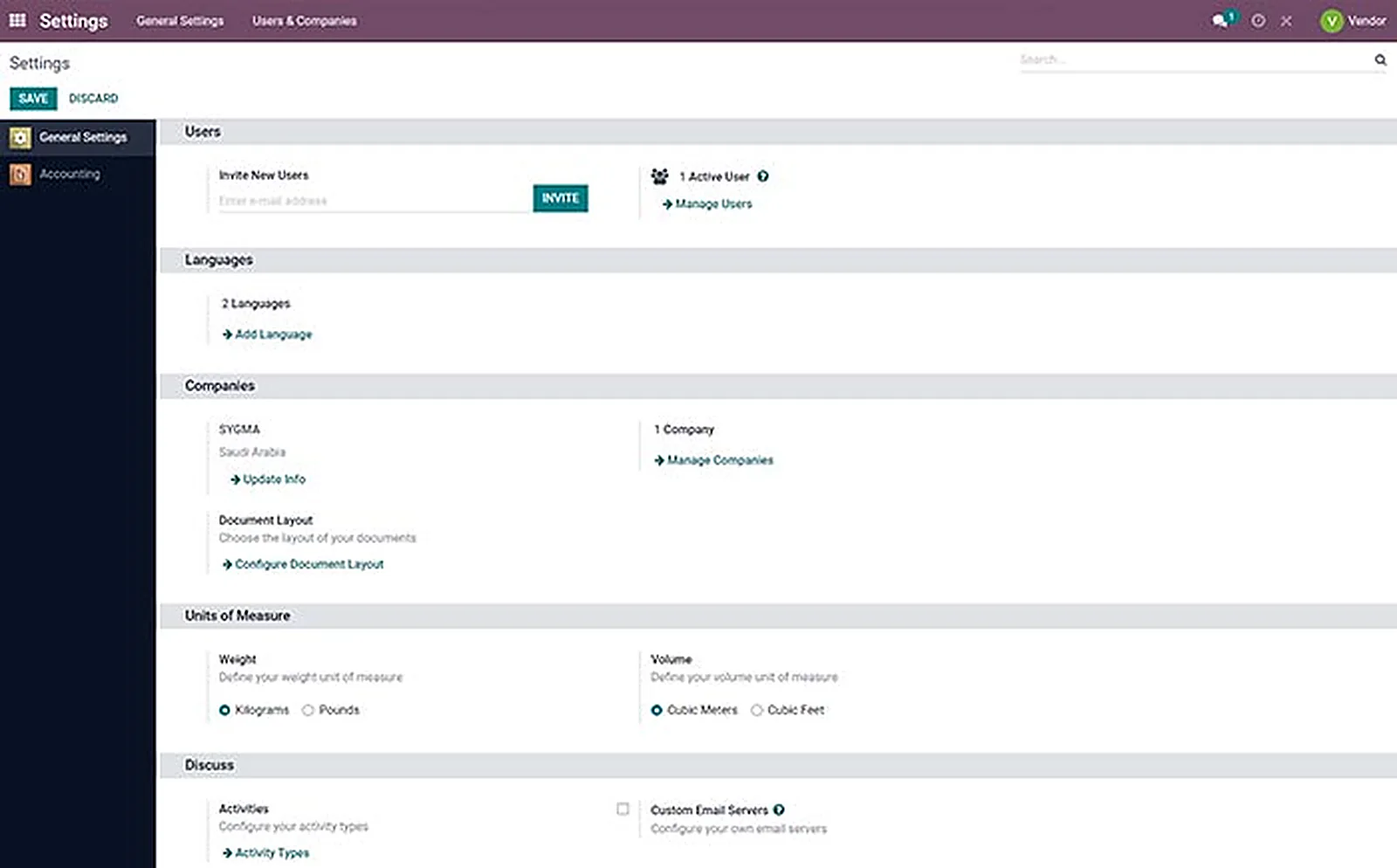
Laboratory information system
What a deliberate custom-code decision looks like: lot scanning with automatic identifiers, a customer testing portal, subcontracted tests alongside in-house work, and COA approval with QA e-signatures. Everything the standard apps covered stayed standard.
Read the case →
/ The line between the two
What does the subscription cover, and what does the implementation cover?
Most confusion about what Odoo costs is confusion about this line: a subscription contracted with Odoo on one side, a program of work on the other.
| Item | The Odoo subscription | The implementation program |
|---|---|---|
| The software license | Contracted with Odoo, per edition and per user | Outside implementation scope, and never blended into one figure |
| Version upgrades | Included in the plans, and mandatory on Odoo Online | Porting Studio changes and custom modules so the upgrade runs |
| Functional support | Odoo’s own support, included in the paid plans | Application support for what we built |
| Configuration | Not included in any plan | The core of the work: accounts, journals, taxes, rules, access |
| Custom code | Explicitly excluded, including its maintenance | Scoped from the fit-gap, written, documented, re-tested at upgrades |
| Data migration | Not included in any plan | Usually the largest single task, and the likeliest to slip |
| Training and change | Odoo’s eLearning platform is included | Role-by-role training and the change work around go-live |
Still deciding? Odoo Community vs Enterprise sets the editions side by side, Odoo hosting options covers where it runs, and Odoo ERP migration covers leaving another system.
/ Questions we are asked
Odoo licensing FAQs.
How much does Odoo cost?
Odoo publishes its own subscription figures, and they change by country, plan tier and billing term, so any number republished elsewhere is stale somewhere. Odoo's pricing page is the only accurate source. What we explain is the structure: which edition, which plan, how many internal users, and where it runs.
Is Odoo Community really free?
Odoo Community Edition is licensed under LGPL version 3, so no subscription is required to run it, modify it or host it yourself. What it leaves out is Odoo's own hosting, its unlimited functional support, its upgrade service and the Enterprise-only apps.
How is the Odoo Enterprise subscription structured?
The Odoo Enterprise Edition License v1.0 permits use only with a valid Odoo Enterprise Subscription for the correct number of users, so it is written per user and contracted with Odoo. Adding a user updates a monthly plan automatically; a yearly plan raises an expiration banner.
Which Odoo plan tier do we need?
The feature list decides it, not the figures. Odoo's free tier runs a single app. The middle tier includes all apps on Odoo Online. The top tier adds Odoo Studio, multi-company and the external API, and alone may run on Odoo.sh or your own servers.
Does adding more Odoo apps change the subscription?
On the free tier yes, since it runs one app only. On the paid tiers no, because Odoo includes all apps in a single per-user subscription. Extra apps still change the implementation, since each one adds configuration, testing, training and support.
What actually drives the scope of an Odoo implementation?
Ten things: internal users and roles, legal entities, countries you file in, apps in phase one, how much history migrates, systems Odoo must talk to, what genuinely has to be built, localization, the finance feature set, and training. Entities and data move scope most.
Does the hosting choice change what we get?
Yes, and the difference is what is included rather than what is charged. Odoo Online is hosted and managed by Odoo but incompatible with custom modules. Odoo.sh adds branches, a web shell, SSH and continuous integration. On-premise puts deployment, backups and upgrades on you.
Do portal users count the same as internal users?
No. Odoo databases have three user types: internal, portal and public. Odoo's documentation treats users as internal database users, while portal users are external people with read and view access who cannot edit records. Counting every contact as a user overstates the number.
Can we start on Community and move to Enterprise later?
Yes, and Odoo documents the route: back up the Community database, install the web_enterprise module, restart the server and enter your Odoo Enterprise Subscription code. The database comes with you. Plan it separately, since an upgrade does not cover switching editions.
How long is an Odoo version supported?
Each major Odoo version is supported for three years. On Odoo Online an upgrade becomes mandatory every two years on a major version and runs automatically if no action is taken by the deadline. On-premise you may stay on one version indefinitely.
/ Next step
Bring us the questions, not a shortlist.
- A senior architect replies within one business day
- Your details are never shared or sold
- An NDA can be signed before we hear any detail
US +1 (631) 897-7276 · Gulf +971-54-737-4253 · Singapore +65-9086-0319 · India +91-22-6116-3300.









Trusted by 2,000+ brands worldwide
“Brainvire has helped our business grow. We feel like it’s a true partnership. They’re always present. It’s been seven great years, looking forward to more.”
Ask an Odoo architect
Tell us how many entities, users and countries you run. We will explain what each changes, and point you at Odoo for the figures.