
Two checkouts are coming to your store: UCP vs ACP, explained for commerce leaders
On 15 October, Google switched on Universal Cart for US shoppers in Search and the Gemini app. A shopper can now fill one cart with items from Nike, Sephora and Target and pay with Google Pay without opening a retailer's tab. Seven months earlier, OpenAI stepped back from doing the same thing inside ChatGPT. Your board has read both headlines, and someone will ask which protocol you're backing. This paper gives you the answer, the evidence behind it and a 90-day plan.
Key takeaways
- Google's Universal Commerce Protocol (UCP) and OpenAI and Stripe's Agentic Commerce Protocol (ACP) now cover almost the same ground: catalog, cart, checkout, orders and a discovery file. Since April 2026, this is no longer a standards war you must pick a side in.
- The real decisions are which AI surfaces you want to be bought on, who owns checkout (the agent or you), and what each route costs. OpenAI's reported fee is 4%; Google hasn't disclosed one.
- Build one commerce API layer with two thin adapters. The expensive work—clean product data, real-time price and stock, order and returns events—is the same for both.
- Native agent checkout is US-only today. In the GCC and Southeast Asia, the card networks' agent payment programs are already live, so start with payments, identity and catalog readiness.
- Nobody has allocated liability for "the agent bought the wrong thing." Keep evidence of what the shopper authorized, and don't assume a chargeback rule will protect you.
- B2B is the bigger prize and the protocols are only starting to serve it. Contract pricing, purchase orders and approvals are still your problem to solve.
Executive summary
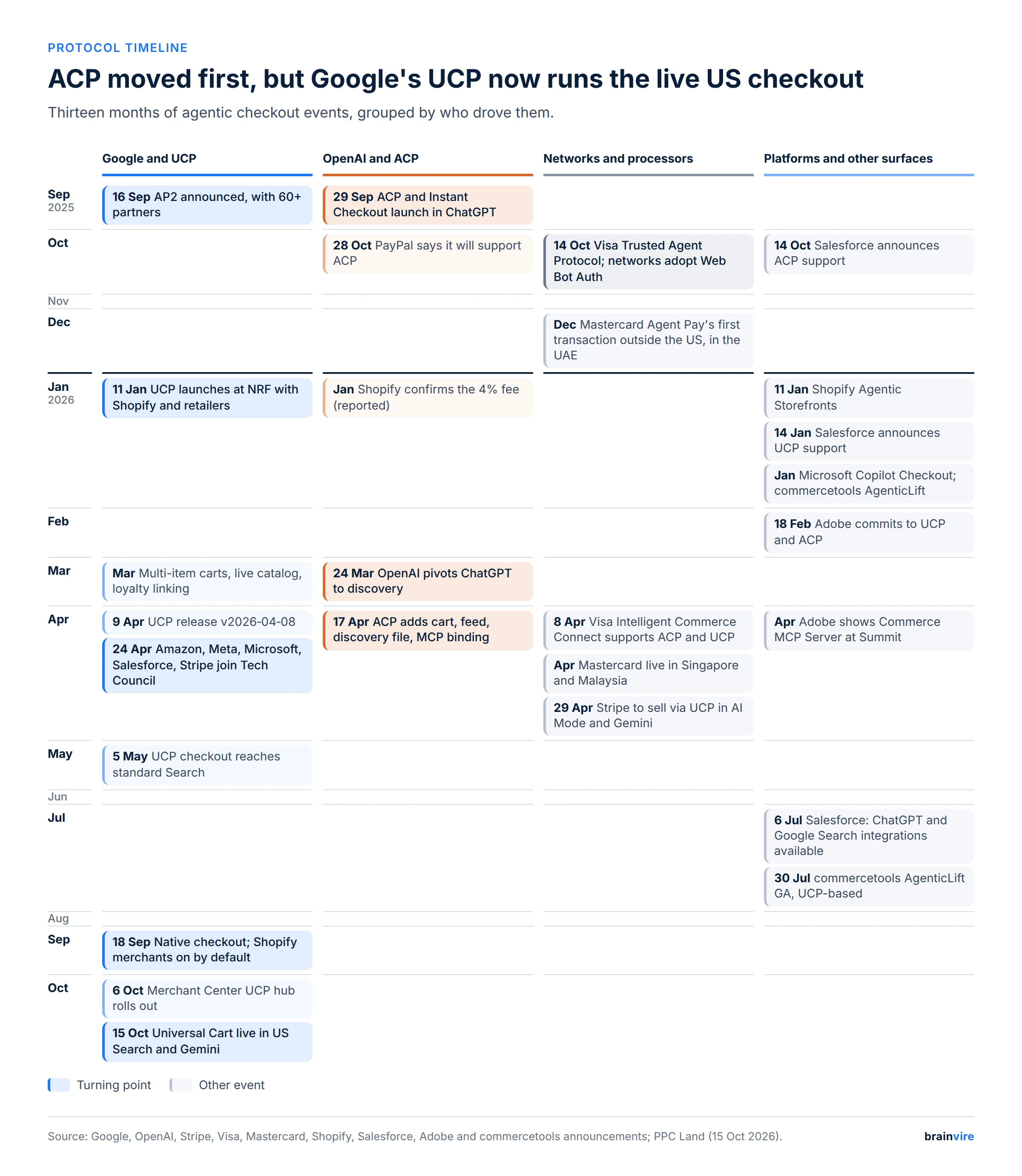
Two checkout protocols for AI agents arrived within four months of each other. ACP launched with ChatGPT's Instant Checkout in September 2025. UCP launched with Google and Shopify in January 2026. Most commentary still frames them as rivals. That frame expired in April 2026. ACP added carts, product feeds and a discovery file. UCP shipped carts and catalog lookups. And Amazon, Meta, Microsoft, Salesforce and Stripe joined UCP's technical council.
Our position is simple. Don't choose a protocol. Choose surfaces, a checkout model and a cost you can live with, then build one commerce API layer that both protocols can call. Shopify merchants get most of this by default. Adobe Commerce, Salesforce Commerce Cloud and custom-stack merchants need a plan, and Magento Open Source merchants need a partner or an extension.
Outside the US, native agent checkout isn't available yet. Use the time to make your catalog machine-readable and your payment stack ready for agent-initiated transactions, which Mastercard and Visa already support in the UAE, Singapore and Malaysia.
Five numbers that matter
- $3–5 trillion: McKinsey's estimate of global agentic commerce revenue by 2030, goods only (McKinsey, 17 Oct 2025).
- 42%: how much better AI-referred visitors converted than other traffic to US retail sites in March 2026 (Adobe, 16 Apr 2026).
- 4%: the fee OpenAI reportedly charged merchants on Instant Checkout sales, before payment processing (Shopifreaks, citing The Information, Jan 2026).
- 10: companies now on UCP's Tech Council, including Amazon, Meta and Microsoft (UCP Tech Council release, 24 Apr 2026).
- 53%: US and UK adults uncomfortable letting an AI assistant buy on their behalf (vendor survey by ACI Worldwide with YouGov, reported 23 Sep 2026).
Note
This field changes monthly. We date every fact and will log material changes in a "What changed since publication" box at the end of this page.
Why this matters in Q4 2026
AI visitors are now your best-converting visitors
A year ago, shoppers arriving from AI assistants were a curiosity that converted badly. That has reversed. Adobe's analysis of US retail traffic found AI-referred visits converted 42% better than other traffic in March 2026, against 38% worse in March 2025. The same study put AI-referred traffic up 393% year over year for the first quarter of 2026.
So the question has changed. It's no longer whether AI traffic is worth chasing. It's whether the agent that sends it can complete the job without you.
Volume is still growing fast, even as the growth rate slows. Adobe forecasts AI-referred retail traffic up 130% this holiday season (1 November to 31 December), after a 693% jump in the 2025 season. That means checkout protocols will get their first real peak-season test in the US this year.
The forecasts agree on direction, not on size
Three serious forecasts put a number on agentic commerce by 2030, and they don't measure the same thing:
- McKinsey (October 2025) estimates $900 billion to $1 trillion of "orchestrated revenue" in US B2C retail, and $3–5 trillion globally. It covers goods only and excludes B2B.
- Bain (December 2025) puts the US agentic market at $300–500 billion, or 15–25% of online retail.
- Morgan Stanley (December 2025) expects agentic shoppers to account for $190–385 billion of US e-commerce, about 10% in its base case and up to 20% in its bull case.
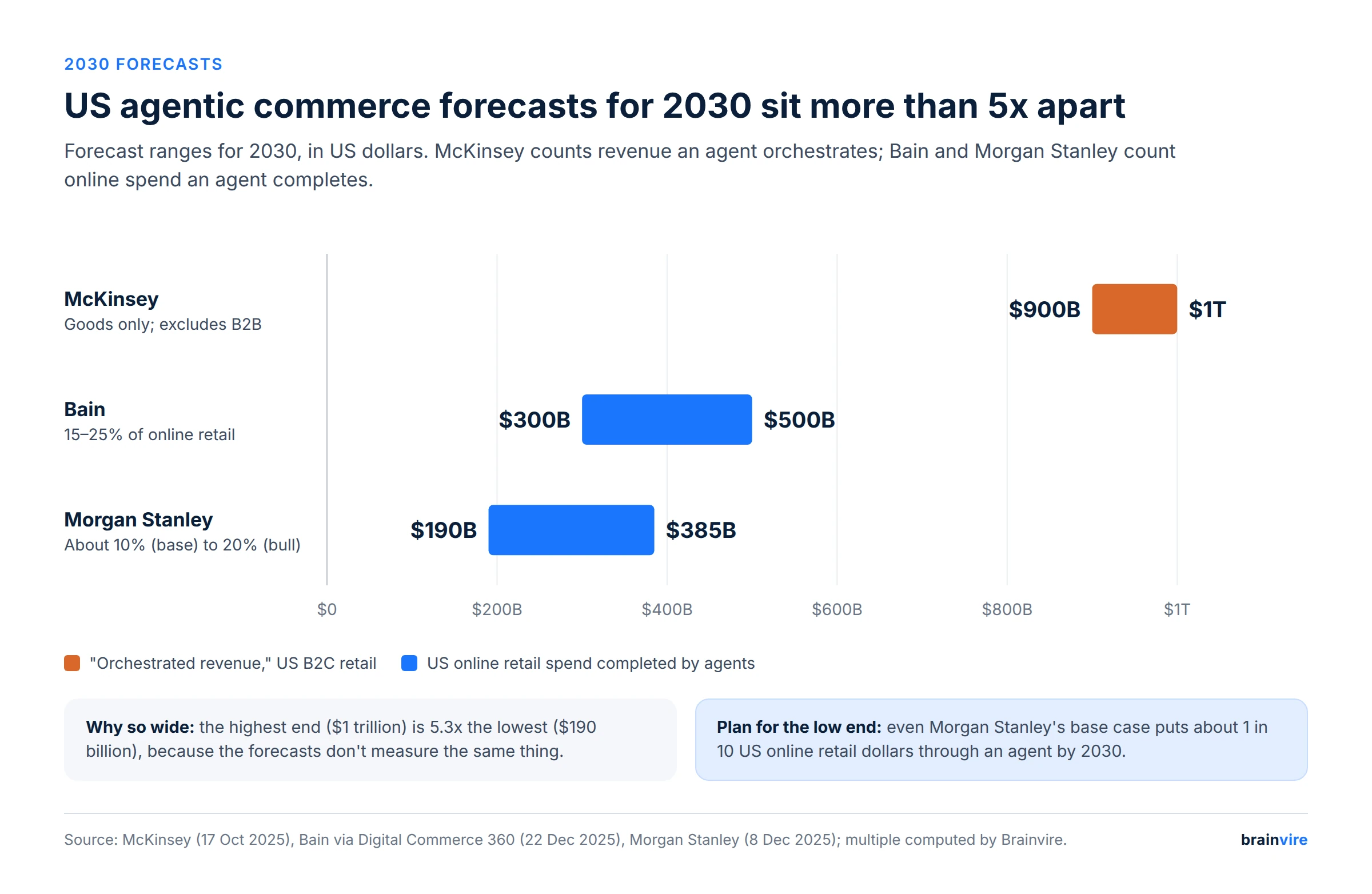
The spread is wide because McKinsey counts any revenue an agent orchestrates, while Bain and Morgan Stanley count online spend an agent completes. For planning, read the low end: even Morgan Stanley's base case puts about 1 in 10 US online retail dollars through an agent by 2030. Budget for the low end, and build so you can scale to the high one.
Trust hasn't caught up
Shoppers use AI to research. Far fewer want it to pay. A vendor survey by ACI Worldwide with YouGov asked 3,328 adults in the US and UK in June 2026. Of those, 53% said they were uncomfortable letting an AI assistant buy for them. Only 7% would allow autonomous purchases within preset conditions. Bain reaches the same conclusion: 30–45% of US consumers already use generative AI to research products, but most aren't comfortable handing over an end-to-end transaction.
This is the honest limit of the whole category. For the next 12–18 months, most agent-driven revenue will come from agents that find and compare, then hand the shopper to a checkout they recognize. The protocols matter because they decide whose checkout that is.
The agentic commerce stack in one picture
"UCP vs ACP" makes it sound as if one protocol does everything. In practice, an agent-led purchase passes through four layers, and different standards own each one.
- Discovery. The agent finds your products, prices and stock. This runs on product feeds (Google Merchant Center, OpenAI's product feed, Shopify Catalog) and, increasingly, on a small discovery file your site publishes so agents can see what you support.
- Checkout. The agent creates a cart, gets shipping options and totals, applies discounts and places the order. This is where UCP and ACP live.
- Payment authorization. The bank and the network need proof that a human approved this purchase within limits. Google's Agent Payments Protocol (AP2) does this with signed "mandates." Mastercard's Verifiable Intent, co-developed with Google, plays a similar role on the card rails.
- Agent identity. Your site needs to tell a legitimate shopping agent from a scraper or a fraud bot. Visa's Trusted Agent Protocol, Mastercard Agent Pay and American Express all adopted Cloudflare's Web Bot Auth in October 2025 for exactly this.
Underneath all four sits the Model Context Protocol (MCP). It isn't a competitor to UCP or ACP. It's one of the ways agents call them. UCP lists MCP as a supported transport, and ACP added an MCP binding in April 2026.
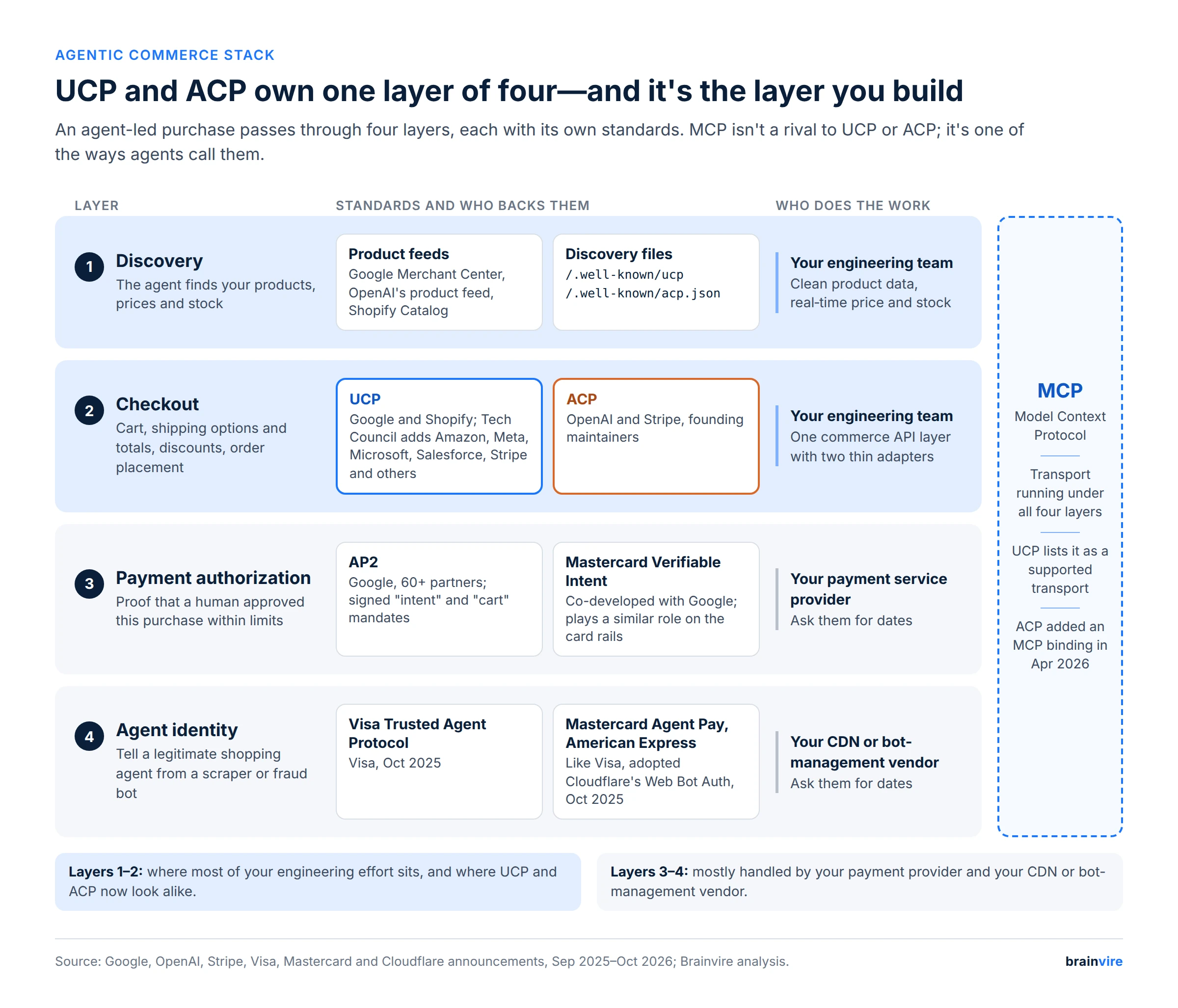
Why this matters for your roadmap: your engineering effort sits mostly in layers 1 and 2, and those are the layers where UCP and ACP now look alike. Layers 3 and 4 are mostly handled by your payment service provider and your CDN or bot-management vendor. Ask them for dates. (If your team needs the basics first, our agentic commerce primer covers them.)
UCP explained: Google's open checkout, now with a crowded council
Who built it and who governs it
Google announced the Universal Commerce Protocol at NRF on 11 January 2026. According to Google's developer blog, it was developed with Shopify, Etsy, Wayfair, Target and Walmart and endorsed by more than 20 partners. Named endorsers include Best Buy, Flipkart, Macy's, The Home Depot and Zalando on the retail side, and Adyen, American Express, Mastercard, Stripe and Visa on the payments side. The spec is open source under Apache 2.0, with the code on GitHub.
The governance changed on 24 April 2026. Amazon, Meta, Microsoft, Salesforce and Stripe joined the UCP Tech Council, alongside founding members Google, Shopify, Etsy, Target and Wayfair. The council sets technical direction and reviews proposals.
The implication: a protocol with Amazon, Microsoft and Stripe at the table is unlikely to be a Google-only channel for long. Assume UCP will show up on surfaces beyond Search and Gemini.
What it covers
UCP is built around capabilities that a merchant declares and an agent negotiates. Shopify's engineering write-up describes it this way: the merchant publishes what it supports, the agent publishes what it can handle, and both work with the overlap. The core pieces are:
- Discovery file. A profile at
/.well-known/ucptells agents which capabilities and payment handlers your store supports. - Checkout. Sessions with line items, totals, tax and status. A checkout can move to
requires_escalation, which hands the buyer to your own page when something needs a human—an age check, a custom option, a payment the agent can't take. - Identity linking. OAuth 2.0 account linking, so a logged-in shopper keeps member pricing or free shipping.
- Orders. Webhooks for shipped, delivered and returned.
- Payments. "Payment instruments" (what the shopper pays with) are separate from "payment handlers" (who processes it). Google Pay and Shop Pay are handlers; any processor can publish its own.
The first version was dated 2026-01-11. In March, Google added multi-item carts, a live catalog capability and identity linking for loyalty. Release v2026-04-08 followed on 9 April. A third-party tracker, UCP Checker, reports a later v2026-08-25 release; we haven't confirmed it on the official repository.
How Google runs it today
Google is UCP's biggest live implementation. Based on Google's Universal Cart announcement and PPC Land's reconstruction of the rollout (15 Oct 2026):
- 5 May: UCP checkout moved from AI Mode into standard Search results.
- 18 September: native checkout rollout began, with eligible Shopify merchants switched on by default.
- 6 October: the Merchant Center UCP hub started rolling out. Merchants choose cart transfer to their own site, native checkout on Google, identity linking, or a mix.
- 15 October: Universal Cart went live in US Search and the Gemini app, built on Google's Shopping Graph of more than 60 billion listings. Shoppers either pay with Google Pay or send the cart to the merchant's site.
Google's UCP FAQ sets three terms worth noting. You stay merchant of record and own the transaction data. Your payment provider must accept Google Pay tokens. And choosing native checkout doesn't change how offers are ranked. The FAQ says nothing about fees.
Onboarding isn't self-serve yet. You implement the spec, submit an interest form, wait for selection, then validate in a sandbox. Native checkout is US-only today. Google has signaled Canada, Australia and the UK next, but published timings conflict, so treat them as unconfirmed.
Shopify's default is "on"
Eligible US Shopify merchants were enrolled in Google's native checkout automatically in September, with an opt-out under Sales channels > Agentic. Shopify laid the groundwork in January, when it launched Agentic Storefronts. Merchants set up product data once in Shopify Admin, and it appears in ChatGPT, Microsoft Copilot, Google AI Mode and Gemini.
That default matters more than any spec detail. If you run Shopify Plus in the US, you may already sell through UCP. Check your admin before you scope a project.
ACP explained: OpenAI's checkout that learned to be humble
Instant Checkout and the 4% fee
OpenAI and Stripe launched the Agentic Commerce Protocol on 29 September 2025, together with Instant Checkout in ChatGPT. At launch, US ChatGPT users could buy single items from US Etsy sellers, with Shopify merchants "coming soon." OpenAI's terms were clear on three points. The merchant stays merchant of record. Merchants "pay a small fee on completed purchases." And the fee doesn't affect ranking.
The fee turned out to be 4%. Shopify confirmed it in January 2026, according to The Information. Shopifreaks puts the all-in cost near 7% once Shopify's payment processing is added. That's the only agent-checkout fee anyone has disclosed so far, which is why it dominates competitor comparisons.
The protocol itself is open source and jointly governed by OpenAI and Stripe as founding maintainers, with a stated aim of moving to neutral stewardship. PayPal announced in October 2025 that it would support ACP to bring PayPal into ChatGPT in 2026.
The March 2026 pivot—what went wrong
On 24 March 2026, OpenAI changed course. It said the first version of Instant Checkout "did not offer the level of flexibility that we aspire to provide." ChatGPT would focus on discovery and comparison. Merchants could use their own checkout or build a ChatGPT app for a native experience (Digital Commerce 360; TechCrunch). Target, Sephora, Nordstrom, Lowe's, Best Buy, The Home Depot and Wayfair were already integrated with ACP for discovery.
Walmart's experience is the data point everyone quotes. MarTech reported, drawing on WIRED, that purchases completed inside ChatGPT converted at roughly one-third the rate of click-outs to Walmart's own site. That ratio is the reporter's characterization, not a Walmart figure. Walmart's Daniel Danker called the in-chat experience "unsatisfying." Retailers told Modern Retail what was missing: real-time inventory, coupons, loyalty, customer data and store pickup.
The lesson isn't that agent checkout failed. It's that a checkout without your promotions, loyalty and fulfillment options is a worse checkout, and shoppers notice.
What the April 2026 release added
Three weeks later, ACP shipped the release that answers most of those complaints. The 2026-04-17 changelog adds:
- Cart API. Single-seller baskets built before checkout.
- Feed API. Merchants push catalog data to the agent platform as JSONL files or partial updates.
- Discovery file. A public
/.well-known/acp.json, which mirrors UCP's approach. - Native orders. Fulfillment events and "adjustments" that cover refunds, returns, disputes and chargebacks.
- Delegated authentication. Agents can run 3-D Secure 2 flows with your chosen provider.
- MCP binding. Five checkout tools that map one-to-one to the REST endpoints.
- Seller-backed payments. Saved cards, gift cards, points and store credit that resolve on your backend.
- Decimal quantities. Explicitly "for B2B use cases such as weight-based items."
It also made idempotency keys mandatory on every POST request and formalized signed webhooks. Those are small details with a big effect: they're what lets an order system trust an agent's retries.
ChatGPT apps vs your own checkout
ChatGPT now offers three ways in. A product feed sends shoppers to your site. A ChatGPT app carries your own login, loyalty and checkout, as Walmart's does. Or a platform runs ACP checkout for you. Most enterprise merchants should start with the feed. An app pays off only if you already have strong account-based buying.
Head-to-head: the two specs have converged
Where they now look the same
Put the two current releases side by side and the overlap is hard to miss. Both have a discovery file under /.well-known/. Both have carts, checkout sessions, discounts, fulfillment options, order webhooks and account linking. Both separate the payment method from the processor. Both keep the merchant as merchant of record. Both run over REST and MCP.
The infrastructure players have noticed. Visa's Intelligent Commerce Connect, announced on 8 April 2026, gives merchants one integration for agent payments. It supports the Trusted Agent Protocol, the Machine Payments Protocol, ACP and UCP. Stripe co-maintains ACP, sits on UCP's Tech Council and announced at Sessions 2026 that its merchants will be able to sell in AI Mode and Gemini through UCP. When the payment networks and a major processor support both, a merchant has little reason to pick one.
Where they still differ
Three differences survive, and none of them is technical:
- Surface. UCP's live checkout is Google's: AI Mode, standard Search, Gemini and Universal Cart. ACP's live surface is ChatGPT, now mostly for discovery. Microsoft Copilot Checkout and other surfaces come through platforms such as Shopify rather than through a protocol choice you make.
- Fee. OpenAI's 4% on Instant Checkout is the only disclosed agent fee. Google's terms are silent. "Undisclosed" isn't the same as "free," and you should ask before you assume.
- Payments. Google's native checkout requires a processor that accepts Google Pay tokens. ACP's default path runs through Stripe's Shared Payment Tokens, with a delegated-payment spec for other processors.
Is this really a standards war?
Not anymore. It was a reasonable worry in January. In October, UCP's council includes Amazon, Meta and Microsoft, the two specs share their core design, and Visa and Stripe sit on both sides. The likelier future is one protocol becoming dominant per surface, with adapters translating between them, much as payment gateways translate between card schemes today.
The practical answer is to build once. Put a commerce API layer in front of your platform that exposes catalog, price, stock, cart, checkout, order and returns events cleanly. Then add a thin UCP adapter and a thin ACP adapter on top. The adapters are the small part. The layer underneath is where your real effort goes, and it serves your own apps and marketplaces too.
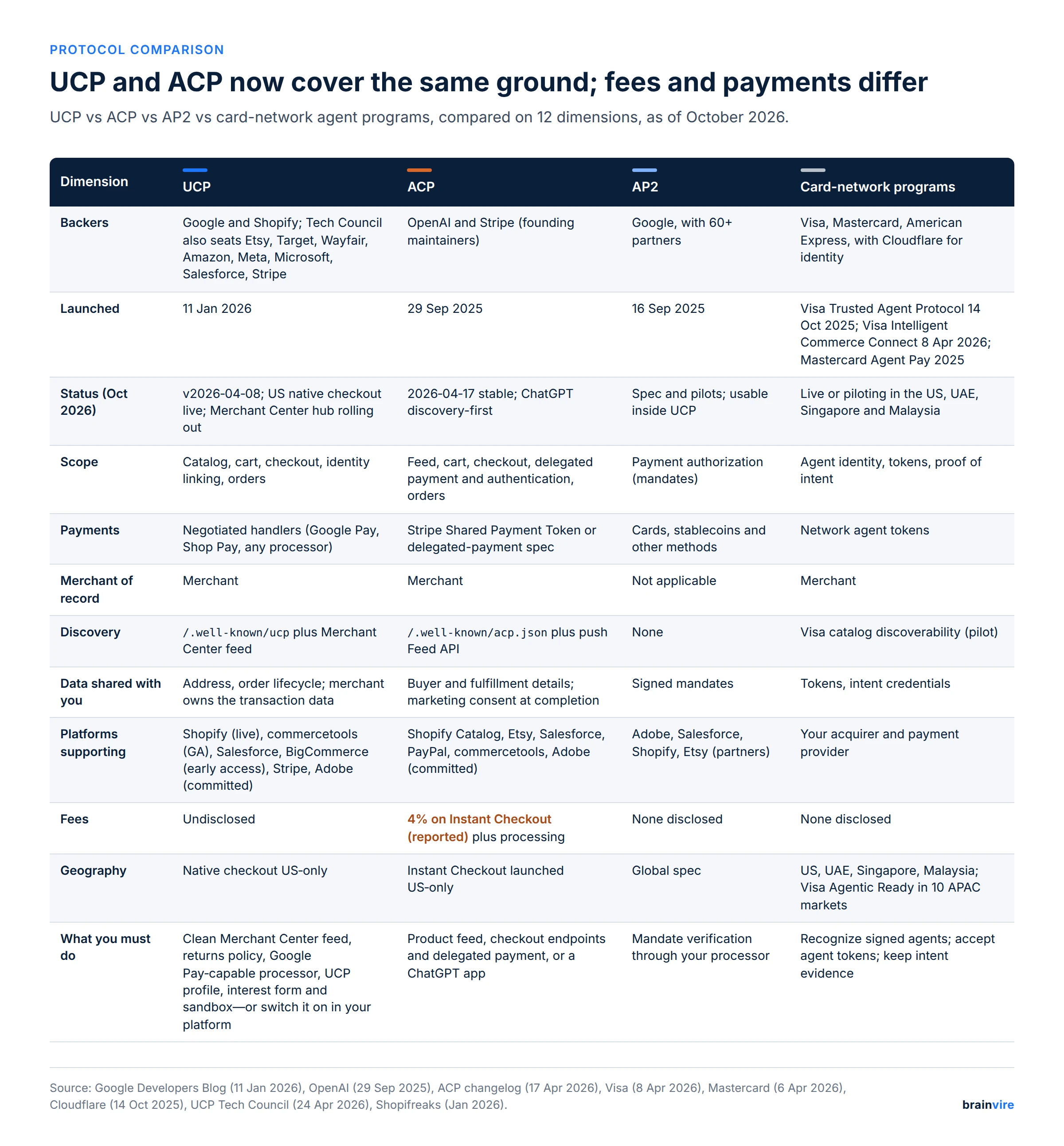
| Dimension | UCP | ACP | AP2 | Card-network programs |
|---|---|---|---|---|
| Backers | Google and Shopify; Tech Council also seats Etsy, Target, Wayfair, Amazon, Meta, Microsoft, Salesforce, Stripe | OpenAI and Stripe (founding maintainers) | Google, with 60+ partners | Visa, Mastercard, American Express, with Cloudflare for identity |
| Launched | 11 Jan 2026 | 29 Sep 2025 | 16 Sep 2025 | Visa Trusted Agent Protocol 14 Oct 2025; Visa Intelligent Commerce Connect 8 Apr 2026; Mastercard Agent Pay 2025 |
| Status (Oct 2026) | v2026-04-08; US native checkout live; Merchant Center hub rolling out | 2026-04-17 stable; ChatGPT discovery-first | Spec and pilots; usable inside UCP | Live or piloting in the US, UAE, Singapore and Malaysia |
| Scope | Catalog, cart, checkout, identity linking, orders | Feed, cart, checkout, delegated payment and authentication, orders | Payment authorization (mandates) | Agent identity, tokens, proof of intent |
| Payments | Negotiated handlers (Google Pay, Shop Pay, any processor) | Stripe Shared Payment Token or delegated-payment spec | Cards, stablecoins and other methods | Network agent tokens |
| Merchant of record | Merchant | Merchant | Not applicable | Merchant |
| Discovery | /.well-known/ucp plus Merchant Center feed |
/.well-known/acp.json plus push Feed API |
None | Visa catalog discoverability (pilot) |
| Data shared with you | Address, order lifecycle; merchant owns the transaction data | Buyer and fulfillment details; marketing consent at completion | Signed mandates | Tokens, intent credentials |
| Platforms supporting | Shopify (live), commercetools (GA), Salesforce, BigCommerce (early access), Stripe, Adobe (committed) | Shopify Catalog, Etsy, Salesforce, PayPal, commercetools, Adobe (committed) | Adobe, Salesforce, Shopify, Etsy (partners) | Your acquirer and payment provider |
| Fees | Undisclosed | 4% on Instant Checkout (reported) plus processing | None disclosed | None disclosed |
| Geography | Native checkout US-only | Instant Checkout launched US-only | Global spec | US, UAE, Singapore, Malaysia; Visa Agentic Ready in 10 APAC markets |
| What you must do | Clean Merchant Center feed, returns policy, Google Pay-capable processor, UCP profile, interest form and sandbox—or switch it on in your platform | Product feed, checkout endpoints and delegated payment, or a ChatGPT app | Mandate verification through your processor | Recognize signed agents; accept agent tokens; keep intent evidence |
The other rails you'll meet
UCP and ACP are the checkout layer. You'll meet these programs in vendor pitches and board questions, so here's one line each:
- Google AP2 (16 September 2025). Signed "intent" and "cart" mandates prove what the shopper approved, with 60+ partners including Mastercard, PayPal, American Express, Salesforce and Shopify. Google's UCP FAQ says AP2 can act as a payment layer within UCP.
- Visa. The Trusted Agent Protocol (October 2025) lets merchants verify an agent's identity; Intelligent Commerce Connect (April 2026) adds one-integration acceptance across protocols.
- Mastercard Agent Pay. Registered agents pay with network tokens. Mastercard targeted all US cardholders by the 2025 holiday season, with Verifiable Intent added in 2026.
- American Express. A developer kit and Agent Purchase Protection for cardholders, both launched in April 2026.
- Microsoft Copilot Checkout (January 2026). In-chat buying in the US, with PayPal, Shopify, Stripe and Etsy as partners; Shopify merchants are auto-enrolled after an opt-out window.
- Stripe (April 2026). An Agentic Commerce Suite, the Machine Payments Protocol and an agent wallet in Link.
- Amazon. Alexa for Shopping replaced Rufus in May 2026, with "Buy for Me" purchases on other sites. Amazon also won a preliminary injunction on 9 March 2026 blocking Perplexity's Comet agent from shopping logged-in Amazon accounts. The judge found it acted "with the Amazon user's permission, but without authorization by Amazon."
- Personal Agent Protocol (October 2026). Sierra and Meta, with Shopify, Stripe and Walmart, are publishing an OAuth-based standard for how personal agents sign in to businesses. A v0.1 spec is due this month.
Brief your legal team on the Amazon case. It's an early ruling that separates a shopper's permission from a merchant's authorization. If you want agents on your site, publish the terms they must follow. If you don't, publish that too, and enforce it with agent identity checks rather than blanket bot blocking.
Platform readiness: what your stack gives you, and what it doesn't
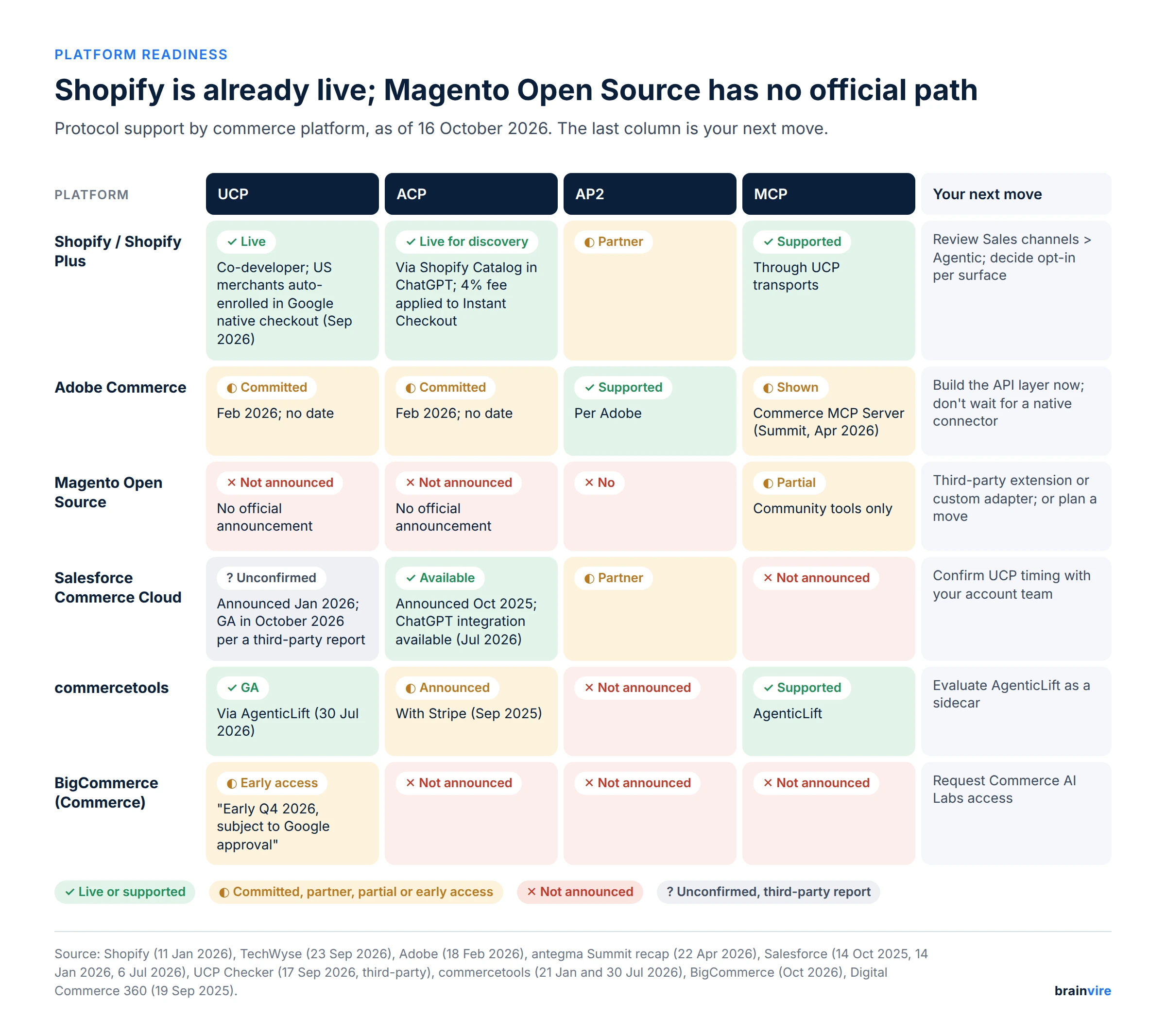
This is the section that decides your budget. The protocol spec is the same for everyone. What differs is how much of it your commerce platform already implements.
| Platform | UCP | ACP | AP2 | MCP | Your next move |
|---|---|---|---|---|---|
| Shopify / Shopify Plus | Live; co-developer; US merchants auto-enrolled in Google native checkout (Sep 2026) | Live for discovery via Shopify Catalog in ChatGPT; 4% fee applied to Instant Checkout | Partner | Supported through UCP transports | Review Sales channels > Agentic; decide opt-in per surface |
| Adobe Commerce | Committed (Feb 2026); no date | Committed (Feb 2026); no date | Supported, per Adobe | Commerce MCP Server (Summit, Apr 2026) | Build the API layer now; don't wait for a native connector |
| Magento Open Source | No official announcement | No official announcement | No | Community tools only | Third-party extension or custom adapter; or plan a move |
| Salesforce Commerce Cloud | Announced Jan 2026; GA in October 2026 per a third-party report | Announced Oct 2025; ChatGPT integration available (Jul 2026) | Partner | Not announced | Confirm UCP timing with your account team |
| commercetools | GA via AgenticLift (30 Jul 2026) | Announced with Stripe (Sep 2025) | Not announced | Supported (AgenticLift) | Evaluate AgenticLift as a sidecar |
| BigCommerce (Commerce) | Early access, "early Q4 2026, subject to Google approval" | Not announced | Not announced | Not announced | Request Commerce AI Labs access |
Shopify Plus: you're probably already in
Shopify co-wrote UCP, routes its catalog into ChatGPT, Copilot, AI Mode and Gemini, and switched eligible US merchants into Google's native checkout by default. Your job is governance, not integration. Decide which surfaces may complete checkout and which should send shoppers to your store. Check what each surface does with your discounts and loyalty pricing.
Adobe Commerce and Magento Open Source: committed, not shipped
Adobe committed Adobe Commerce to both UCP and ACP on 18 February 2026, building on earlier AP2 support. It promised machine-readable catalogs, pricing and inventory for surfaces like Gemini and ChatGPT, with "additional capabilities planned throughout the year." It named no dates and no editions. At Adobe Summit in April, Adobe showed a Commerce MCP Server for catalog, cart, pricing, checkout and orders, alongside Brand Concierge for on-site conversational shopping.
Here's the candid view. If you run Adobe Commerce, the protocol adapters will likely arrive, but your catalog quality, real-time stock and order events are yours to fix today. Those are exactly what a UCP or ACP adapter will call. Magento Open Source has no official roadmap here. Your options are a third-party extension, a custom adapter on top of the REST or GraphQL API, or using agent readiness as one input into a replatforming decision.
Salesforce Commerce Cloud: both protocols announced, one live
Salesforce took both sides early. It announced ACP support with OpenAI in October 2025 and native UCP support in January 2026. Its July 2026 release made Shopper, Buyer and Merchant agents generally available and listed ChatGPT and Google Search integrations as available now. UCP Checker, a third-party crawler, reports that Salesforce set UCP general availability for October 2026. It found no Commerce Cloud storefronts publishing a UCP profile in mid-September. Ask your account team for a date in writing.
BigCommerce and commercetools: two different bets
commercetools launched AgenticLift in January and made it generally available on 30 July 2026. It runs as a "stack-agnostic sidecar" with UCP-based checkout, so it can sit beside a platform you don't plan to replace. BigCommerce, now trading as Commerce, offers Agentic Checkout with Google UCP in early access, "early Q4 2026, subject to Google approval," with Feedonomics handling catalog exports.
Headless, custom and ERP-led commerce
If your storefront is headless or your order logic lives in an ERP such as Odoo, no vendor will ship this for you. That's less bad than it sounds: a headless stack usually has the API layer already. You add the discovery file, the two adapters, signed webhooks and idempotent order creation. The hard part is making sure price, stock and promotions come from one source of truth, so the agent and your website never quote different numbers.
Economics and risk: the questions your CFO and risk team will ask
What each route costs
Only one price is public. OpenAI's reported 4% on Instant Checkout means $40,000 on every $1 million of agent-completed sales, before payment processing. Shopifreaks estimates the total near 7% for Shopify merchants (Shopifreaks, Jan 2026). Google hasn't published UCP checkout terms, and its FAQ doesn't mention fees. Several articles that rank for "UCP vs ACP" quote a 3.2% total for UCP. None of them gives a source, and you shouldn't put that number in a business case.
Compare the fee with what you already pay to acquire an order through marketplaces, affiliates or paid search. A 4% fee on a first order from a new customer can be cheap. On a repeat customer who would have come direct, it's a tax. That's why the checkout decision matters more than the protocol decision.
Chargebacks: who's liable when an agent gets it wrong
The short answer is that nobody knows yet for the hardest case. Worldpay's head of agentic commerce wrote in July 2026 that "no liability shift exists yet." If an agent authenticates properly and the token is issued correctly, existing rules for tokenized transactions apply. The issuer carries fraud risk, and the cardholder keeps chargeback rights. But disputes where the agent bought the wrong item are still being negotiated among issuers, acquirers, agent platforms and merchants. US Regulation E assumes a payment was either authorized or not; it has no category for an agent that misread an instruction.
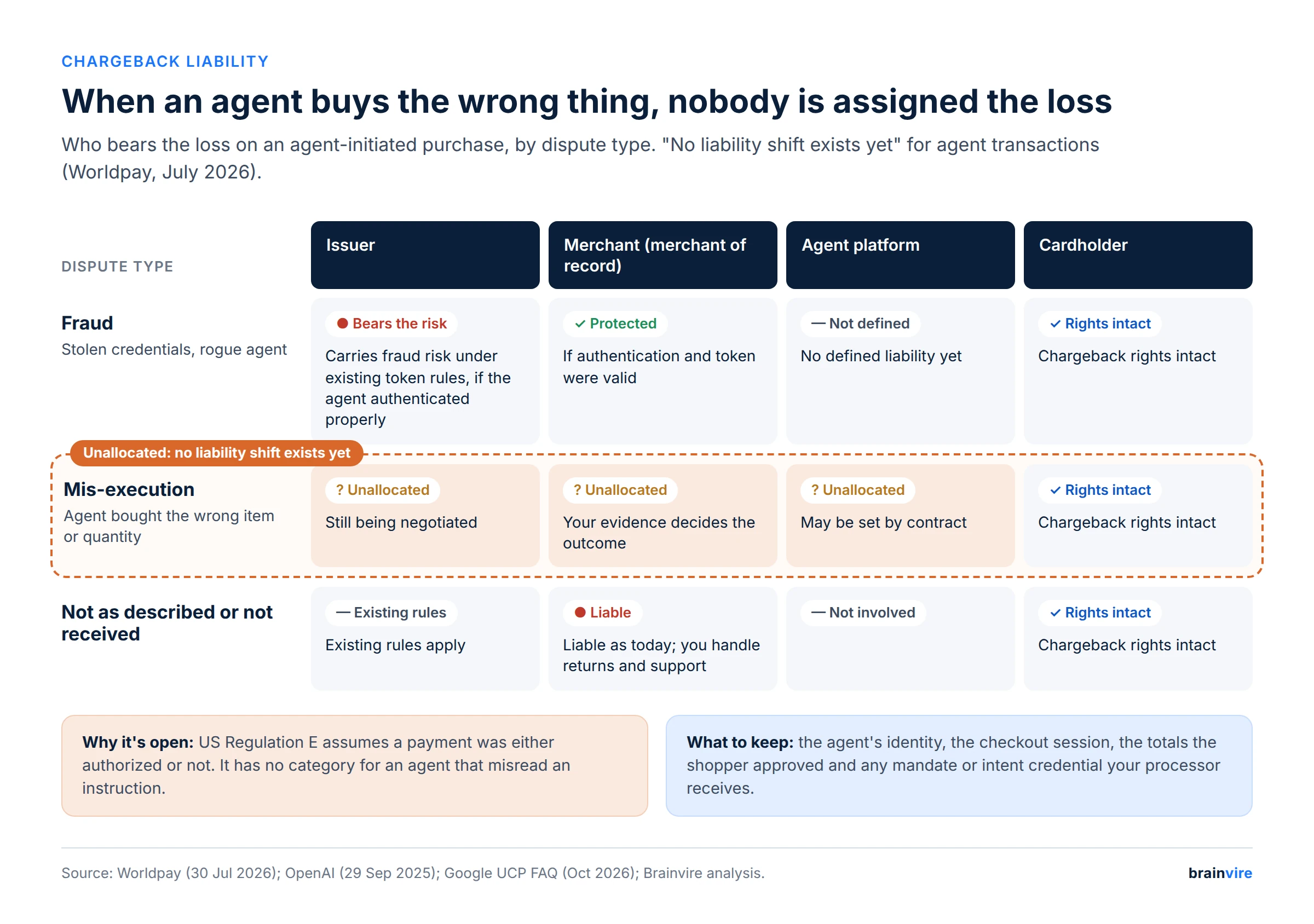
| Dispute type | Issuer | Merchant (merchant of record) | Agent platform | Cardholder |
|---|---|---|---|---|
| Fraud (stolen credentials, rogue agent) | Carries fraud risk under existing token rules, if the agent authenticated properly | Protected if authentication and token were valid | No defined liability yet | Chargeback rights intact |
| Mis-execution (agent bought the wrong item or quantity) | Unallocated | Unallocated; your evidence decides the outcome | Unallocated; may be set by contract | Chargeback rights intact |
| Not as described / not received | Existing rules | Liable as today; you handle returns and support | Not involved | Chargeback rights intact |
What this means for you: keep evidence. Store the agent's identity, the checkout session, the totals the shopper approved and any mandate or intent credential your processor receives. Industry rules are moving. EMVCo has an agentic payments framework in draft, and its feedback window closed on 30 September 2026, according to a chargeback vendor's regulatory summary. Until those rules are final, your evidence file is your best protection in a "my agent went rogue" dispute.
Data, merchant of record and brand risk
Every protocol here keeps you as merchant of record. That doesn't guarantee you keep the relationship. On Google's native checkout you receive the order and address, and Google keeps its own order history for the shopper. ACP's April release added a way to capture marketing consent at checkout, which tells you the first version didn't. Before you switch on any agent checkout, confirm three things: you receive the shopper's email, your loyalty ID travels with the order, and your returns policy displays as written.
Regulation to watch
- EU. The PSD3 and Payment Services Regulation deal of 27 November 2025 adds risk-based authentication and new fraud-refund duties for payment providers, with entry into force expected in 2027. It has nothing specific to agents. The AI Act's transparency duties for systems that interact with people (Article 50) have applied since 2 August 2026, as the same vendor summary notes; the 2026 AI Omnibus delayed the high-risk rules, not these.
- US. No federal rule addresses agent purchases. Regulation E and Regulation Z dispute rights apply as written.
- Access law. The Amazon v. Perplexity injunction under the US Computer Fraud and Abuse Act makes your site's terms for agents a legal instrument, not just a policy page.
B2B and regional realities
B2B is the bigger prize
The largest number in this field isn't a consumer one. At its IT Symposium/Xpo in October 2025, Gartner said AI agents will "intermediate more than $15 trillion in B2B spending by 2028." Definitions differ, but that's several times larger than any 2030 consumer forecast in Exhibit 1. B2B sellers should read it as a direct signal: the buyer's agent will reach your catalog before your sales rep does.
But B2B buying isn't one shopper with a card. Forrester's State of Business Buying 2026 counts 13 internal stakeholders and 9 external influencers in a typical purchase, with procurement involved in 53% of buying cycles. Neither protocol yet models contract pricing, purchase-order numbers, approval chains, credit terms or company accounts. ACP's decimal quantities "for B2B use cases" are the first sign of movement. Salesforce's Buyer Agent, which serves B2B buyers over WhatsApp and SMS, is another.
So the near-term B2B opportunity is less about public checkout protocols and more about agents on your side of the counter. At Brainvire, we built an agentic purchase-order pipeline into Adobe Commerce for American Lighting. It reads purchase orders arriving as PDF, Excel or plain text and turns them into orders in 20–30 seconds on average. Throughput rose from about 250 to 400–1,000 purchase orders a day. When buyers' agents start sending structured orders, the same pipeline is the one that receives them.
The GCC: payment rails first
No agent checkout surface sells natively in the GCC yet. Google's native checkout and ChatGPT's Instant Checkout both launched US-only. The payment rails, though, are already here. Mastercard completed its first Agent Pay transaction outside the US in the UAE in December 2025, with Majid Al Futtaim and fintech Dataiera. Abu Dhabi's Aldar is a pilot partner for Visa Intelligent Commerce Connect.
For a UAE or Saudi retailer, this sets the order of work. Make your catalog agent-readable for the global surfaces that already crawl it. Ask your acquirer when it will accept agent tokens. Make sure your bot management recognizes signed agents rather than blocking them.
Southeast Asia: the issuers are ready
Southeast Asia is further along on payments than most Western coverage suggests. Mastercard's authenticated agentic transactions went live in Singapore and Malaysia in April 2026, after region-wide testing with UOB. Visa's Agentic Ready program enrolled 54 issuers across 10 Asia-Pacific markets, including DBS, Maybank, UOB, HSBC and Standard Chartered. When Google or OpenAI open checkout in the region, the issuer side won't be the bottleneck. Your catalog and your checkout API will be.
Decision framework: four positions, not two protocols
Most enterprises will land in one of four positions. Your platform, your markets and whether you sell B2B decide which one.
- Discovery-only. Supply clean feeds to Google, ChatGPT and Copilot, and send every shopper to your own checkout. This is the right position outside the US today, and for US brands whose promotions, bundles or loyalty pricing don't yet survive an agent checkout.
- UCP-first. Turn on Google's native checkout or cart transfer through your platform. This suits US merchants on Shopify Plus, commercetools, BigCommerce or Salesforce Commerce Cloud for whom Google Shopping is already a major channel.
- Dual. Run UCP and ACP adapters on one commerce API layer. This suits US enterprises with several brands, real ChatGPT referral volume and an engineering team that owns its APIs.
- Wait and fix data. Pause checkout integration and fix product data, stock accuracy and order events first. This is the honest answer for most Magento Open Source stores, catalogs with low machine-readability, and B2B sellers whose prices depend on the customer.

Whichever position you choose, start with the product page. Adobe scored retail product pages at 66% machine-readable, the lowest of any page type it measured. An agent that can't read your size chart or delivery promise won't recommend you, whatever protocol you support.
What we would do
Days 1–30: decide and inventory.
- Pick your position from the four above for each brand and region, and write down why.
- Audit what your platform already does. On Shopify, check Sales channels > Agentic. On Salesforce, BigCommerce or Adobe, get dates in writing.
- Measure catalog readiness on your top 100 SKUs: titles, attributes, GTINs, live price and stock, returns policy and shipping promises.
- Ask your payment provider three questions: Can you accept Google Pay tokens? Do you support Stripe Shared Payment Tokens or ACP delegated payment? When will you accept network agent tokens?
Days 31–60: build the layer.
- Expose catalog, price, stock, cart, checkout, order and returns events through one internal commerce API.
- Make order creation idempotent and webhooks signed. Both protocols now expect it.
- Publish an agent access policy, and configure bot management to recognize signed agents (Web Bot Auth) instead of blocking all automation.
- Set up a dispute evidence store that logs agent identity, the checkout session and the approved totals.
Days 61–90: connect and measure.
- Add the UCP adapter, the ACP adapter, or both, and publish the
/.well-known/discovery files. - Go live on one surface with a limited set of SKUs. Track conversion, average order value, returns and disputes separately from web orders.
- Review the fee against your acquisition cost per order. Expand only where the numbers hold.
The plan assumes a team that owns its commerce APIs. If your order logic lives inside a monolith, expect the middle phase to take longer. And if your product data is weak, start there: no adapter can fix that.
Frequently asked questions
Do we need to pick one protocol?
No. Since the April 2026 releases, UCP and ACP share their core design: discovery files, carts, checkout sessions, orders and separate payment handlers. Visa and Stripe support both. Pick your AI surfaces and checkout model instead, then build one internal commerce API with a thin adapter per protocol. The adapters are small. The data and order plumbing underneath is the real work.
Will Google charge a fee for UCP checkout?
Google hasn't said. Its UCP FAQ doesn't mention merchant fees, and coverage of Universal Cart notes that Google hasn't disclosed fees or ranking rules. The only disclosed agent-checkout fee is OpenAI's reported 4% on Instant Checkout. Ask your Google account team directly, and don't base a business case on the unsourced "3.2%" figures circulating online.
We're on Magento Open Source. What now?
There's no official UCP or ACP support for Open Source. Adobe's commitment covers Adobe Commerce, with no dates. Your options are a third-party extension, a custom adapter on the REST or GraphQL API, or making agent readiness one input into a platform review. Whichever you choose, fix catalog data and real-time stock first.
Who's liable if an agent orders the wrong item?
For now, nobody has decided. Worldpay noted in July 2026 that no liability shift exists for agent transactions. Fraud follows existing token rules, but "the agent bought the wrong thing" disputes are still being negotiated among issuers, acquirers, agent platforms and merchants. As merchant of record, you'll handle the return. Store the agent's identity, the session and the totals the shopper approved, so you can contest a weak claim.
Does any of this work outside the US yet?
Not for native checkout. Google's UCP checkout and ChatGPT's Instant Checkout are US-only, and timing for Canada, Australia and the UK is unconfirmed. Discovery isn't limited the same way: AI assistants can already find and cite your products wherever they crawl. The payment rails are also live in places. Mastercard Agent Pay ran in the UAE in December 2025 and in Singapore and Malaysia from April 2026, and Visa has 54 Asia-Pacific issuers in its Agentic Ready program.
One commerce layer, every checkout
The title promised two checkouts. In practice there will be more: Google's, OpenAI's, Microsoft's, Amazon's and whichever agent your customers adopt next year. You can't integrate each one by hand, and you won't need to. The protocols have converged enough that one well-built commerce layer, with clean data and honest order events, can serve all of them.
That layer is the work we do. Brainvire builds AI into the commerce and ERP systems enterprises already run: Adobe Commerce, Shopify Plus, Salesforce Commerce Cloud and Odoo. Our teams work across North America, the GCC, the UK, India and Asia-Pacific. In a working session, we'll map each of your brands to one of the four positions and size the commerce layer it needs.
The protocol war was over before it started. The catalog race isn't.
What changed since publication
- 16 October 2026: first published.
About this paper: Facts are as of 16 October 2026. We used primary sources first—protocol specifications, company announcements and regulatory texts—and labeled vendor-run surveys and third-party reports where we relied on them. Where sources conflict, we say so.
Sources
- Google Developers Blog, "Under the hood: Universal Commerce Protocol (UCP)," 11 January 2026. https://developers.googleblog.com/under-the-hood-universal-commerce-protocol-ucp/
- Shopify Engineering (Ilya Grigorik), "UCP," 11 January 2026. https://shopify.engineering/UCP
- Shopify News, "AI commerce at scale," 11 January 2026. https://www.shopify.com/news/ai-commerce-at-scale
- Universal Commerce Protocol, GitHub repository and releases (v2026-04-08, 9 April 2026). https://github.com/universal-commerce-protocol/ucp
- Newsfile, "Amazon, Meta, Microsoft, Salesforce, and Stripe join the Universal Commerce Protocol Tech Council," 24 April 2026. https://www.newsfilecorp.com/release/294133/
- Retail TouchPoints, "Google adds new agentic shopping features as OpenAI pivots, Amazon enters the mix," 20 March 2026. https://www.retailtouchpoints.com/news/google-adds-new-agentic-shopping-features-as-openai-pivots-amazon-enters-the-mix/
- Google, "Universal Cart" launch announcement, 15 October 2026. https://blog.google/products-and-platforms/products/shopping/universal-cart-launch/
- PPC Land, "Google's Universal Cart reaches US Search and Gemini, but not YouTube," 15 October 2026. https://ppc.land/googles-universal-cart-reaches-us-search-and-gemini-but-not-youtube
- Google for Developers, "UCP frequently asked questions," accessed 16 October 2026. https://developers.google.com/merchant/ucp/faq
- ALM Corp, "Google rolls out its UCP hub for US merchants," 9 October 2026. https://almcorp.com/news/google-rolls-out-ucp-hub-us-merchants/
- TechWyse, "Google enrolls eligible Shopify merchants in native AI checkout across AI Mode and Gemini," 23 September 2026. https://www.techwyse.com/news/ai-search/google-native-ai-checkout-shopify-merchants-ucp
- UCP Checker (third-party), "Salesforce's UCP date: what its storefronts declare now," 17 September 2026. https://ucpchecker.com/blog/salesforce-commerce-cloud-ucp-october
- OpenAI, "Buy it in ChatGPT: Instant Checkout and the Agentic Commerce Protocol," 29 September 2025. https://openai.com/index/buy-it-in-chatgpt/
- Shopifreaks, "Shopify confirms a 4% fee on sales made through ChatGPT, but what's the real cost?," 26–27 January 2026 (citing The Information). https://www.shopifreaks.com/shopify-confirms-a-4-fee-on-sales-made-through-chatgpt-but-whats-the-real-cost/
- Agentic Commerce Protocol, GitHub repository and governance. https://github.com/agentic-commerce-protocol/agentic-commerce-protocol
- Agentic Commerce Protocol, changelog for release 2026-04-17, 17 April 2026. https://github.com/agentic-commerce-protocol/agentic-commerce-protocol/blob/main/changelog/2026-04-17.md
- PayPal Newsroom, "OpenAI and PayPal team up to power Instant Checkout and agentic commerce in ChatGPT," 28 October 2025. https://newsroom.paypal-corp.com/2025-10-28-OpenAI-and-PayPal-Team-Up-to-Power-Instant-Checkout-and-Agentic-Commerce-in-ChatGPT
- Digital Commerce 360, "OpenAI reveals updates to its agentic commerce experience for ChatGPT," 24 March 2026. https://www.digitalcommerce360.com/2026/03/24/openai-agentic-commerce-updates-chatgpt-walmart/
- TechCrunch, "OpenAI's plans to make ChatGPT more like Amazon aren't going so well," 24 March 2026. https://techcrunch.com/2026/03/24/openais-plans-to-make-chatgpt-more-like-amazon-arent-going-so-well
- MarTech, "Walmart says ChatGPT checkout converted 3x worse than its own website," 20 March 2026 (citing WIRED). https://martech.org/walmart-says-chatgpt-checkout-converted-3x-worse-than-its-own-website/
- Modern Retail, "What went wrong with ChatGPT's Instant Checkout," 27 March 2026. https://www.modernretail.co/technology/what-went-wrong-with-chatgpts-instant-checkout/
- Digital Commerce 360, "Google's AI payments protocol AP2," 19 September 2025. https://www.digitalcommerce360.com/2025/09/19/google-ai-payments-protocol-ap2/
- Cloudflare, "Cloudflare collaborates with leading payments companies to secure and enable agentic commerce," 14 October 2025. https://www.cloudflare.com/press/press-releases/2025/cloudflare-collaborates-with-leading-payments-companies-to-secure-and-enable-agentic-commerce/
- Visa, "Visa opens the door to AI-driven shopping for businesses worldwide" (Intelligent Commerce Connect), 8 April 2026. https://usa.visa.com/about-visa/newsroom/press-releases.releaseId.22276.html
- Visa via Kyodo News PR Wire, "Visa launches 'Agentic Ready' program in Asia Pacific with over 50 partners," 30 April 2026. https://kyodonewsprwire.jp/release/202604308373
- Mastercard, "Mastercard powering ASEAN's AI ambitions in the future of payments," 6 April 2026. https://www.mastercard.com/news/ap/en/newsroom/press-releases/en/2026/mastercard-powering-asean-s-ai-ambitions-in-the-future-of-payments/
- CDO Magazine, "Mastercard launches Agent Pay in the UAE, completing its first transaction outside the US," 2 December 2025. https://www.cdomagazine.tech/aiml/mastercard-launches-agent-pay-in-the-uae-completing-its-first-transaction-outside-the-us
- PaymentsJournal, "Mastercard upgrades agentic commerce platform ahead of the holidays," 11 September 2025. https://www.paymentsjournal.com/mastercard-upgrades-agentic-commerce-platform-ahead-of-the-holidays/amp/
- Retail TouchPoints, "Etsy, Shopify among early partners for Microsoft's Copilot Checkout," 9 January 2026. https://www.retailtouchpoints.com/news/etsy-shopify-among-early-partners-for-microsofts-copilot-checkout/156346/
- Stripe, "Everything we announced at Sessions 2026," 29 April 2026. https://stripe.com/blog/everything-we-announced-at-sessions-2026
- Resultsense, "Amazon launches Alexa for Shopping, retiring Rufus across the search bar," 14 May 2026. https://www.resultsense.com/news/2026-05-14-amazon-alexa-for-shopping-launch/
- GeekWire, "Judge blocks Perplexity's AI bot from shopping on Amazon in early test of agentic commerce," 10 March 2026. https://www.geekwire.com/2026/03/10/judge-blocks-perplexitys-ai-bot-from-shopping-on-amazon-in-early-test-of-agentic-commerce/
- The Next Web, "Sierra announces Personal Agent Protocol, an open standard for personal AI agents," 6 October 2026. https://thenextweb.com/news/personal-agent-protocol-sierra-meta
- Adobe, "Adobe Commerce commits to agentic commerce standards," 18 February 2026. https://business.adobe.com/blog/adobe-commerce-commits-to-agentic-commerce-standards
- antegma, "Adobe Commerce at Summit 2026: agentic commerce, Commerce MCP and Developer Agent," 22 April 2026. https://www.antegma.com/en/blog/2026/04/22/adobe-summit-2026-adobe-commerce-recap/
- Salesforce, "Salesforce and OpenAI announce strategic partnership expansion," 14 October 2025. https://www.salesforce.com/news/press-releases/2025/10/14/openai-partnership-expansion-announcement/
- Salesforce, "Salesforce announces support for Google's Universal Commerce Protocol," 14 January 2026. https://www.salesforce.com/news/stories/google-universal-commerce-protocol-support-announcement/
- Salesforce, "As AI agents transform commerce, Salesforce unleashes its biggest Agentforce Commerce release yet," 6 July 2026. https://www.salesforce.com/ap/news/press-releases/2026/07/06/as-ai-agents-transform-commerce-salesforce-unleashes-its-biggest-agentforce-commerce-release-yet/
- commercetools, "commercetools launches AgenticLift," 21 January 2026. https://commercetools.com/press-releases/commercetools-launches-agenticlift
- commercetools Docs, "AgenticLift is now generally available," 30 July 2026. https://docs.commercetools.com/agentic-commerce/releases/2026-07-30-agenticlift-is-now-generally-available
- BigCommerce, "Google agentic checkout: how to enable buying in AI Mode and Gemini via UCP," October 2026. https://www.bigcommerce.com/articles/ecommerce/google-agentic-checkout/
- McKinsey & Company, "The agentic commerce opportunity: how AI agents are ushering in a new era for consumers and merchants," 17 October 2025. https://www.mckinsey.com/industries/retail/our-insights/the-agentic-commerce-opportunity-how-ai-agents-are-ushering-in-a-new-era-for-consumers-and-merchants
- Morgan Stanley, "Here come the shopping bots," 8 December 2025. https://morganstanley.com/insights/articles/agentic-commerce-market-impact-outlook
- Digital Commerce 360, "Bain: agentic AI could drive up to a quarter of US ecommerce sales by 2030," 22 December 2025. https://www.digitalcommerce360.com/2025/12/22/bain-agentic-ai-us-ecommerce-sales-2030/
- Digital Commerce 360, "Gartner: AI agents to intermediate $15 trillion in B2B purchases by 2028," 28 November 2025. https://www.digitalcommerce360.com/2025/11/28/gartner-ai-agents-15-trillion-in-b2b-purchases-by-2028/
- Adobe Digital Insights, "AI traffic surges, but retail sites aren't machine-readable," 16 April 2026. https://business.adobe.com/au/blog/ai-traffic-surge-retail-sites-not-machine-readable
- Adobe, 2026 holiday shopping forecast release, 28 September 2026. https://news.adobe.com/news/downloads/pdfs/2026/09/adi-holiday-forecast-release-9-26.pdf
- Let's Data Science, "ACI survey finds limits on AI shopping autonomy," 23 September 2026 (ACI Worldwide and YouGov survey released 16 September 2026; vendor survey). https://letsdatascience.com/news/aci-survey-finds-limits-on-ai-shopping-autonomy-710dc1a1
- Forrester, "Forrester: 2026 the state of business buying," 21 January 2026. https://www.forrester.com/press-newsroom/forrester-2026-the-state-of-business-buying/
- Worldpay, "Agentic commerce liability is still being written," 30 July 2026. https://www.worldpay.com/en/insights/articles/agentic-commerce-liability-is-still-being-written
- DLA Piper, "PSD3 and PSR," March 2026. https://www.dlapiper.com/en/insights/publications/2026/03/psd3-and-psr
- Chargeflow (chargeback vendor), "Agentic commerce regulation: what merchants need to know," accessed 16 October 2026. https://www.chargeflow.io/blog/agentic-commerce-regulation-what-merchants-need-to-know
- Brainvire, "Agentic AI automation for a US-based lighting manufacturer" (American Lighting case study). https://www.brainvire.com/agentic-ai-automation-for-us-based-lighting-manufacturer/
- Brainvire, "Agentic commerce and the evolution of digital retail." https://www.brainvire.com/blog/agentic-commerce-digital-retail-evolution/
Related reading
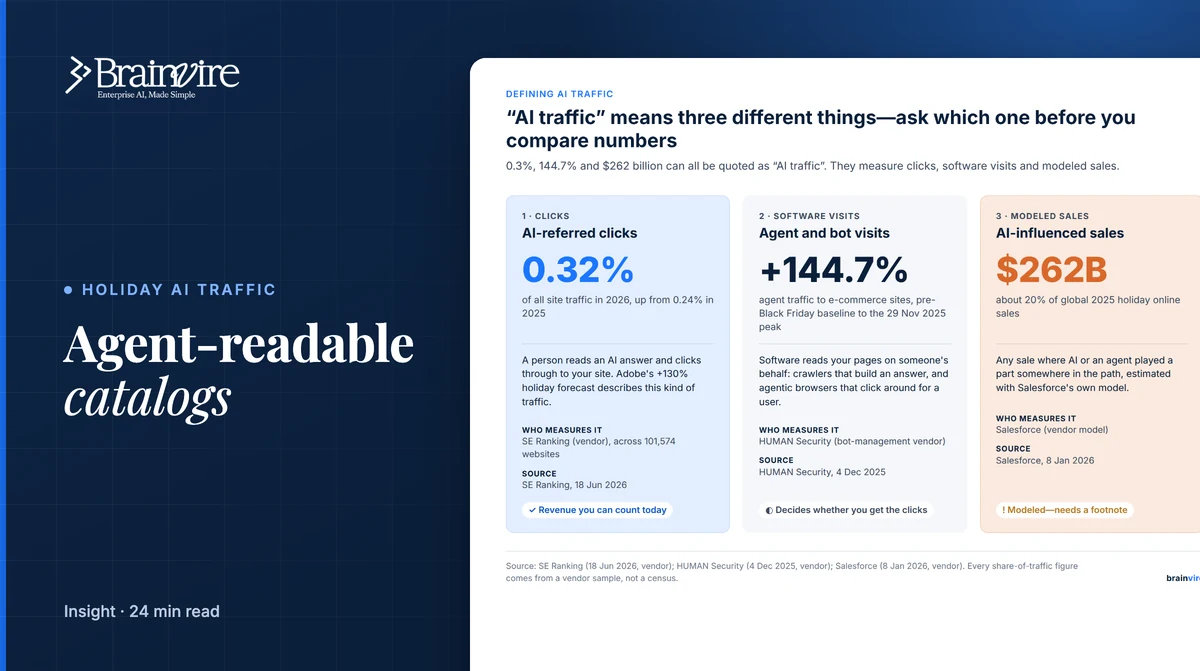 AI-referred traffic is up 130% this holiday. Can an agent actually read your catalog?October 16, 2026 · 24 min read
 Ecommerce business models: who buys and how the money comes inJuly 1, 2022 · 12 min read
 The ecommerce challenges hiding in your shipping, returns and platform billsJune 21, 2023 · 12 min read