Odoo ERP for Energy, Oil & Gas: one system for the whole operation
Odoo ships no oil, gas, energy or solar application; none of those words appears in the Odoo 18 documentation index. It ships Maintenance, Field Service, Project, Inventory, Purchase, POS and Accounting on one database. Brainvire configures that, then builds the rest.
Maintenance, Field Service, Project, Inventory, Purchase, POS and Accounting on one database, with an analytic account behind every site.
Fuel retail networks, oilfield service firms, solar EPC and installation businesses, and utilities that own assets and send crews out.
No oil and gas application. Upstream and hydrocarbon accounting, joint-venture billing and SCADA links are not in Odoo. Each is a build.
Small implementations 8 to 12 weeks, mid-market 12 to 24 weeks, multi-country rollouts 6 to 12 months. Our estimates.
/ Before you change anything
Does your operation look like any of this?
Patterns we see where plant, crew and ledger disagree.
You learn a pump failed by losing output
Service history sits in a spreadsheet, intervals are remembered rather than scheduled, and no asset record exists.
Job sheets come back on paper
A technician fills in a form at a wellhead, and someone retypes it days later.
Every site counts its own stock
Fuel, lubricants, spares and meters are counted locally, so the group figure is a guess.
Each country closes its own books
Separate charts of accounts and tax rules per market push the group view weeks late.


Trusted by enterprise Odoo teams worldwide




/ The work itself
What does Brainvire actually configure in Odoo for an energy business?
Odoo ships Maintenance, Field Service, Project, Inventory, Purchase, POS and Accounting, and no energy application. The value is in the configuration, and in being straight about the rest. See Point of Sale and Project and Timesheets.
| Odoo default | What Brainvire changes | Why it matters |
|---|---|---|
| Equipment tracked on a spreadsheet | Maintenance on, with an equipment record per asset, corrective and preventive requests and a calendar | A pump, genset or inverter carries its history |
| Field work reported on paper | Field Service tasks with worksheet templates built in Studio, and shifts dispatched by role in Planning | The crew’s work is captured on site |
| A project with no financial trail | Analytic accounting on, an account per site or solar project, and the profitability dashboard reading revenue beside cost | EPC cost against contract is a screen |
| No upstream or joint-venture accounting | Odoo ships neither; both are a build. | You know up front which part is a build |
| Owned and hired equipment off system | Fixed assets on, so depreciation posts itself, plus Rental with scheduled pickup and return, and serial numbers, as GOWell Petro needed | Tanks, rigs and hire units stay in stock and the ledger |
| Each market closes on its own | Legal entities and branches on one database, multi-currency on, and fiscal localization per market. Odoo 18 ships fiscal localization modules for 102 countries, 30 of them African; the rest we build from local rules | The group closes on one chart of accounts |
| No link to a dispenser or a SCADA historian | Odoo’s IoT system connects scanners, printers, terminals and measurement tools, nothing else. For a global energy provider we are building middleware that reads dispensing meters | Meter readings post as transactions, not typing |
Feature names follow the Odoo 18 documentation, checked in September 2026. So were the rows saying it ships nothing.
/ Automation, where it pays
Where does automation earn its place across an energy network?
Four places it pays for itself.
A new site provisioned from one form
For Puma Energy we built a Dealer Rollout app. One form sets up scoped users, approval thresholds, accounting and taxes, cutting onboarding from two hours to fifteen minutes.
Convenience stores that keep selling
Odoo Point of Sale runs in a browser and keeps selling while the connection is down. On Puma’s network that held about 95% uptime.
Asset postings that raise themselves
At GOWell Petro, purchases and rentals reached finance by hand. Automated asset and maintenance workflow put acquisition, depreciation and disposal on a schedule.
Country data pushed to the group lake
Puma’s loyalty and e-Wallet platform streams country transaction data to a central AWS S3 data lake on scheduled jobs, so group reporting is no longer an export.
What has to connect to an energy operator’s ERP?
Odoo does not replace every system an energy business runs.E-commerce
Fuel is not sold online. Lubricants, panels and appliances are, and where a product arm exists the storefront reads Odoo stock directly.
 and more
ERP Systems
Leaving QuickBooks, Sage or an older platform need not lose history. We map accounts, suppliers, open jobs and asset registers, then reconcile before cut-over, as planned for a renewable-energy client.
 and more
EDI & Marketplace
A supply-side concern, not a forecourt one. Where the business also distributes product, channel orders map into one structure.
 and more
Shipping Gateways
Panels, meters and spares reach a depot or a site, not a doorstep, and a delivery to a site is a transfer into its stock location.
 and more
Taxation
Energy is taxed by the market it sells in, and fuel carries duties on top. Fiscal positions cover most of it; Avalara or TaxJar take over once rate upkeep is the bigger job.
 and more
Payment Gateways
Forecourt customers pay at the counter, contract customers on terms. Both settle against one receivable, and a split tender closes on one order.
 and more
Other Integrations
Dispenser controllers, SCADA historians, telematics, inverter portals and BI tools all touch the operation. Odoo speaks to none of them, so each gets an interface and a reconciliation.
 and more
/ Delivery
How does an Odoo rollout run across an energy network?
Small implementations 8 to 12 weeks, mid-market 12 to 24 weeks, multi-country 6 to 12 months. Our estimates.
Discovery
We sit with a site manager, a maintenance planner and the accountant, walk one asset end to end, and list where cost lands.
Design
Entity structure, analytic coding, the equipment register, billing method and integration map are agreed in writing, and so is what Odoo will not ship.
Build and data
Configuration, then custom work, then the register, open jobs and asset values loaded into a test database.
Pilot and go-live
One country or depot goes live first, proven by reconciling asset values against the old system. The rest follow at period end.
/ Scope
What makes an energy or solar scope bigger or smaller?
A typical engagement covers Maintenance, Field Service, Inventory, Purchase and Accounting in one country.
How much you own
A register of a few hundred units is a different problem from one of thousands. Serial numbers and depreciation rules scale with it.
How many places at once
Each depot, station or site adds a stock location, a route and hours that must reach the right account.
Entities and fiscal rules
Each legal entity adds a localization, intercompany rules and a statutory report. Markets Odoo ships no localization for are built from local rules.
How you get paid
Forecourt retail, wholesale supply, rental, EPC milestones and service contracts each bill differently.
/ Odoo, on the record
Where have we done this for energy, oil and gas operators?
Two named clients, on the record. A third, a full Odoo ERP for Euronet, is in delivery.
 87.5%faster dealer and branch onboarding
Puma Energy
A global energy company with fuel stations and convenience stores in twelve African countries. We delivered a multi-entity Odoo 18 ERP and POS platform on a legal entity to dealer to site model, with a custom Dealer Rollout app, a seven-role security matrix and fiscal localization per country on one mergeable chart of accounts. The case states a target of 700 or more sites, not a count live.
Read the case →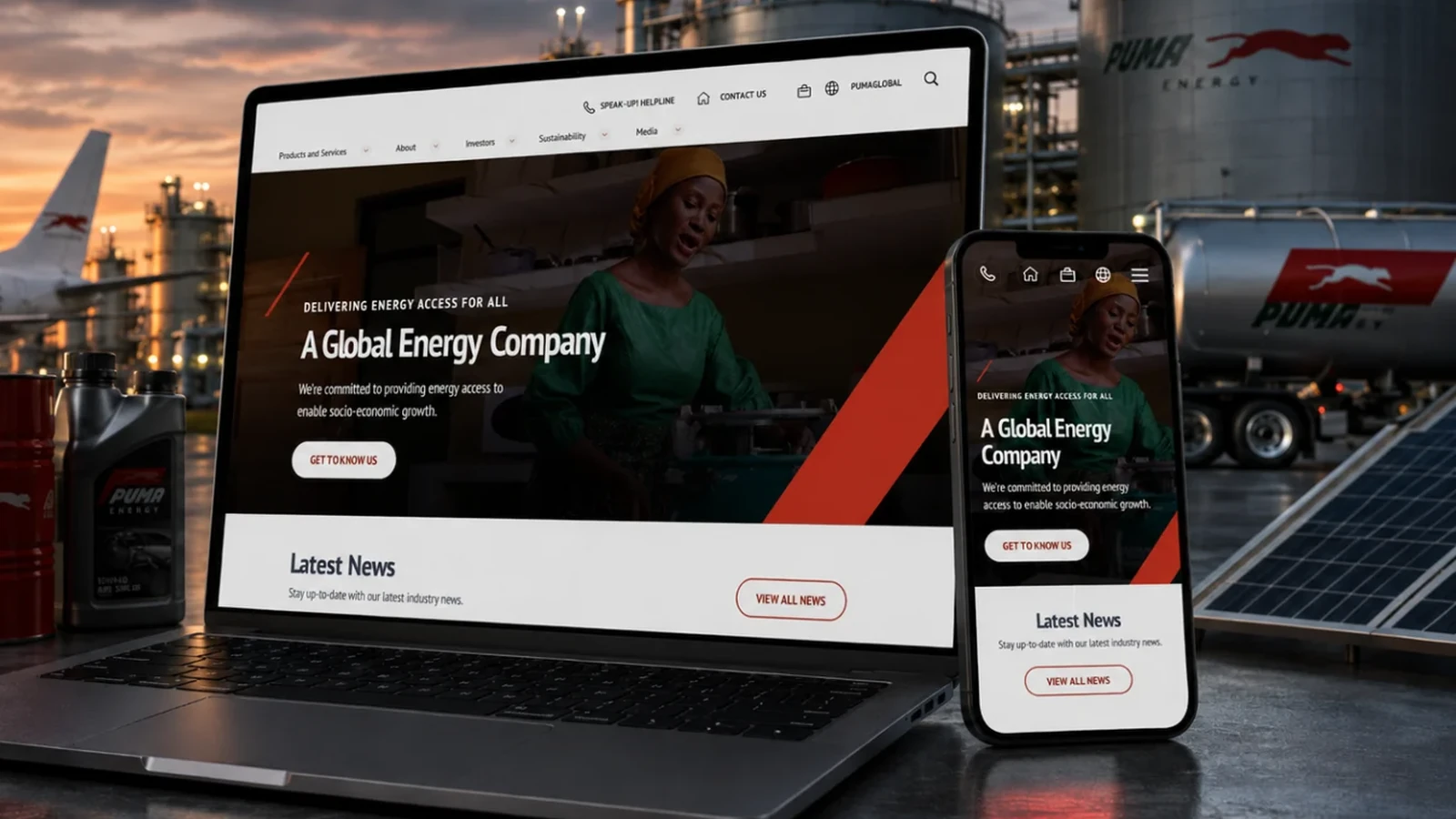
GOWell Petro
A distributed-sensing and wireline logging supplier in formation evaluation and well integrity. Tracking equipment by hand into rental left asset records wrong and maintenance dates missed. Odoo now carries equipment, rental, maintenance and the asset ledger together.
Read the case →
/ Comparison
Odoo, or an industry-specific energy ERP?
An energy ERP starts ahead on the barrel, Odoo on everything around it.
| Criterion | An industry energy ERP | Odoo |
|---|---|---|
| Upstream and hydrocarbon accounting | Shipped: volumes, entitlements, royalties, revenue distribution | Not shipped. Nothing in Odoo models a producing well; this is a build |
| Joint-venture accounting | Joint interest billing, partner statements and cash calls | Not shipped. A second analytic plan reads cost by venture; partner billing is custom |
| Assets, maintenance and field crews | Strong on plant, separate system for the crew | Maintenance, Field Service, Planning and Timesheets share the records |
| Downstream retail and convenience | A forecourt system wired to finance, not part of it | Point of Sale shares the database with stock and the ledger; it sells offline |
| Everything that is not the barrel | Separate systems for CRM, purchasing, HR, projects, web | One database runs them against the same sites and assets |
Choose an industry energy ERP if upstream accounting, entitlements and joint interest billing are the daily job; rebuilding those in Odoo is a bad trade. Choose Odoo if the weight sits downstream, in oilfield services, renewables or utilities. See also Odoo versus SAP Business One.
/ Questions energy operators ask
Odoo for energy, oil, gas and solar FAQs.
Does Odoo have an oil and gas module?
No. There is no oil, gas, energy or solar application in Odoo, and none of those words appears in the Odoo 18 documentation index. An energy business runs Maintenance, Field Service, Planning, Project, Inventory, Purchase, Point of Sale and Accounting, with analytic accounting behind each site.
Can Odoo handle upstream production or joint-venture accounting?
No. Odoo models no producing well, so production volumes, entitlements, royalties and revenue distribution are absent, and so is joint interest billing. A second analytic plan reads cost by venture, but partner statements and cash calls must be built elsewhere.
How does Odoo track energy assets and their maintenance?
Through the Maintenance app. Each asset becomes an equipment record, and corrective or preventive requests are raised against it and scheduled on the maintenance calendar. Custom worksheets capture what the technician did, serial numbers make one unit traceable, and Accounting depreciates it on a schedule.
Can Odoo Point of Sale run a forecourt convenience store?
Yes. Odoo Point of Sale works in any browser and keeps taking orders while the connection is down, resynchronizing once it returns. Across Puma Energy stores that held around 95% uptime. Capturing the fuel sale off the dispenser is the gap, and needs custom middleware.
Does Odoo connect to SCADA or to a fuel dispenser?
Not on its own. The Odoo IoT system supports barcode scanners, receipt printers, payment terminals and measurement tools, and the documentation lists nothing for process control. For a global energy provider we are building middleware that reads dispensing meters and raises the order.
How does Odoo cost a solar or EPC project?
Through analytic accounting. An analytic account opens per project, and timesheets, purchases, vendor bills, expenses and stock moves are distributed onto it. The project profitability dashboard reads every record on that account and shows revenue beside cost in three columns.
Can one Odoo database run an energy group in several countries?
Yes. One database holds several legal entities, with branches beneath them, each carrying its own fiscal localization, chart of accounts and statutory reporting, plus multi-currency. Odoo 18 ships fiscal localization modules for 102 countries, 30 of them African, and markets outside that list are built from local rules.
How long does an energy implementation take?
Small implementations run 8 to 12 weeks, mid-market 12 to 24 weeks, and multi-country rollouts 6 to 12 months. Version upgrades run 3 to 8 weeks. Custom work such as dispenser middleware or joint-venture billing is estimated separately. These are our estimates.
/ Next step
Let’s map your sites, assets and crews onto Odoo.
- A senior architect replies within one business day
- Your details are never shared or sold
- An NDA can be signed before we hear any detail
US +1 (631) 897-7276 · Gulf +971-54-737-4253 · Singapore +65-9086-0319 · India +91-22-6116-3300.








Trusted by 2,000+ brands worldwide
“Brainvire has helped our business grow. We feel like it’s a true partnership. They’re always present. It’s been seven great years, looking forward to more.”
Book a working session
Tell us how many sites you run.