How Much Does Adobe AEM Cost? A Breakdown for US Enterprises
-

Hiren Raval

The digital shelf is where billions of dollars are won and lost. For global enterprises, consistency, speed, and hyper-personalization are no longer optional. They are the cost of entry. This reality drives leaders to invest in a premium engine: Adobe Experience Manager (AEM). AEM powers the seamless customer journeys behind the world’s biggest brands such as Nike, Sony, Audi, and Cisco.
But here is the strategic pitfall: Adobe does not publish a static price list. The quote you receive is a complex formula based on projected usage, consumption, and integration with your existing tech stack. Getting this budget wrong means risking significant cost overruns, hindering deployment, and eroding your platform’s ROI.
This guide demystifies AEM’s pricing structure for US enterprises. We move beyond the license fee to break down the four critical factors that define your multi-million-dollar commitment, ensuring your investment drives measurable growth, not budget shock.
Part 1 | The Core Components of AEM Pricing
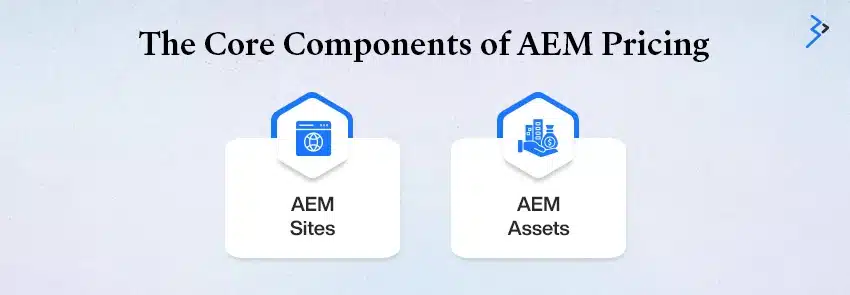
When a large US enterprise licenses Adobe Experience Manager, the cost is not for a single piece of software. It’s for a suite of powerful tools, and the total fee is an annual subscription based on a handful of key factors. It is like building a premium car: you pay for the base model, then add the essential features.
The Core Modules (The Base Price)
AEM (Adobe Experience Manager) has different parts called “modules,” which you can choose based on your business needs. The two most popular and costly modules are:
- AEM Sites: A key tool for creating and managing website content is vital for effective communication and organization. It usually accounts for the most significant part of the AEM cost.
- AEM Assets: The location contains all media types, including images, videos, documents, and 3D files. It helps keep your brand consistent across all platforms.
What Affects the Cost of These Modules?
- Content Requests (for AEM Sites): A key factor is present. It mainly counts the number of page views and API calls your websites and apps get in a year. A big company with millions of visitors will pay much more than a smaller one.
- Storage and Users (for AEM Assets): The cost depends on how much cloud storage you need (measured in terabytes) and how many “Power Users” you have. These are the team members who actively manage and edit the assets.
The Deployment Model (AEM as a Cloud Service – AEMaaCS)
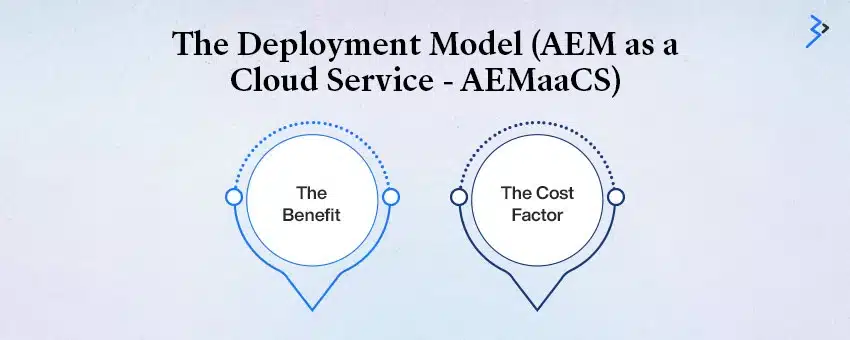
For almost all new US enterprises, Adobe promotes the modern cloud-native solution AEM as a Cloud Service (AEMaaCS).
This subscription service model includes the software license, the hosting infrastructure (usually managed by Adobe on AWS or Azure), and the maintenance/upgrades.
- The Benefit: It is more straightforward and flexible, eliminating the massive upfront hardware and perpetual license costs of the old on-premise AEM versions. Adobe manages the security, scaling, and updates automatically.
- The Cost Factor: The annual subscription fee for AEMaaCS is premium-priced because it bundles the software and the managed cloud hosting. The license fee represents the platform’s Total Cost of Ownership (TCO).
Part 2 | The 4 Major Factors that Customize Your Final Price
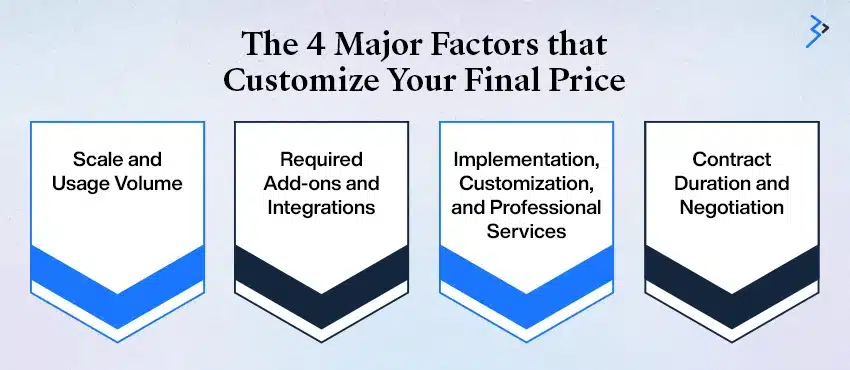
Adobe will provide numbers based on a private quote tailored to these four areas. They are what separate a six-figure deal from a multi-million-dollar commitment.
Factor 1: Scale and Usage Volume
The simplest cost driver is straightforward. The bigger your digital footprint, the higher the price.
- Content Requests (The Main Driver): The annual allowance of Page Views/API Calls is the core scaling metric for AEM Sites. Your baseline cost will be high if you are a global brand running hundreds of domain names.
- Number of Environments: Every AEM license has a certain number of environments (Production, Stage, Development, etc.). Large development teams often need extra Development and Quality Assurance (QA) environments for parallel workstreams, sold as paid add-ons.
- Author Users: The number of internal users who need “Author” access and the ability to create, edit, and publish content.
Factor 2: Required Add-ons and Integrations
AEM is just one piece of the puzzle. Most enterprises integrate it with other essential tools in the Adobe Experience Cloud (AEC) or external systems.
- Adobe Marketing Cloud Integrations: Does your AEM need to connect seamlessly with Adobe Analytics for data, Adobe Target for personalization, or Adobe Campaign for email automation? Using more Adobe products usually leads to an Enterprise Term License Agreement (ETLA), a massive, multi-year contract that bundles all licenses at a volume discount.
- Forms and Screens: Do you need AEM Forms to manage secure, high-volume government or financial applications? Do you need AEM Screens for digital displays in physical retail stores? These are powerful, specialized add-ons that add significant fees.
- Generative AI Capabilities: The platform’s future is in new features like Adobe Firefly and Content Hub, which accelerate content creation using Artificial Intelligence. Their consumption is often licensed separately or factored into a higher-tier subscription.
Factor 3: Implementation, Customization, and Professional Services
The license fee only covers the right to use the software. The cost to build your websites and digital experiences is a separate, significant investment handled by a specialized implementation partner.
- Custom Development: AEM is highly customizable. The cost depends entirely on how many custom templates, complex components, and unique workflows you must build to meet your business logic. This professional services cost typically ranges from $500,000 to over $5,000,000 for a complex, multi-site implementation.
- Content Migration: Moving years of content (and all its metadata) from a legacy CMS (like Drupal or a custom system) to AEM is a vast, one-time project. The more content and complexity you have, the higher the service cost.
- Training and Support: AEM is a sophisticated tool. Proper training for your authors, developers, and administrators is essential. Many large enterprises prefer Adobe’s Premium Support or enhanced support from their implementation partner, despite having standard support included.
Factor 4: Contract Duration and Negotiation
Adobe primarily works with long-term, multi-year contracts, usually for 3/5 years.
- Longer Commitment = Better Rate: The longer you commit, the more leverage you have for negotiating a favorable overall rate.
- The ETLA Factor: Most US enterprises sign an ETLA, which simplifies billing but locks you into a high financial commitment.
Part 3 | Why Enterprises Pay the Premium (The ROI)
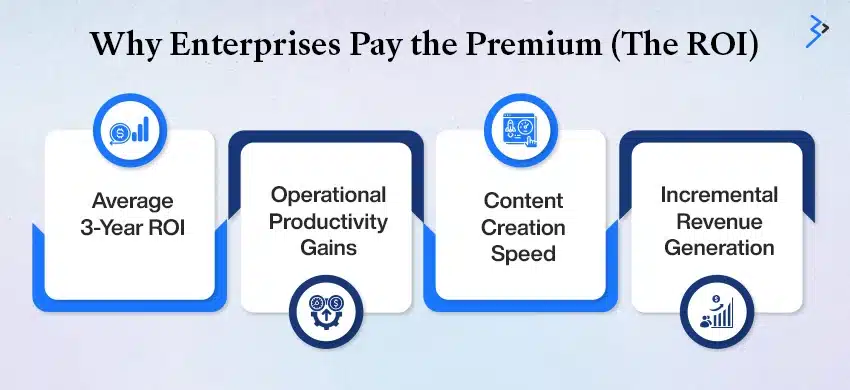
The high price tag makes sense because AEM delivers a colossal return on investment (ROI) and drives measurable business growth that cheaper platforms cannot match at scale. These statistics justify the platform’s cost.
- Average 3-Year ROI: According to Adobe’s commissioned IDC White Paper, “The Business Value of Adobe Experience Manager Sites”, enterprises using AEM Sites achieved an average 348% three-year ROI through faster content delivery, higher productivity, and improved conversions.
- Operational Productivity Gains: Adobe’s commissioned IDC study, The Business Value of Adobe Experience Manager Forms, found that organizations achieved a 20% reduction in form-abandonment rates after implementing AEM Forms.
- Content Creation Speed: According to a Forrester Consulting‑commissioned TEI study for Wedia, organizations achieved a 90% reduction in the time required to manage visuals after deploying the DAM solution.
- Incremental Revenue Generation: Adobe reported that companies using Adobe Experience Cloud achieved a 25% increase in web and mobile conversion rates over 3 years.
Part 4 | Building Your Realistic AEM Budget (A Simple Breakdown)
To budget for AEM in 2025, an enterprise should plan for three buckets of costs over the contract period:
1. The Annual License Fee (The Adobe Fee)
What it covers: The right to use AEM Sites, assets, and forms (if applicable), as well as all core platform features, standard cloud hosting, and basic support.
A case study published in the journal Sustainability (MDPI) reported that a global enterprise invested approximately €80 million, about 15% of its regional turnover, to consolidate 21 ERP systems into one unified platform. The company projected annual savings of €20 million and a complete ROI within 4 years.
2. The Implementation and Migration Cost (The Partner Fee)
What it Covers: The one-time project cost to design, develop, and launch your first wave of websites and content, plus the effort to migrate existing content and integrate AEM with your CRM, ERP, and other marketing systems.
3. The Ongoing Run and Maintenance Costs (The Opex Fee)
- What it Covers: This is the cost of keeping the lights on after launch.
- Internal Team Salaries: The cost of in-house AEM developers, architects, and content authors.
- Partner Retainer: An ongoing monthly or annual retainer fee paid to your implementation partner for continuous support, minor feature development, performance monitoring, and security patching.
- Overage Fees: Fees incurred if you exceed your contracted limits for Content Requests or storage.
According to Win Without Pitching, one agency offered a USD $500,000 annual retainer, though procurement attempted to negotiate it down to $300,000.
Adobe Experience Manager (AEM) is a robust platform tailored for larger businesses with substantial budgets. Its pricing can be complex, but the investment pays off through improved returns, higher conversion rates, and faster content creation.
To successfully transition from just purchasing a license to having a fully functional platform, you need more than money; expert assistance is essential.
At Brainvire, we simplify the AEM experience for businesses. As an Adobe Gold Partner, we maximize the value of your license agreement, ensure efficient implementation, and ensure you understand all costs upfront. We connect AEM’s powerful features with your business goals, driving tangible success. Choose Brainvire to make your Adobe AEM investment a wise and profitable decision.
FAQs
The cost of AEM depends on multiple factors, including the scale of your digital footprint, the number of page views and API calls, required modules like AEM Sites or Assets, cloud storage needs, user licenses, add-ons (Forms, Screens, AI features), and contract duration. Implementation, customization, and professional services also significantly impact the total cost.
AEMaaCS bundles the software license, cloud hosting, and maintenance into a subscription model. While the annual fee is premium-priced, it eliminates massive upfront hardware costs and reduces IT overhead, as Adobe manages security, scaling, and updates automatically.
Beyond the license fee, enterprises should budget for implementation and migration costs (custom development, content migration, integration), ongoing maintenance fees, training, additional environments, and any overages on storage or content requests.
Yes. According to the official product page for Adobe Experience Manager Forms, companies reported up to a 25% increase in web and mobile conversion rates via accelerated form‑submission workflows.
Partnering with an experienced Adobe implementation partner like Brainvire ensures optimal license utilization, accurate budgeting, smooth implementation, and ongoing support. This strategic approach maximizes ROI and aligns AEM’s powerful features with business goals.
Related Articles
-
 From Chaos to Clarity: Optimizing Marketing Operations with Adobe Workfront and AI
In the world of modern marketing, chaos often reigns supreme. Picture this: scattered emails, endless spreadsheets, missed deadlines, disconnected teams, and campaign assets that vanish into black holes. The pressure
-
Adobe Commerce 2.4.7 Release – How it’s Beneficial to Your Business?
dobe commerce 2.4.7 features
-
How to Set Up and Launch Your Store on Adobe Commerce Cloud?
Summary Setting up an Adobe Commerce Cloud store has to be one of the most exciting yet challenging journeys. Adobe Commerce Cloud offers digital entrepreneurs a unique platform for quickly