Total Cost of Ownership: AEM Cloud vs. On-Prem Over 3 Years
-

Hiren Raval
Every significant technology investment demands a ruthless look at the actual costs and benefits, and that scrutiny must extend far beyond the initial price tag. For your digital experience platform, you face a pivotal strategic choice: Adobe Experience Manager (AEM) as a Cloud Service (AEMaaCS) or the traditional, self-managed on-premise/AMS model.
This choice isn’t merely a technical preference; it fundamentally reshapes your financial strategy: your Capital Expenditure (CapEx), your ongoing Operational Expenditure (OpEx), how you allocate precious IT resources, and, most critically, your business agility for years to come.
At Brainvire, we understand that planning a strategic move requires more than just gut feeling. It demands solid, verifiable data. That’s why we’ve assembled this in-depth, simplified guide for you.
It precisely breaks down the Total Cost of Ownership (TCO) for both AEM models over a typical three-year enterprise lifecycle, focusing on the essential financial, operational, and strategic differences. This lets you cut through the complexity, compare models side-by-side, and make a completely informed, future-proof decision.
The Executive Summary: Shifting from CapEx to OpEx
The most profound difference between AEM on-premise and AEM as a Cloud Service is the shift in your spending model.
- AEM On-Premise: Embarking on this model means preparing for substantial capital expenditures (CapEx). You’ll invest significantly in hardware, server licenses, and infrastructure. While the initial costs may be high, be ready for unpredictable ongoing expenses related to maintenance, manual upgrades, and skilled personnel. It’s a balance of investment and opportunity that can lead to great rewards.
- AEM as a Cloud Service: Imagine a business model that transforms costs into a predictable, subscription-based fee covering software, hosting, maintenance, and updates. This approach turns unexpected expenses into a manageable operating budget, freeing up capital for growth. Say goodbye to financial surprises and hello to a streamlined way of managing resources.
For a modern enterprise focused on agility and maximizing capital, this OpEx model is often the clear winner for TCO over three years.
Read More-: Build vs. Buy: When AEM Components Outperform Custom FE Frameworks
The 3-Year TCO Breakdown: Where the Money Really Goes
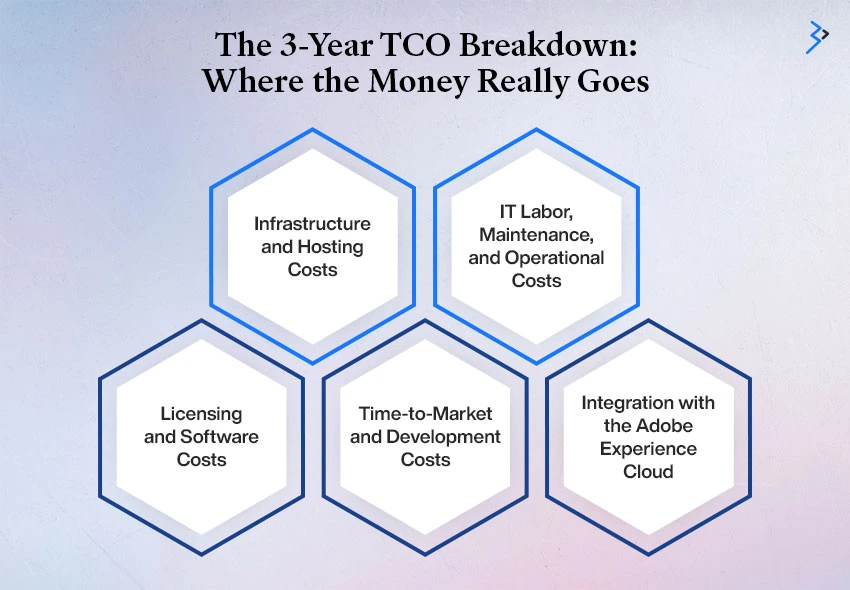
To truly compare AEM deployment models, we must look at the five major components of TCO over a 36-month horizon.
1. Infrastructure and Hosting Costs
| Cost Factor | AEM On-Premise | AEM as a Cloud Service | 3-Year Financial Impact |
| Initial Hardware | High CapEx for servers, storage, networking gear, data center space, and cooling. | $0.00 – Eliminated. Adobe fully manages infrastructure on cloud platforms (AWS/Azure). | Immediate Savings: Avoids massive CapEx budget approval in year one. |
| Scalability | CapEx-intensive and slow. Scaling up requires purchasing, installing, and configuring new physical hardware (often over-provisioning). | Included and Automatic. Auto-scaling dynamically adjusts resources up and down based on traffic/demand. | Reduced Waste: Ensures you pay only for the capacity you use, preventing costly over-provisioning. |
| Data Center Costs | Ongoing OpEx for power, cooling, physical security, and real estate. | $0.00 – Eliminated. Managed entirely by Adobe’s cloud providers. | Substantial OpEx Reduction: Eliminates hidden facility and utility costs. |
The shift to AEM as a Cloud Service effectively converts what IDC often calls “hard costs” of infrastructure into a single, predictable OpEx subscription. Adaptability is particularly important in unstable markets where resource demand can change quickly.
2. IT Labor, Maintenance, and Operational Costs
| Cost Factor | AEM On-Premise | AEM as a Cloud Service | 3-Year Financial Impact |
| Platform Upgrades | Manual, costly, and disruptive “Big Bang” projects every 12-18 months. Requires dedicated FTEs for planning, testing, and deployment. | Automated and Continuous. Updates are applied in the background (often daily/weekly) with no downtime. | Principal OpEx Reduction: Eliminates the cost of large, dedicated upgrade teams and months of project labor. |
| Security & Patching | Manual process. A dedicated security team is required for continuous monitoring, vulnerability testing, and patch deployment. | Automated. Adobe continuously applies security fixes and patches. | Risk Reduction & Cost Savings: Lowers FTE requirements for security ops and reduces the financial risk of vulnerabilities. |
| Monitoring & Administration | Requires 24/7 dedicated IT staff for patching, environment setup, and performance tuning. | Automated via Cloud Manager. Administration is simplified, focusing staff on business value. | FTE Optimization: According to Forrester Research, as much as 80% of the IT budget is consumed by maintenance and support activities, leaving only about 20 % for strategic initiatives and innovation. |
3. Licensing and Software Costs
The licensing model for AEM has evolved significantly with the Cloud Service, shifting from a complex, instance-based model to a transparent, consumption-based approach.
- AEM On-Premise: Licensing usually limits you to a certain number of servers or instances. If you need to scale up for a big sales day quickly, you might face legal issues or unexpected costs for temporary licenses. It’s something to consider ahead of time.
- AEM Cloud Service Licensing: We base our pricing on page views, asset storage, and user count. Our pay-as-you-go model means your costs grow with your success, giving you better control and flexibility as your business evolves.
Read More-: AEM Sites vs. Headless: How to Choose for Enterprise Scale in 2025
4. Time-to-Market and Development Costs
While not a direct dollar-for-dollar TCO line item, the cost of delay is a critical factor.
- On-Premise: Provisioning new development or staging environments can take weeks or months due to hardware procurement and manual setup. The traditional CI/CD pipeline is slow and requires custom tooling.
- AEM as a Cloud Service: Environments can be provisioned almost instantly through Cloud Manager. The built-in, automated CI/CD pipeline enforces best practices and drastically accelerates deployment.
Key Insight: Faster time-to-market translates directly to quicker revenue realization. This accelerated development cycle significantly impacts the Return on Investment (ROI) within the three years.
5. Integration with the Adobe Experience Cloud
For organizations looking to maximize the power of their investment, the seamless integration between AEM and the rest of the Adobe Experience Cloud is a major TCO reducer.
- On-Premise: Integrating AEM with other Adobe solutions like Analytics, Target, or Commerce requires custom development, complex configurations, and ongoing maintenance of these connectors, all of which add to TCO.
- AEM as a Cloud Service: The platform is built specifically for native, out-of-the-box integration with the entire Adobe Experience Cloud. Eliminating the need for costly and time-consuming custom integration efforts allows teams to utilize powerful marketing capabilities more quickly. This synergy is crucial for organizations using the full Adobe Marketing Cloud vs. Adobe Experience Manager stack.
The Financial Upshot: Statistical Evidence and ROI

While specific TCO figures depend on your organization’s size and traffic, independent research consistently validates the cost-effectiveness of moving to a cloud-native platform like AEM as a Cloud Service.
IDC and Forrester Findings
According to IDC’s Cloud Pulse 4Q 2023 survey, nearly half of cloud buyers reported spending more on cloud services than they had originally expected in 2023, and 59 % anticipate similar budget overruns in 2024.
- TCO Reduction: According to an analysis by Accenture, many organizations migrating workloads to public clouds can achieve up to 30-40% reductions in total cost of ownership (TCO) over a multi-year horizon, by shifting from large upfront capital expenditures (CapEx) to operational expenditures (OpEx) and reducing ongoing labour/management overhead.
- Operational Efficiency: One of the core arguments is the efficiency gain. By automating manual maintenance, CIOs can significantly reduce the FTE effort required for infrastructure management. The cloud converts what were once multiple, high-cost activities (hardware refresh, patching, scaling) into a single, predictable subscription cost.
Focus on Opportunity Cost and Risk
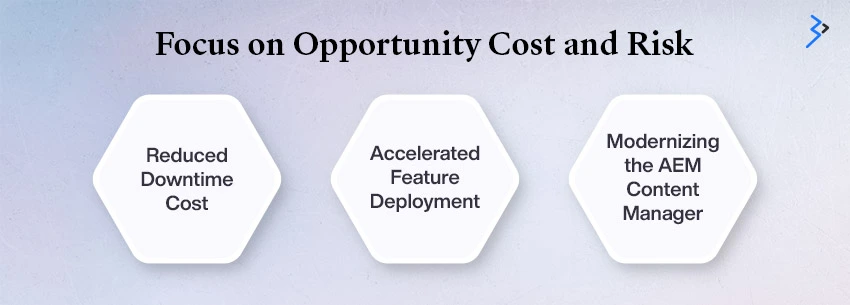
The most significant savings may come from mitigating risk and unlocking strategic opportunity:
- Reduced Downtime Cost: AEM Cloud’s auto-scaling and continuous delivery model offer higher uptime and resilience. Every hour of downtime on a high-traffic site can cost hundreds of thousands of dollars, but the cloud architecture inherently reduces this risk.
- Accelerated Feature Deployment: Faster deployment enables your marketing teams to react faster to market trends and competitor moves. Achieving a competitive advantage and accelerating revenue generation significantly enhances ROI.
- Modernizing the AEM Content Manager: By offloading infrastructure, your technical teams can stop being systems administrators and focus on advanced, revenue-driving projects like personalization, headless content delivery, and leveraging new services within the Adobe Experience Cloud vs. the Adobe Experience Manager ecosystem.
Our Concluding Recommendation
Over three years, AEM as a Cloud Service has been delivering a demonstrably lower and more predictable TCO than the traditional on-premise model. It replaces depreciating capital expenditures with a flexible operational expenditure subscription, significantly reducing maintenance costs.
Accelerating the time it takes to bring a product to market leads to a quicker return on investment. For the modern enterprise, embracing AEM Cloud is not just an IT choice; it’s a strategic financial decision that prepares your digital foundation for unstoppable growth. A strategic partner can help navigate the complexities of migration, customization, and integration to ensure business goals are met.
Brainvire specializes in digital experience and commerce solutions, leveraging our expertise to maximize your organization’s investment in Adobe Experience Manager and accelerate the realization of a strong TCO reduction and ROI.
Frequently Asked Questions
The primary advantage lies in the shift from CapEx to OpEx. AEM as a Cloud Service shifts organizations from unpredictable costs to a fixed subscription model. This lowers upfront costs and recurring expenses, leading to a more predictable Total Cost of Ownership (TCO).
According to a Boston Consulting Group (BCG) report, organisations that execute cloud transformations well can lower infrastructure costs by up to 40%, boost productivity by as much as 50%, and accelerate time-to-market by up to 60%.
Absolutely. AEM Cloud actively optimizes performance and scales automatically to meet demand. The Cloud Service automatically adjusts resources based on demand, unlike on-premise environments that require manual hardware provisioning. Enterprises pay only for what they use, ensuring better scalability, uptime, and performance without operational complexity.
AEM as a Cloud Service comes with continuous security patching, automated updates, and built-in compliance controls managed by Adobe. Significantly reducing the risk of vulnerabilities and compliance breaches is crucial, as it addresses a significant financial concern for CIOs and CFOs. It also minimizes potential downtime costs, reaching hundreds of thousands of dollars per hour for high-traffic websites.
Brainvire is an Adobe Experience Manager partner that helps enterprises assess infrastructure and customize AEM Cloud for better ROI. Brainvire combines digital experience and cloud strategy for smoother transitions, faster deployments, and better costs over three years.
Related Articles
-
 AI-Driven Smart Tagging and Metadata in AEM Assets
Imagine an extensive digital library without an easy way to find files. It’s full of images and documents, making it hard, for example, to locate a photo of a “team
-
How Retail Businesses Use AEM for eCommerce and Customer Engagement
Summary: It’s 2024; your online business needs more than a working website to stand among your competitors. Besides, your ideal clients won’t waste time around slow-loading websites to complete their
-
How to Set Up and Launch Your Store on Adobe Commerce Cloud?
Summary Setting up an Adobe Commerce Cloud store has to be one of the most exciting yet challenging journeys. Adobe Commerce Cloud offers digital entrepreneurs a unique platform for quickly