AEM vs. WordPress Enterprise: Why Large Organizations Are Choosing Adobe Experience Manager for Content at Scale
-

Hiren Raval
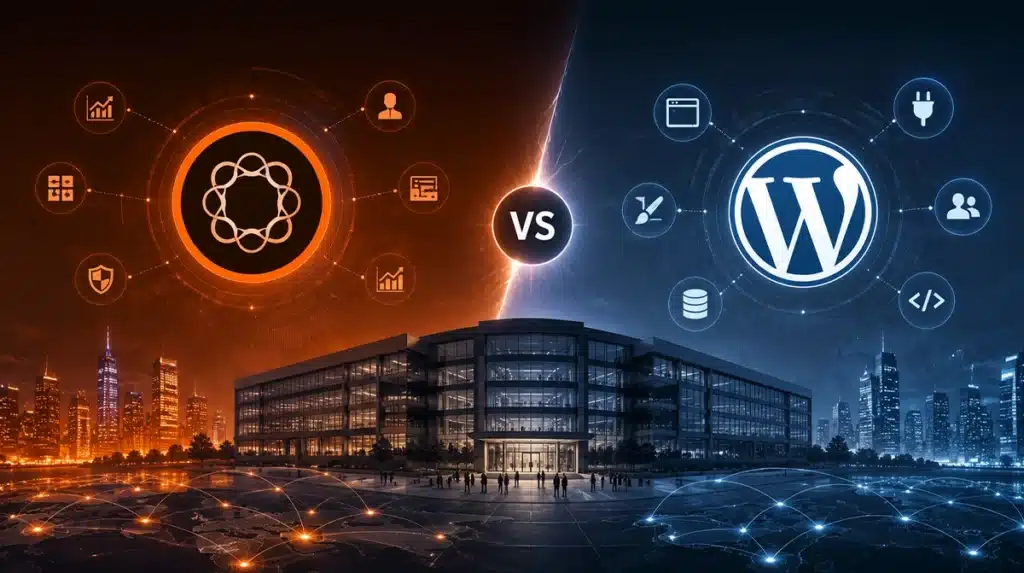
Digital properties sprawl across regions, and marketing teams need personalized experiences delivered faster than the previous quarter’s roadmap allowed. The digital management system sitting at the center of it all either keeps up or becomes the single biggest obstacle in the operation.
For years, the controversy between Adobe Experience Manager and WordPress has been framed as a battle between complexity and simplicity. When managing lots of pages, multiple brands, and a global team, the real question is which platform was actually built to carry this kind of weight.
The answer depends entirely on where your organization sits, and being honest about that distinction is worth more than any feature comparison chart.
What Each Platform Was Actually Built For

The foundational design philosophy of a platform shapes every decision downstream: governance models, content workflows, security posture, and total cost of ownership. All trace back to the original intent behind the architecture.
WordPress
WordPress was originally built for bloggers, but over time, it evolved into an actually capable CMS that now powers over 43% of all websites globally, according to W3Techs. It’s capable of a vast plugin ecosystem, low barrier to entry, fast deployment, and an enormous developer community. For media companies, editorial teams, and organizations where publishing speed and low overhead are the priorities, WordPress continues to deliver.
Adobe Experience Manager (AEM)
AEM is part of Adobe Experience Cloud and combines content management, digital asset management, personalization, multi-site orchestration, and omnichannel delivery into a single unified platform. It is a digital experience platform designed for organizations that need to govern content across dozens of properties, markets, and teams simultaneously.
What the Market Numbers Actually Tell You
Market share figures dominate this conversation, and they can mislead just as easily as they inform. WordPress holds around 43.5% of the global CMS market, including 36% of the top one million websites by traffic, according to W3Techs. AEM, on the other hand, holds around 0.1% of the overall CMS market. On the surface, the numbers favor WordPress, and for the majority of use cases, they should.
But overall market share is the wrong benchmark for enterprise decision-making. Organizations running 20 or more sites across multiple languages, managing hundreds of thousands of digital assets, and delivering personalized experiences to segmented global audiences are simply not in the same operating category as a regional business running a single WordPress site.
Why AEM Works Better for Large-Scale Digital Ecosystems

1. Multi-Site Management and Global Governance
For businesses managing regional sites, brand portfolios, or global language versions, AEM’s Multi-Site Manager is a key feature. It enables teams to create, copy, and modify content across global properties from a central interface. This helps maintain brand stability with regional customization. Moreover, it eliminates the need to duplicate work or set up separate content pipelines for each market.
WordPress does not offer this feature by default. You can set up multisite configurations, but they require a lot of custom development and regular maintenance. WordPress also doesn’t provide the same level of centralized control.
2. Digital Asset Management at Scale
A global enterprise has 500,000 product photos, campaign visuals, regional variations, and video cuts, spread across teams and time zones.
AEM Assets manages that volume cleanly. Adobe Sensei auto-tags uploads, Smart Crop generates device-specific renditions automatically, and the Creative Cloud integration means a designer can complete the work on Photoshop and publish directly to the DAM. No file transfers, no version confusion, no “which one is the final final” email chain.
WordPress manages media decently for a mid-size operation. But once you cross into hundreds of thousands of assets across multiple regions and brand teams, the native media library faces limitations. Most enterprises end up bolting on a third-party DAM, which solves the storage problem but creates another integration to maintain, with data silos quietly forming in the background.
3. Personalization and Adobe Ecosystem Integration
A first-time visitor and a loyal customer shouldn’t see the same homepage. AEM makes sure they automatically don’t, through native Adobe Target and Analytics integration. Different experience, same content model, no manual page builds.
Honest caveat, though: this only works if your organization is actually ready. Data infrastructure, content volume, and governance need to exist first. Licensing the feature and using it well are two completely different things.
WordPress manages personalization through HubSpot, ActiveCampaign, and similar tools. For teams not already in the Adobe ecosystem, that works out fine. But if Adobe Analytics and Target are already in your stack, native AEM connectivity beats stitched-together integrations every time.
4. Headless Architecture and Omnichannel Delivery
A CMS built only for web pages becomes a bottleneck fast.
AEM’s headless architecture lets content teams create once and push everywhere through APIs, GraphQL, and REST OpenAPI, both supported with meaningful capability expansions through 2025 and into 2026. One content model, every channel.
WordPress does headless too, through its REST API and WPGraphQL. The gap shows up in governance, approval chains, brand controls, and structured workflows at scale. While AEM manages it all natively, WordPress usually needs additional tooling to get there.
5. Enterprise-Grade Security and Compliance
In financial services, healthcare, and government, security is not a feature; it is a requirement. AEM as a Cloud Service builds it from the ground up: automated updates, granular role-based access, audit trails, version control, and HIPAA compliance, where applicable.
WordPress can be made secure; the emphasis being on “made.” Responsibilities such as core updates, plugin patches, firewall configuration, and ongoing monitoring, all sit with your team. Managed hosting reduces the burden, but it does not change the fundamental posture.
While AEM is secure by design, WordPress is secure by effort. For regulated industries, that difference matters more than any feature list.
Where WordPress Holds Its Ground

WordPress retains real advantages that matter in specific enterprise contexts. WordPress implementations for enterprise-ready sites normally take 2-4 months for simpler configurations.
AEM deployments often run six months to a year or longer, given the platform’s architectural depth. For organizations that need to move fast and iterate rapidly, that gap is significant.
WordPress’s Gutenberg editor helps non-technical content creators build and publish pages without developer dependency. AEM’s authoring environment has improved considerably through the Universal Editor, but it carries a steeper learning curve and normally requires more formal training before teams operate independently.
Total cost of ownership for mid-scale operations is also a genuine consideration.
AEM licensing starts at six figures each year and increases significantly. When you consider specialized developer salaries, Adobe-certified staff, managed services, and ongoing support, the total investment adds up. Organizations that manage fewer than 20 sites, operate in fewer than twelve languages, or lack the maturity to use AEM’s personalization features will probably find that WordPress offers enterprise capability for better value.
A Practical Comparison
| Capability | AEM | WordPress Enterprise |
| Multi-site governance | Native, centralized via MSM | Requires custom development |
| Digital Asset Management | Enterprise DAM with AI tagging | Requires third-party integration |
| Personalization depth | Native via Adobe Target + Analytics | Third-party plugins and integrations |
| Headless/omnichannel | Structured, API-first delivery | REST API and WPGraphQL are available |
| Security and compliance | Built-in, cloud-native | Requires active management |
| Speed to market | 6–12+ months for complex builds | 2–4 months for simpler builds |
| Content team usability | High complexity, training required | Intuitive, low barrier to entry |
| Licensing cost | $250K–$1M+ annually | Open-source core; hosting and plugins variable |
| Best suited for | 20+ sites, global enterprises, Adobe ecosystem | Speed-first teams, mid-scale publishing |
Source: Industry benchmarks, Dazzlebirds (2026), Clear Digital (2026)
When Does AEM Become the Right Answer?

Picking the wrong platform in either direction is an expensive mistake, and it happens more often than anyone likes to admit. If you’re running 20 or more digital properties, governance cannot rely on manual effort. Adobe Analytics, Target, or Experience Platform are already in your stack. And your teams actually have the data infrastructure and content volume to use personalization tools, not just pay for them.
If those conditions do not apply, WordPress configured correctly gets you to enterprise-grade performance at a fraction of the cost. The two most common mistakes: choosing AEM for its reputation rather than its fit, and choosing WordPress without realizing it cannot scale to your governance needs without significant custom development down the road. Both are avoidable with an honest assessment upfront.
Conclusion
Scale, governance maturity, long-term digital strategy are the three things that determine the right call for the AEM vs. WordPress Enterprise debate, not feature lists or market share numbers.
WordPress wins when agility, lower cost, and faster time to market are priorities. AEM wins when the organization needs centralized governance, strict compliance, and personalized experiences delivered across dozens of markets simultaneously. Neither platform is universally better. Both are right for different organizations at different stages.
What is clear is that enterprises investing in AEM in 2026 are not doing it for simplicity. They are doing it because the alternative, stitching together multiple platforms to achieve the same outcome, costs more in the long run and breaks at the worst possible moments.
That investment only pays off with the right partner behind it. Brainvire brings years of experience and a team of certified professionals across AEM implementation, cloud migration, multi-site management, and full Adobe ecosystem integration. Contact our experts today and make your decisions easier.
Frequently Asked Questions
The main difference between AEM and WordPress is that AEM is an enterprise-grade digital experience platform, while WordPress is a flexible CMS best suited for faster, lower-cost implementations.
Yes, WordPress is suitable for mid-scale enterprises prioritizing speed, cost efficiency, and simpler content operations.
AEM is preferred by large enterprises because of its strong multi-site management, integrated DAM, personalization, and Adobe ecosystem connectivity.
Yes, AEM is more expensive than WordPress as it involves significantly higher licensing and implementation costs.
Related Articles
-
 Empowering Your Business with Analytics: Making Informed Choices Using Adobe Commerce Data
Both technology and shopping trends are always in a state of constant evolution. Any company that doesn’t adapt to these changes is bound to see failure in the long run.
-
 From Chaos to Clarity: Optimizing Marketing Operations with Adobe Workfront and AI
In the world of modern marketing, chaos often reigns supreme. Picture this: scattered emails, endless spreadsheets, missed deadlines, disconnected teams, and campaign assets that vanish into black holes. The pressure
-
 Transform Customer Journeys with AI-Driven Audience Activation in Adobe Experience Platform
As marketers strive to create personalized customer experiences, they frequently face challenges with large datasets, intricate segmentation, and the significant challenge of engaging audiences on a large scale. The promise