AI Agents vs. Chatbots: What Businesses Actually Need to Know Before Spending on Either
-

Pratik Roy
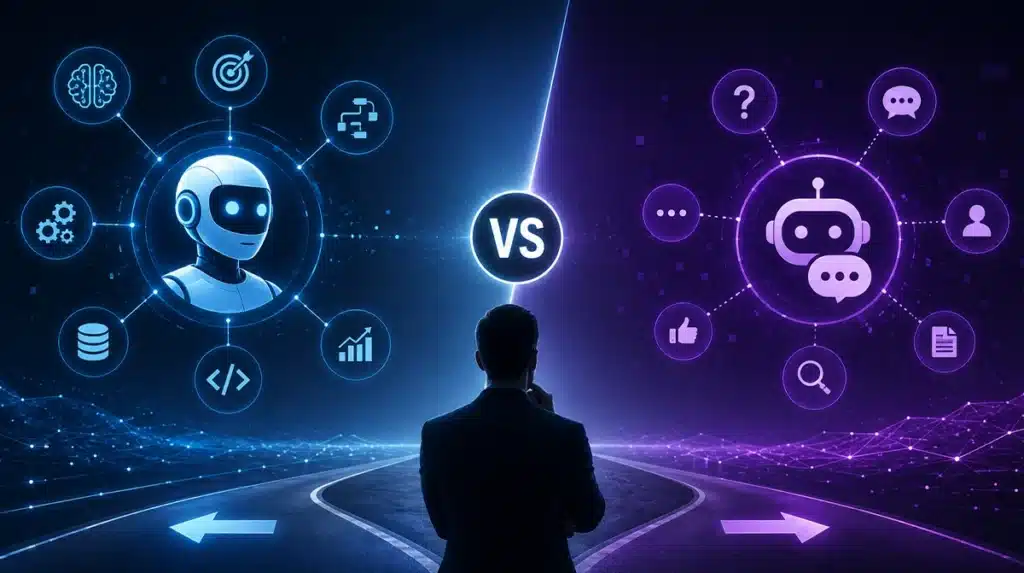
Every year, organizations pour significant capital into AI without a clear blueprint of what they are actually procuring. Somewhere between the high-gloss vendor demo and the boardroom sign-off, two fundamentally different technologies: Chatbots and AI Agents, get collapsed into the same category.
Treating them as the same product at different price points is a strategic error. It isn’t just a technical nuance; it’s an expensive misunderstanding.
The wrong AI investment does more than just underdeliver. It creates technical friction: it slows down operations, alienates customers with rigid logic, and eventually necessitates a costly architectural rebuild. For leaders responsible for technology ROI, this isn’t a distinction to “sort out later.” This decision determines whether AI remains a novelty or becomes the primary engine of your business for the next decade.
In this guide, we strip away the marketing jargon to define the hard line between AI Agents and Chatbots. We’ll explore where each makes genuine business sense and provide a practical decision framework, one built around your operational reality, not the current market hype.
The Current Market Scenario
The data tells a clear story: businesses that have experimented with both are rapidly pivoting toward AI Agents for complex operational needs. This isn’t just a trend; it is a fundamental reallocation of digital investment.
The statistics from Grand View Research highlight a divergence in how these tools are valued:
- The Utility Baseline: The Chatbot market remains robust, growing at roughly 23% annually as it moves toward a $27 billion valuation by 2030. These tools are becoming the standard for basic, high-volume communication.
- The Agentic Explosion: AI Agents, valued at $7.63 billion in 2025, are expanding at a blistering 45–50% CAGR. Depending on the sector, the market ceiling for Agents is projected to soar between $47 billion and $183 billion in the same timeframe.
This staggering gap in market projections exists because the use cases are fundamentally different. While Chatbots are optimized for information retrieval, Agents are being built for operational execution.
Most organizations are only now realizing that they don’t just need a tool that can talk about the work, they need a system that can perform it.
What is a Chatbot? (The Digital Front Desk)

A chatbot is a conversation simulator. Its primary function is to interpret a user’s prompt and retrieve a corresponding response. While advanced versions use Natural Language Processing (NLP) to understand intent, the underlying logic remains a linear “prompt-response” loop.
A chatbot is like a highly competent front-desk attendant who has memorized the company handbook perfectly. They are efficient, available 24/7, and never get tired. However, they cannot step away from the desk to reconcile your accounts or update your logistics database. Weighing chatbots pros and cons at this stage sets a realistic expectation, because the same scripted logic that keeps costs predictable also leaves the bot short on nuance when a customer uses slang, sarcasm, or ambiguous wording.

Where Chatbots Genuinely Deliver Value:
- Data Capture: Collecting names, contact details, and issue types.
- Standardized Workflows: Guiding users through returns, bookings, or password resets.
- Intelligent Routing: Categorizing tickets and directing them to the correct human department.
- Cost Efficiency: A chatbot interaction costs $0.50–$0.70, compared to $6–$15 for a human agent. According to McKinsey, this reduces support overhead by 30%.
What is an AI Agent? (The Autonomous Operator)

An AI Agent is a fundamentally different category of technology. Where a chatbot responds, an AI agent acts. Built on Large Language Models (LLMs) and designed for autonomous execution, agents perceive their environment, reason through goals, and carry out multi-step tasks without constant human intervention.
The Practical Difference:
- Chatbot Scenario: A customer flags a billing dispute. The chatbot logs the ticket and tells the customer a human will be in touch.
- AI Agent Scenario: The agent receives the dispute, logs into the billing system, pulls the transaction history, verifies the claim against company policy, applies a credit, updates the CRM, and emails the customer a confirmation. Zero human touchpoints.
Side-by-Side: Chatbots vs. AI Agents
| Factor | Chatbots | AI Agents |
| Core Behavior | Reactive (Responds to input) | Proactive (Acts to achieve goals) |
| Task Complexity | Simple, single-step interactions | Complex, multi-step workflows |
| Decision-Making | Scripted or rule-based | Autonomous reasoning & judgment |
| System Integration | Surface-level (Conversation only) | Deep (Writes to CRMs, ERPs, APIs) |
| Memory | Resets between sessions | Retains context across the lifecycle |
| Upfront Investment | Lower ($200/mo – $50k) | Higher ($50k – $500k+) |
| ROI Timeline | Fast (3–6 months) | 74% achieve ROI in Year 1 (Google Cloud) |
The Decision Framework for Enterprise Leaders
The most expensive mistake in AI adoption isn’t the cost of the software, it’s the cost of a mismatched implementation. To determine which technology fits your specific business process, enterprise leaders must evaluate their workflows through these four strategic lenses:
1. Is the interaction predictable or emergent?
Standardization is the playground of the Chatbot. If 80% of your customer queries follow a repeatable pattern, such as order tracking, account balance checks, or basic policy FAQs, a chatbot provides the highest efficiency at the lowest cost.
However, if your queries are emergent, meaning the next step depends entirely on unique customer history, sentiment, or complex variables, you are in Agent territory. Agents excel when the path to a solution hasn’t been pre-scripted.
2. Does the solution require Horizontal System Integration?
This is the “Surface vs. Engine” distinction. Chatbots usually live on the surface; they retrieve information but rarely change it. If your process requires Horizontal Integration: pulling data from a legacy ERP, cross-referencing it with a CRM, and then triggering a payout in a third-party gateway, you need an AI Agent. Agents are built to operate within the engine of your business, executing read/write permissions across your entire tech stack.
3. Is there a genuine judgment call involved?
Chatbots operate on “Decision Trees,” if A, then B. They cannot navigate ambiguity. AI Agents, powered by Large Language Models (LLMs), have reasoning capabilities. They can weigh conflicting information, interpret nuanced context, and land on a logical conclusion even when there isn’t a single perfect answer. For judgment-heavy tasks like loan applications, insurance adjustments, or fraud flags, an agent’s ability to think through the data is mandatory.
4. What is the risk profile of an error?
For high-volume, low-stakes tasks (e.g., “What are your holiday hours?”), the occasional chatbot hallucination is a minor nuisance. However, for processes with legal, financial, or reputational consequences, you cannot afford an unguided tool.
In these cases, you need an AI Agent running within a rigorous governance framework. Deloitte notes that 60% of leaders cite legacy system integration as their biggest hurdle here; if the agent can’t see the full picture, the risk of a high-consequence error increases.
Two Misconceptions That Derail AI Projects

Misconception 1: Agents Can Fix Messy Data
There is a dangerous belief that AI is a magic wand for poor data hygiene. It is actually the opposite: AI is a magnifying glass for data quality. An agent is only as effective as the data it can access and interpret.
Deploying a sophisticated AI agent into a fragmented, siloed, or poorly labeled data environment is like hiring a brilliant analyst and then locking them out of the filing cabinet. If the agent cannot find “source of truth” data, it will either stall or, worse, hallucinate an answer based on faulty logic. Data searchability and clean API end-points remain the #1 barrier to automation success in 2026.
Misconception 2: AI Agents Eliminate the Need for Human Involvement
The goal of AI agents is not to remove humans from the loop, but to reposition them. AI agents don’t eliminate jobs; they change the definition of the work.
Instead of performing the manual execution, searching for files, copying data, and sending emails, your team shifts to System Governance. This involves setting the agent’s parameters, reviewing edge case exceptions, and monitoring for model drift (where the AI’s performance degrades over time). It is a fundamental shift from manual labor to strategic oversight, requiring your team to become “Architects of the AI” rather than “Operators of the Data.”
Conclusion: Defined Problem vs. Market Hype
Ultimately, choosing between a chatbot and an AI agent is not a technology decision; it is a business definition exercise. The market is currently pushing Agentic AI as the solution to everything, but a smart leader knows that complexity for complexity’s sake is a recipe for a failed ROI.
- High volume and predictable? Deploy a Chatbot to protect your margins.
- Complex and multi-system? Deploy an AI Agent to expand your capacity.
- Strategic growth? Design a Hybrid Architecture where the chatbot acts as the concierge and the agent acts as the fulfillment engine.
The organizations winning with AI in 2026 aren’t necessarily those with the largest R&D budgets. They are the ones that were honest about their data foundations, disciplined about their governance, and clear about the specific problems they were trying to solve before they spent a single dollar on the technology.
Frequently Asked Questions
The answer lies in your business complexity. Volume problems, high-frequency, predictable interactions call for chatbots. Complexity problems, multi-step workflows, cross-system decision-making, and dynamic task execution call for AI agents. Start with a precise definition of the use case before evaluating any vendor.
Not automatically. A chatbot is a strategic starting point, not a foundation that transitions naturally into agentic capability. However, the data, workflows, and organizational literacy you build through chatbot deployment do create a more solid platform for agent deployment when the time and the business case are right.
Three causes consistently appear: the wrong tool for the problem, insufficient data infrastructure to support the technology, and vendors relabeling conventional chatbots as AI agents to capture higher price points. Evaluating each independently before committing to a vendor is essential.
Three things: define the use case with enough specificity to select the right tool; assess the quality and accessibility of your data; and build a governance framework before deployment, not after.
Related Articles
-
 Top AI-based Logistics Softwares
In 2025, supply chain and logistics industries increasingly adopt AI-driven platforms to enhance efficiency, improve decision-making, and tackle complex challenges. These platforms utilize advanced technologies such as machine learning, predictive
-
How Autonomous AI Agents Are Rewriting the Rules of Cyber Defense
The traditional Security Operations Center (SOC) is reaching its breaking point. For years, Chief Information Security Officers (CISOs) across the Middle East, North Africa (MENA), and Europe have combated a
-
Top 10 Reasons Your Company Needs To Hire An AI Developer
Let’s face it, software and technology are the future of businesses. Today, it’s imperative for business owners to adopt cutting-edge technologies to maintain a competitive edge in the evolving landscape.