The NLP Revolution: Tracing the Evolution of Transformer Models
-

Pratik Roy
AI has always aimed to understand human language, to write clearly, send personalized messages, and summarize complex information in seconds. For years, traditional Natural Language Processing (NLP) tried to do this by analyzing text one word at a time, almost like unrolling an old scroll.
Early methods, using Recurrent Neural Networks (RNNs) and Long Short-Term Memory (LSTM) networks, had limitations. They were slow, often lost context in longer texts, and struggled with the huge amounts of data needed to sound human.
Everything changed in 2017 with the paper “Attention Is All You Need.” It introduced the Transformer architecture, which looks at all words in a sentence at once instead of one by one. This made AI faster and smarter and set the stage for modern language models like BERT and GPT.
This breakthrough wouldn’t have made the way AI reads and writes today possible, and the story of Transformers is just getting started.
The Core Mechanism: How Attention Works (Simplified)
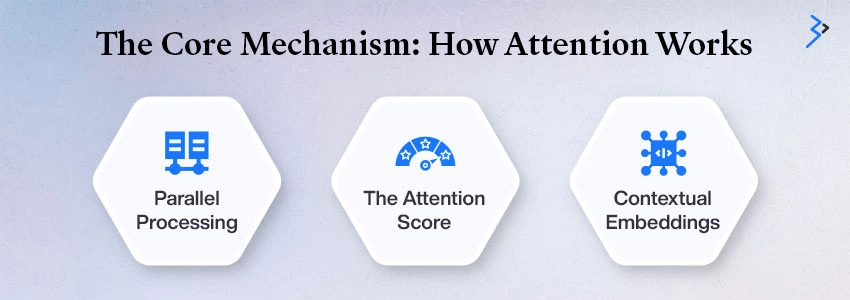
To understand how the Transformer model works, focus on its key feature: the Attention Mechanism.
Older models, such as RNNs, process information sequentially by handling one word at a time. As a result, they often lose track of earlier words, leading to confusion in long sentences. In contrast, the Transformer operates like a team of managers. When it encounters a new word, it considers the relevance of every other word in the input, enabling it to grasp context much better than older models.
Here is the basic concept:
- Parallel Processing: Instead of processing words sequentially, the Transformer processes the entire sentence or document simultaneously. This parallel capability drastically reduces the time required for training and inference compared to older models, making large-scale AI viable.
- The Attention Score: The mechanism assigns an “attention score” to each word to show its importance relative to others. In “The bank was overflowing, so I went to the river bank,” “bank” refers to the land by the river, not a financial institution.
- Contextual Embeddings: The scoring process creates detailed representations of words, called embeddings, that change based on surrounding text. The AI’s enhanced capabilities allow it to understand subtle meanings, sarcasm, and intricate connections within language.
Understanding long-range context transformed simple language processing into accurate language comprehension. This advancement also made sophisticated language generation possible.
The Transformer Advantage: Why Businesses Care
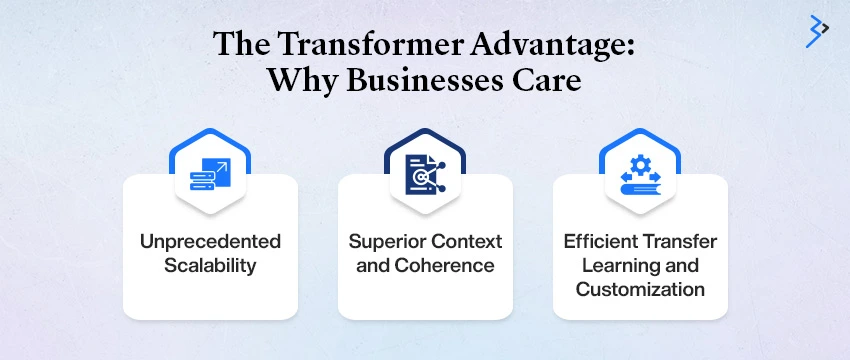
The Transformer’s architectural superiority translates directly into measurable business advantages across three key areas:
01 | Unprecedented Scalability
The shift to parallel processing enabled the development of Large Language Models (LLMs). Earlier models faced limitations due to hardware that could only handle millions of parameters. The Transformer architecture helped models scale up dramatically, with today’s LLMs containing hundreds of billions of parameters. This scale gives them extensive knowledge and near-human reasoning abilities.
02 | Superior Context and Coherence
Because the Attention Mechanism processes the entire sequence simultaneously, the generated text maintains coherence and contextual relevance across massive paragraphs and pages, not just a single sentence. The following is crucial for enterprise applications:
- Summarization: Condensing a 100-page legal contract into key clauses without losing critical context.
- Drafting: Generating long-form, multi-section reports or marketing content with a consistent brand voice.
03 | Efficient Transfer Learning and Customization
Big language models like GPT are trained on vast amounts of internet data, giving them general knowledge. Companies can then adapt these models using their specific information, making it quicker and cheaper to create specialized AI systems. This results in an AI that better understands the company’s data and industry terms.
Generative AI: From NLP to Enterprise Revolution
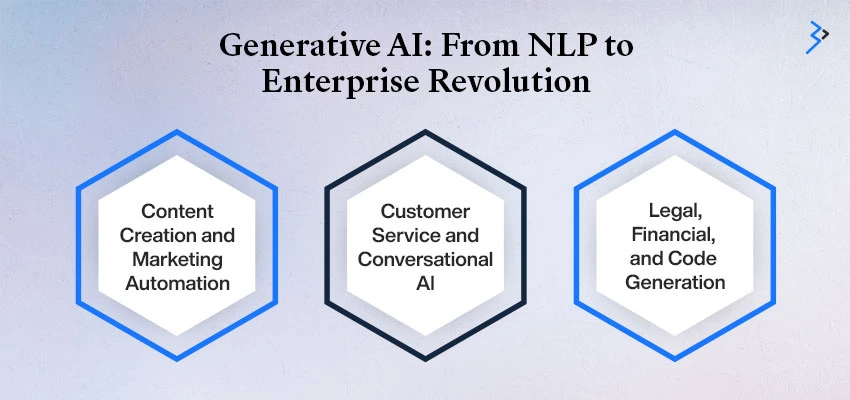
The true revolution came when researchers began using a modified version of the Transformer, the Decoder-Only architecture, to focus purely on generation. The development of the Generative Pre-trained Transformer (GPT) models arose from predicting the next logical word based on a prompt.
This capability is transforming core business functions globally through:
1. Content Creation and Marketing Automation
Marketing teams now use advanced computer models to quickly create unique and SEO-friendly product descriptions and social media posts. This speed lets companies launch new products and test marketing messages much faster.
2. Customer Service and Conversational AI
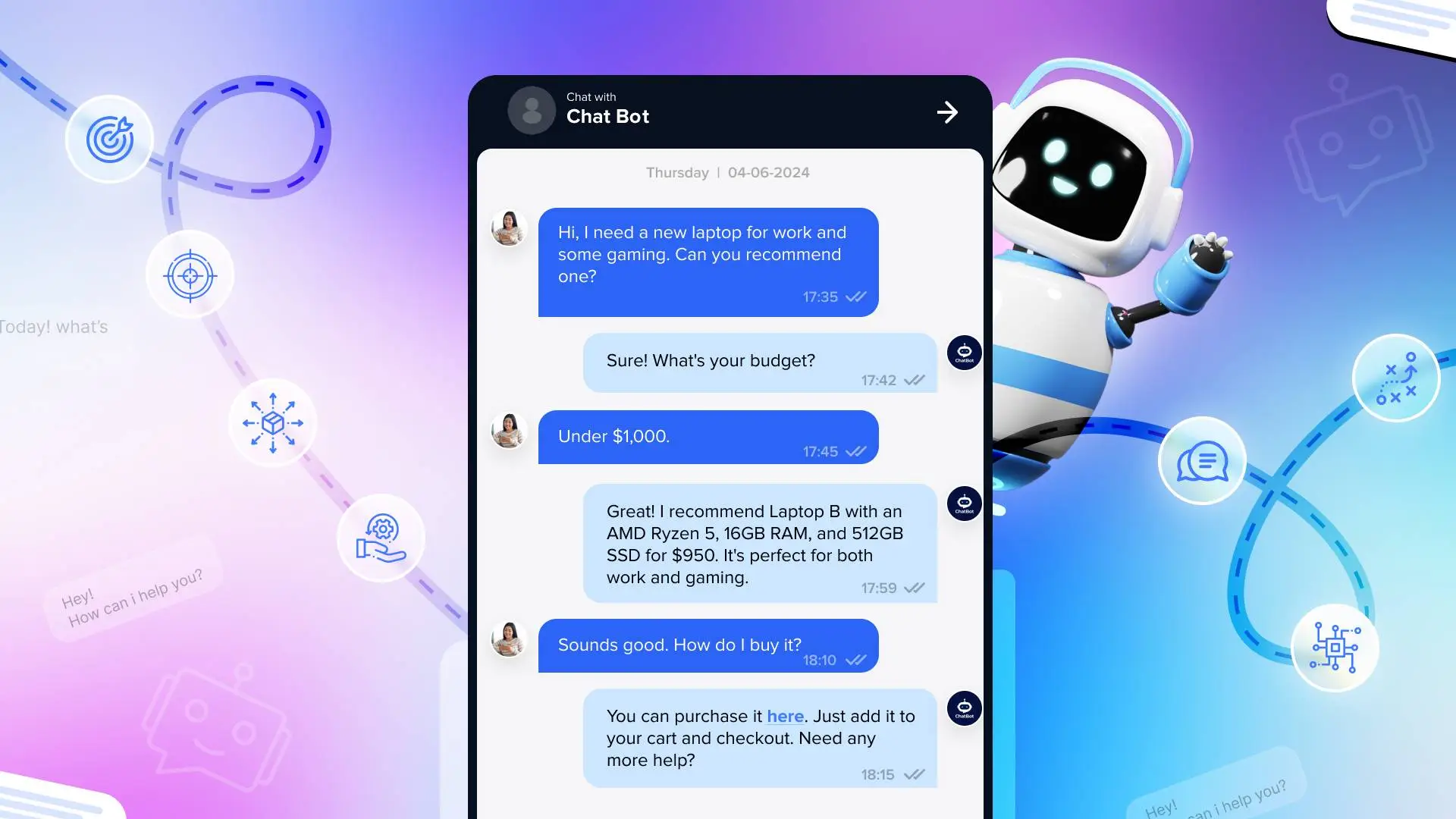
Transformer models have transformed chatbots and virtual assistants, powering modern AI Chatbot Software capable of managing complex conversations and long contextual interactions. Unlike older ones, they can understand and manage long conversations, handle complex customer queries, and quickly summarize past interactions. This automation enables 24/7 customer support, saving costs and turning customer service into a valuable knowledge-gathering tool.
3. Legal, Financial, and Code Generation
Generative NLP excels at understanding and creating organized content. It can quickly review documents like contracts to find errors or summarize them. In software development, tools like GitHub Copilot help programmers by suggesting code and fixing bugs, making development faster and more productive.
The Impact on Productivity and Scale
The move to the Transformer architecture is not just a technical shift; it’s an economic transformation. It democratizes access to high-quality Artificial Intelligence and exponentially boosts knowledge worker productivity.
The widespread adoption of these LLMs is a clear indicator of their value.
According to Reuters, as of August 2024, OpenAI announced that ChatGPT had surpassed 200 million weekly active users worldwide, marking a significant rise from the previous year.
This milestone highlights the platform’s rapid adoption and growing role in everyday digital interactions, from education and business workflows to creative and technical problem-solving.
Enterprises that deploy these tools see immediate returns:
- Data Insight at Scale: A big insurance company can examine many documents, such as customer claims, reviews, and emails. Using advanced data analysis, they can spot new trends or signs of fraud that human teams find hard to notice or handle quickly.
- Operational Efficiency: Workers can use AI to handle basic tasks like writing initial email replies, summarizing meetings, or creating standard parts of contracts. The flexibility in their roles enables them to concentrate on creatively solving problems and managing more critical responsibilities.
According to McKinsey & Company, organizations that effectively integrate AI, especially generative and agentic AI, can unlock significant cost savings. They can reduce their total cost base by 25-40%. A large insurance company can review many documents, such as customer claims, reviews, and emails. Using advanced tools, they can quickly find new trends or signs of fraud that might be difficult for people to catch.
To achieve this, it’s essential to introduce new ways to automate processes, make decisions faster, and simplify work. The report points out that these improvements come from decreasing manual work and rethinking how the entire business operates, which helps increase productivity and flexibility in different departments.
Conclusion: Partnering for a Smarter Future
The Transformer architecture has been a game-changer in artificial intelligence (AI) over the past 10 years. It is the main driver behind modern Generative AI and large language models. By using an attention mechanism and allowing for parallel processing, Transformers have overcome the limitations of earlier natural language processing (NLP) methods, leading to greater scale, speed, and intelligence.
For businesses, this means you can quickly understand and create language that fits your specific needs. The real challenge now is not the technology itself, but figuring out how to effectively incorporate these powerful models into your existing systems.
At Brainvire, we focus on customizing and implementing Transformer-based language models for businesses. We work with you to determine the best use cases, fine-tune the models using your specific data to ensure relevance, and set up the necessary security and ethical guidelines.
Partnering with us means you use cutting-edge technology and gain a significant competitive advantage by leveraging the latest advances in NLP.
FAQs
The Transformer model looks at whole sentences or groups of words simultaneously, rather than one word at a time, like older models (RNNs or LSTMs). Thanks to the Attention Mechanism, this ability to process everything simultaneously allows it to remember important details from long texts. It can also work quickly and efficiently with large amounts of data, producing text that sounds natural and human-like.
Like older models, the Transformer model can read entire sentences or phrases simultaneously, instead of just one word at a time. The approach makes it faster and better at remembering important information from longer texts. Because of this, it can handle large amounts of data and create text that sounds very natural, similar to how humans write.
Attention helps Transformer models determine how important each word in a sentence is compared to the other words. Models like GPT and BERT are good at understanding the subtleties, feelings, and intentions behind the words in a sentence.
Transformers are advanced technologies that help different business tools work better. These technologies are used in chatbots, legal document analysis tools, marketing automation, and code-writing assistants like GitHub Copilot. Automating regular language tasks makes it easier and faster to get work done while ensuring the information is accurate and easy to understand.
Brainvire focuses on creating and improving language models powered by AI that fit different business requirements. We assist companies in implementing AI solutions to boost efficiency and achieve real results. We also set guidelines to ensure AI’s ethical use and keep data secure.
Related Articles
-
 Chatbots and Their Impact on Customer Support
Introduction In today’s digital age, where customer expectations are sky-high, businesses constantly seek innovative ways to enhance customer experience (CX). Enter chatbots – virtual assistants that are revolutionizing the customer
-
 How is AI-led Adobe Solution Shaping the Future of eCommerce?
In a world where technology is still revolutionizing sectors, thereby changing the face of business, artificial intelligence is at the forefront of innovation. Let us explore AI empowered as we
-
The Future of AI Agents: How Intelligent Automation Is Transforming Enterprise Workflows
We’re entering a new era of automation~ smarter, faster, and more human-like than ever. For years, businesses used basic automation to handle repetitive tasks, but those tools couldn’t adapt or