The “Zero-Loss” Retailer: Mastering Vertical AI for Demand and Security
-

Pratik Roy

Imagine a Monday morning when your stockroom is perfectly balanced: no overstocked winter coats gathering dust, yet every best-selling sneaker is ready for the morning rush. Across town, a suspicious return attempt is flagged and blocked by your system before the customer even reaches the counter: no frantic phone calls, no emergency shipments, and no shrinkage headaches.
This isn’t a retail fairy tale. It’s the reality of the “Zero-Loss” Retailer.
In 2026, the gap between market leaders and the rest of the pack is being defined by Vertical AI. While general AI (the kind that writes your emails) is a versatile generalist, Vertical AI is the specialist. It is a model purpose-built for the high-speed, high-stakes world of retail. It understands seasonality, the impact of a local heatwave on cold-brew sales, and the subtle digital fingerprints of a professional fraud ring.
The stakes couldn’t be higher. Reports by Appriss Retail and Deloitte show that retailers lose $103 billion annually to returns fraud, a staggering 15% of the total $685 billion lost to all forms of retail shrinkage. Meanwhile, traditional forecasting remains a guessing game, leading to stockouts that frustrate customers and overstock that eats margins. But for those mastering Vertical AI, the story is different: we are seeing stockouts drop by 20-50% and inventory accuracy hitting levels once thought impossible, as noted by McKinsey.
Vertical AI in Retail: The Specialized “Brain” Your Business Needs
What makes “Vertical AI” different from the AI everyone was talking about last year? It is like the difference between a general practitioner and a heart surgeon. While General AI (Horizontal AI) can write a poem or summarize a meeting, Vertical AI is specifically designed, trained, and optimized for a particular industry, domain, or specialized function.
[ Read More: Generative Models Unpacked: The Innovations Powering Next-Gen AI ]
It is pre-trained on industry-specific “ontologies”, meaning it doesn’t just see numbers; it understands that a “markdown” in July has a different ripple effect than one in December. It integrates multi-source data, including:
- Internal Signals: Point-of-Sale (POS) logs, inventory levels, and promotional calendars.
- External Signals: Local weather patterns, community events (like a stadium concert), and shifting social sentiment.
Unlike general models, Vertical AI excels at high-stakes, domain-specific tasks:
- Predicting Demand: It moves beyond historical averages. It realizes that a 2-degree temperature drop, combined with a local high school football game, will spike sales of hot cocoa and blankets by 22% in a specific zip code.
- Real-Time Security: It acts as a digital sentry, monitoring transactions 24/7. It can spot a “polymorphic” fraud pattern, where a thief slightly alters their method across five different stores, in seconds, a task that would take a human analyst weeks to correlate.
At a Glance: General AI vs. Vertical AI
| Feature | General (Horizontal) AI | Vertical (Industry-Specific) AI |
| Core Goal | Versatility across all tasks. | Precision in a specific niche. |
| Data Context | Starts with zero industry context. | Pre-trained on retail logic and terminology. |
| Primary Use Case | Content creation, basic Q&A, coding. | Demand forecasting, fraud prevention. |
| Implementation | “Project-based” (requires custom build). | “Product-based” (designed to plug in). |
| Reliability | Prone to “hallucinations” in complex tasks. | High accuracy (95%+) in domain tasks. |
| Data Handling | Struggles with siloed, messy retail data. | Built to unify POS, ERP, and IoT signals. |
Retail Rewired reports that currently, 90% of retailers are exploring AI, but there’s a catch. Most are stuck in “Pilot Paralysis” because their data is siloed, hidden in different departments that don’t talk to each other. This is why only 3% of retailers feel truly ready to scale these systems, according to Deloitte.
Demand Forecasting: Predicting the Future Without the Crystal Ball
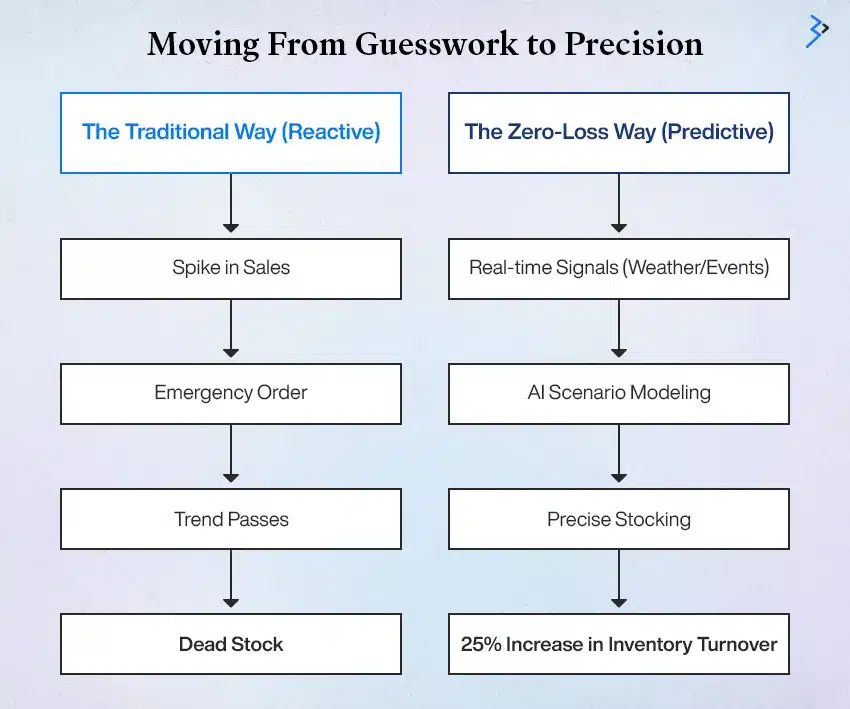
Traditional demand planning is reactive. You see a spike, and you order more. But by the time the stock arrives, the trend has often passed. Vertical AI shifts the model toward prediction. By adopting these tools, companies report a 20-50% improvement in forecast accuracy, which translates directly into fewer markdowns and stronger margins.
How It Works
AI ingests thousands of data points: POS transactions, promotions, macro-economic shifts, and even competitor pricing. It then runs “what-if” scenarios.
What if the shipping lane is delayed? What if we run a 20% discount on Tuesday instead of Friday?
At Brainvire, we use Machine Learning (ML) to automate these trend predictions. This helps retailers achieve:
- Dynamic Baselines: Your “normal” stock levels adjust daily based on real-time signals, not monthly averages.
- Reduced Overstock: By knowing exactly what will sell, you avoid the “overstock trap” and can reduce excess inventory by up to 25%.
- Improved Inventory Turns: Moving product faster means your capital isn’t tied up in boxes sitting in a warehouse.
The biggest challenge isn’t the AI itself; it’s data integration. Most mid-to-large retailers have data stuck in legacy ERP systems. Our roadmap starts with unifying this data onto a single platform, creating a “clean” stream the AI can use to drive ROI of up to 10x.
Security and Fraud Prevention: The 24/7 Digital Sentry
Retail crime has evolved. It’s no longer just about shoplifting; it’s about Returns Fraud, “Wardrobing” (buying an outfit for an event and returning it), and “Bracketing” (buying five sizes and returning four).
Fraudsters are getting smarter, too. Deloitte reports a 37% spike in AI-generated fraudulent traffic in the last year alone, with 69% of retailers reporting they’ve been targeted by AI-enabled fraud.
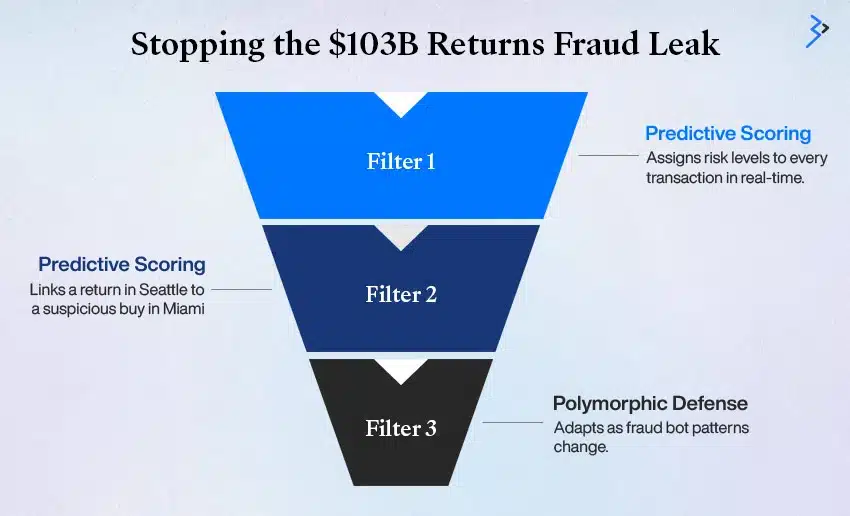
Vertical AI uses Predictive Scoring to assign a “risk level” to every transaction and return.
- Anomaly Detection: Surveillance AI monitors both digital and physical footprints 24/7. It can link crime cases together, recognizing that a fraudulent return in Seattle is connected to a suspicious purchase in Miami.
- Polymorphic Defense: As fraudsters use AI to change their attack patterns, Vertical AI learns and adapts in real-time.
With 87% of retail leaders expecting fraud to rise this year, according to Fisher Phillips, having an AI that flags risks in real-time is no longer a luxury; it’s a survival requirement. By implementing these specialized safeguards, retailers can protect the revenue lost to return
Real-World Mastery: Who is Winning?
Top global brands are no longer just “testing” AI; they are integrating it into their core operations to eliminate waste and protect margins. Here is how the industry leaders are mastering Vertical AI:
Walmart: Localized Accuracy at Scale
Articsledge shows Walmart utilizes Vertical AI to analyze millions of SKUs against neighborhood-level signals like local weather and promotions.
- The Impact: This hyper-local forecasting has resulted in a 30% reduction in logistics costs and helped drive a 26.18% YoY growth in earnings per share (EPS).
- Supplier Automation: Their AI even automates supplier negotiations, achieving a 68% success rate and cutting costs by an average of 3%.
[ Read More: Your Smart Guide to UAE Construction Cost Control with Odoo ERP ]
Target: Empowering the Frontline
Articsledge also shows Target has deployed Vertical AI in nearly 2,000 stores through its “Store Companion” chatbot.
- The Impact: This GenAI tool assists frontline workers with real-time inventory checks, significantly boosting turnover ratios.
- Personalization: By feeding POS and online data into a specialized engine, they’ve reduced reliance on clearance sales and enhanced customer loyalty through tailored recommendations.

Levi Strauss: Granular Demand Sensing
VKTR’s case studies show that Levi Strauss uses AI in partnership with SAS to plan supply chains down to specific geographies, styles, and sizes.
- The Impact: By processing consumer signals at a granular level, they align shelf stock with actual local demand, predicting risks before they hit the bottom line.
Brainvire’s Zero-Loss Roadmap
Building a Zero-Loss enterprise doesn’t happen overnight. We recommend a phased approach:
| Phase | Timeline | Primary Objectives | Core Outcomes |
| 01 | Audit and Pilot | Months 1–3 | Data unification and deploying a “Demand Bot” for a single product category. | Proof of Concept: Validates AI accuracy in a low-risk environment before a full-scale rollout. |
| 02 | Deploy | Months 4–6 | Implementation of AI security surveillance and real-time fraud detection systems. | Visibility: Launch of a live ROI dashboard to track and measure prevented shrinkage in real-time. |
| 03 | Scale | Months 7+ | Full integration with ERPs (Odoo, SAP) and eCommerce platforms for autonomous operations. | Efficiency: Supply chains become self-optimizing, with a projected 25% increase in inventory turnover. |
With over 100+ AI experts and a deep focus on Retail IT, Brainvire is the partner of choice for brands moving toward the “Zero-Loss” future.
Future-Proofing: The 2026 Vision
As we move through 2026, we are entering the age of Agentic Commerce. This means AI won’t just “suggest” an order; it will autonomously negotiate with suppliers, re-route deliveries to avoid weather, and instantly adjust pricing to beat a competitor’s flash sale.
The biggest risk in 2026 is the “AI Data Divide.” Retailers with unified data will achieve zero-loss operations, while those with siloed data will struggle with rising fraud and inaccurate stock. The question isn’t whether AI is coming to retail, it’s whether your data is ready to power it.
Ready to start your Zero-Loss journey? Contact our experts today.
FAQs
General AI (like ChatGPT) has broad knowledge but lacks the context of retail. Vertical AI is specifically trained on retail data, like SKU performance, seasonality, and shipping logs, making it much more accurate for demand forecasting and fraud detection.
On average, Vertical AI can reduce stockouts by 20-50%. By analyzing real-time signals rather than relying on historical averages, the system can predict a surge in demand days or weeks in advance.
Yes. In 2025, we saw a 37% spike in AI-driven fraudulent traffic. Fraudsters are using AI to create “synthetic identities” and bypass traditional security. Vertical AI is the only way to combat this, as it can detect the microscopic patterns these bots leave behind.
Absolutely. AI uses predictive scoring to flag “serial returners” or patterns consistent with fraud (like returning an item that was never actually shipped). This helps retailers block fraudulent returns without hurting the experience for loyal customers.
Multiple sources show that most retailers see a 1.7x to 10x ROI within the first 12 months. The “Experiment” phase usually shows results within 90 days, primarily through improved forecast accuracy and reduced manual labor in demand planning.
Related Articles
-
 AI-Powered Banking: Enhancing Human Expertise for Improved Customer Experience
The fear is real. Artificial Intelligence(AI) has shown it can pass competitive exams and even clear job interviews. So does it mean it’s coming for your job at the bank?
-
 AI-Driven Fintech Apps: Preparing for the Next Generation of Digital Banking
The pace at which the financial sector is transforming is remarkable. Traditional banks with physical branches are being rapidly overshadowed by digital-first experiences that offer personalization, speed, and predictive intelligence,
-
The NLP Revolution: Tracing the Evolution of Transformer Models
AI has always aimed to understand human language, to write clearly, send personalized messages, and summarize complex information in seconds. For years, traditional Natural Language Processing (NLP) tried to do