Build vs. Buy: When AEM Components Outperform Custom FE Frameworks
-

Hiren Raval

There’s always that classic “Build vs. Buy” dilemma we all wrestle with, especially when it comes to an enterprise-grade Digital Experience Platform (DXP) like Adobe Experience Manager (AEM). Going for a custom, high-tech Front-End (FE) framework is tempting. Think React, Vue, or even the latest twist from Svelte.
The promise of top-notch performance and unmatched flexibility sounds really enticing.
But here’s the harsh reality that often gets overlooked in the initial excitement: The long-term Total Cost of Ownership (TCO) for a pure custom FE framework within the AEM ecosystem is a hidden budget killer.
At Brainvire, we’ve helped many enterprise teams make this decision. Generally, using and enhancing AEM’s native components, especially the AEM Core Components, is often the easiest and most cost-effective choice.
Here’s a comprehensive and precise cost comparison to help you decide what’s best for your team, budget, and digital strategy.
1. The Real Cost of “Custom”: Beyond the Initial Sprint
The appeal of a completely custom component, built from the ground up on a preferred JavaScript (JS) framework (e.g., a decoupled React application integrated via the AEM Headless CMS), is undeniable. It offers:
- Pixel-Perfect Control: Complete design freedom
- Performance Promise: Highly optimized bundles and faster page loads
The high cost of custom software development persists even after the team checks the component into Git. The focus needs to be on maintenance, upgrades, and developer overhead—factors that rapidly inflate the TCO.
| Cost Factor | AEM Core Component (Extend/Overlay) | Custom FE Framework (e.g., React SPA) | Engineering Impact |
| Initial Development | Moderate (mostly styling/logic extension) | High (Build, Test, Integrate, Document) | Slower Time-to-Market (TTM) for foundational features. |
| AEM Version Upgrades | Low (Core Components are backward compatible by design) | High (Manual code review, dependency updates, potential re-architecture) | Significant, unplanned engineering debt and project delays. |
| Security & Audits | Low (Adobe-managed and constantly audited) | High (Custom component is your team’s full responsibility) | Time spent on fixing vulnerabilities is diverted from innovation. |
| Authoring Experience | Low (Native AEM UI, drag-and-drop) | Moderate/High (Requires custom Authoring Interface/Sling Model integration) | Lower content velocity for AEM Content Manager teams. |
| Team Onboarding | Low (Standard AEM/HTL skills) | High (Requires AEM knowledge plus deep expertise in the chosen JS framework) | Higher hiring and training costs, increasing friction in scaling teams. |
The Engineering Reality
According to an article published in Dr. Dobb’s Journal, developing a reusable software asset can initially cost 1.5 to 2.2 times more than creating a single-use component. However, you can start realizing the benefits immediately by leveraging AEM Core Components, which already embed this upfront investment in reusability. When you build custom, you pay that 1.5-2.2x multiplier plus the ongoing cost of maintenance and version-lock. A custom React component tied to an outdated version of AEM can easily become a blocker during essential DXP upgrades.
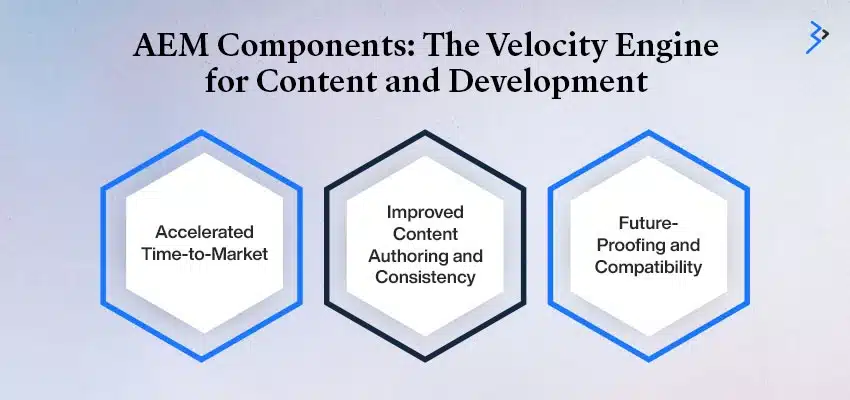
2. AEM Components: The Velocity Engine for Content and Development
The modern digital landscape demands speed. Your marketing team needs new campaigns live yesterday, and your development team needs stable, predictable release cycles. AEM Core Components excel as a powerful engine for enhancing content velocity.
The AEM Core Component Advantage: Faster TTM and Higher ROI
AEM Core Components are more than just pre-built UI elements; they are highly optimized, production-ready blueprints that follow Adobe’s best practices. Their core benefits translate directly into measurable efficiency gains:
A. Accelerated Time-to-Market (TTM)
By utilizing or minimally customizing Core Components, your team drastically reduces boilerplate coding. The primary focus shifts from building a component (HTML, CSS, Sling Model, Dialogs, HTL) to simply styling and extending it (mostly CSS/JS).
A study conducted by IDC for Adobe Experience Manager Sites revealed that organizations saw an average ROI of 348% over three years. This surge in return was attributed directly to faster time to market, increased team productivity, and enhanced customer experience.
Engineering takeaway: Your developers can concentrate on creating unique, differentiating features. They won’t waste time rebuilding basic Title or Button components repeatedly.
B. Improved Content Authoring and Consistency
A significant pain point with custom FE frameworks is the poor authoring experience they can create if not meticulously integrated. AEM Content Managers rely on the consistency and predictability of the native UI.
The Adobe Experience Manager Core Components documentation explains that these components aid in creating versatile tools for content authors, significantly enhancing the authoring process and enabling non-technical users to navigate more easily. This focus on Authoring Experience (AX) directly impacts speed.
According to a blog by Rezolve.ai, organizations that adopt advanced technologies like generative AI and automation in their service desk operations see up to a 60% reduction in support-ticket volume, freeing up cross-functional teams (such as marketing) to move faster and more efficiently. A well-governed AEM Core Component ecosystem contributes to this by reducing “how-to” authoring tickets.
C. Future-Proofing and Compatibility
AEM Core Components are explicitly designed for compatibility and upgradeability, especially within AEM as a Cloud Service. When Adobe releases a new AEM version or a Core Component update, the path to adoption is clear and low-risk.
The Custom Component Risk: A custom Adobe Experience Manager JS framework or a non-Core Component implementation introduces a significant risk layer. Adobe’s white paper states that long-term maintenance benefits are easily overlooked when you begin a project. But two or three years later, when you’re maintaining home-grown functionality, Experience Manager Core Components can make a significant difference from a cost-saving and productivity perspective. You avoid the “rewriting roadblock” that plagues custom systems.
3. The Front-End Framework Integration: Where to Draw the Line
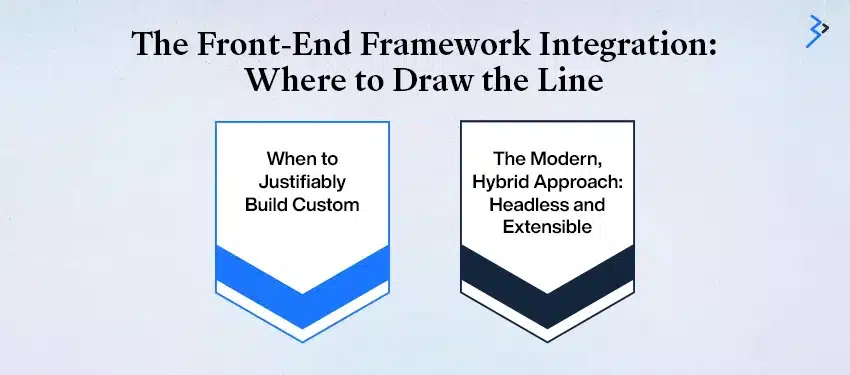
While the Core Components handle the vast majority of standard UI elements (text, image, list, navigation), there are times when a full custom FE framework is genuinely necessary. The key is knowing where to draw the line.
Read More-: Elevate your Adobe Experience Manager Sites Website with Generative AI Chatbots
When to Justifiably Build Custom
You should consider building a custom FE application on a modern Adobe Experience Manager JS framework (like React, Angular, or Vue) only for:
- Highly Interactive Applications: A complex portal, a checkout funnel with dozens of states, or a custom real-time data visualization dashboard.
- Actual Application Experiences: Features that behave more like an application than a static content page (e.g., a complex insurance quote calculator or a multi-step user configuration tool).
- Specific Performance Benchmarks: Where a fraction of a second in page load directly impacts conversion, necessitating a decoupled architecture.
The Modern, Hybrid Approach: Headless and Extensible
The best strategy marries the stability of AEM components with the flexibility of modern FE frameworks:
- Use Core Components as the Default: Leverage Core Components for every standard marketing page element (headers, footers, text blocks, images, navigation, etc.). This is your primary cost-saving solution.
- Extend, Don’t Re-Invent: According to Adobe Experience Manager Core Components documentation, you should never modify the Core Components code directly, as such customizations make upgrades painful and unsupported. Instead, use patterns like proxy components or Sling Model delegation to safely extend their functionality and styling.
- Isolate the Custom Framework: For those complex 20% “application-like” use cases, build your custom FE framework (the React or Vue app). Embed this custom component into an AEM page as an isolated micro-frontend. This way, the custom code is confined, reducing its impact on the rest of the DXP’s stability and maintenance.
4. The Content Migration Cost Perspective
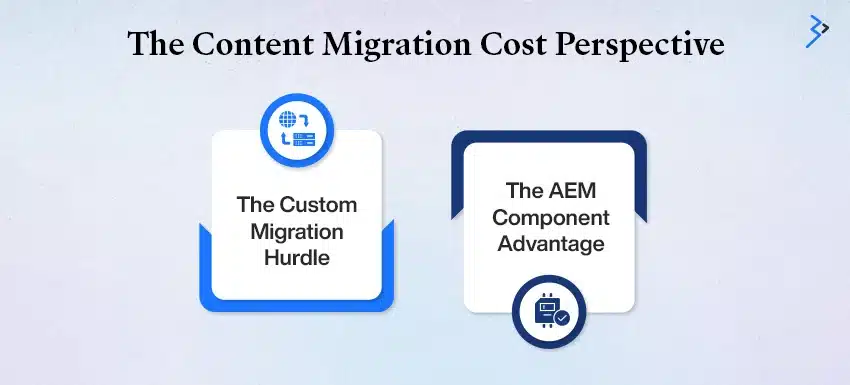
Another crucial area where native AEM component architecture pays dividends is during major platform initiatives, particularly AEM Content Migration.
Moving millions of pages and digital assets from a legacy system (or an older, custom AEM implementation) to AEM as a Cloud Service is complex. A primary source of complexity is the lack of component standardization.
- The Custom Migration Hurdle: Every non-standard, custom-built component requires a dedicated, bespoke migration script to map its structure and content into the new environment. More custom components mean exponentially more scripting, testing, and risk.
- The AEM Component Advantage: Core Components and their recommended extensions are predictable and standardized. Tools like Adobe’s Content Transfer Tool (CTT) and the Cloud Acceleration Manager (CAM) effectively handle this content seamlessly because they understand and support the underlying structure.
According to a recent industry guide for Adobe Experience Manager (AEM) migrations, the duration of an AEM content migration can vary significantly based on factors such as the complexity of your environment, the volume of content, and the extent of customizations. It can take anywhere from a few weeks to several months.
Minimizing component customization and adhering to Core Component standards directly reduces the duration and complexity of all future migrations, which is a massive win for the engineering budget and a safeguard against unexpected project delays.
Read More-: The Adobe Experience Manager Advantage: 5 Pillars Powering Next-Gen eCommerce
Our Closing Recommendation: Maximizing Your AEM Investment
Decision Matrix
| Prioritize AEM Core Components | Justify Custom FE Framework | |
| Goal | Consistency, speed, low TCO, and easier upgrades. | Precise interactivity, application-like experience. |
| Cost Driver | Reduced long-term maintenance/upgrade cost. | Initial high development cost + high long-term maintenance. |
| Risk | Low (Adobe-supported, standard pattern). | High (Version lock, technical debt, custom security fixes). |
| Best Practice | 90% of your website content and UI. | 10% (Isolate complex application functionality). |
At Brainvire, we are experts in architecting AEM solutions that strategically blend the power of Core Components with targeted, modern Front-End development. We help you identify where to leverage the “Buy” (AEM Core) to save budget and where to strategically “Build” (Custom FE) to win the market.
Don’t let the promise of a custom framework blind you to the hidden costs of maintenance and technical debt. We view AEM as your long-term, scalable asset. Our approach ensures that every component is a strategic contributor to your overall success. By partnering with us, you gain a trusted advisor who helps you build smart, using AEM Core Components as the foundation for rapid, resilient, and cost-effective digital experiences.
Frequently Asked Questions
AEM Core Components are Adobe-built, secure, and upgrade-friendly. They reduce maintenance, speed up delivery, and lower Total Cost of Ownership (TCO). Custom frameworks like React or Vue often add complexity, higher costs, and version-lock risks.
Opt for a custom framework only when creating highly interactive apps, such as real-time dashboards or complex configurators. For most websites, extending AEM Core Components is faster, simpler, and more sustainable.
According to International Data Corporation (IDC), organizations using Adobe Experience Manager Sites realized a 348% three-year ROI, thanks in large part to much faster time-to-market and higher team productivity through reuse of core components rather than rebuilding foundations.
Core Components follow consistent patterns, making migrations smoother with Adobe tools like the Content Transfer Tool (CTT). Industry insights show AEM migrations can take a few weeks to several months, but standardized components shorten that timeline.
Brainvire recommends a 90/10 approach: Use AEM Core Components for 90% of your site and reserve custom FE frameworks for the complex 10%. This ensures speed, stability, and long-term cost efficiency.

Related Articles
-
 Why US Manufacturers Are Moving from Legacy Systems to Adobe Commerce
US manufacturers are no longer competing solely on product quality. Digital experience now plays a decisive role in how buyers evaluate, select, and remain loyal to suppliers. From initial product
-
Why Enterprises are Moving to Adobe Commerce Cloud for Scalable eCommerce?
Summary Choosing the right platform can be the most crucial aspect of your business! Wonder why? There are nearly 26 million eCommerce websites on the Internet, indicating that your business
-
 Why Does Adobe Experience Manager Matter – Accelerating the Journey from Content to Experience
Customers who contact a company receive an experience, whether in person, on a website, in a tailored email, or via an app notification. Consider an experience a collection of material