Your Complete Guide to Hiring Software Development Partners in Kuwait and the GCC
-

Pratik Roy

Searching for the right software partner in the Middle East often feels like trying to find a specific storefront in a bustling traditional souq; there is plenty of noise, a lot of promises, but very few guides who actually know the backstreets of local regulation and user culture.
You might have a world-class product, but if your digital partner doesn’t understand the nuance of how a Kuwaiti user interacts with a screen or how a Saudi regulator views data residency, your global expansion can stall before it even starts.
In this region, the gap between a coder and a partner is measured in more than just successful deployments; it’s measured in regional fluency. While the GCC presents a staggering $1 trillion economic opportunity, as noted by Gulf News, the path to entry is guarded by strict CITRA standards and the unique architectural challenge of Arabic-first (RTL) logic.
The stakes have never been higher. With the Middle Eastern IT market growing at a 12.5% CAGR according to Grand View Research, the talent gap has become a strategic bottleneck for those who don’t know where to look.
Cyber Defense Magazine shows that 65% of businesses report misaligned expectations with their developers, proving that in Kuwait’s high-stakes digital economy, choosing a partner isn’t just a technical decision, it’s a survival requirement for your ROI.
The Kuwaiti Advantage: A Strategic Hub
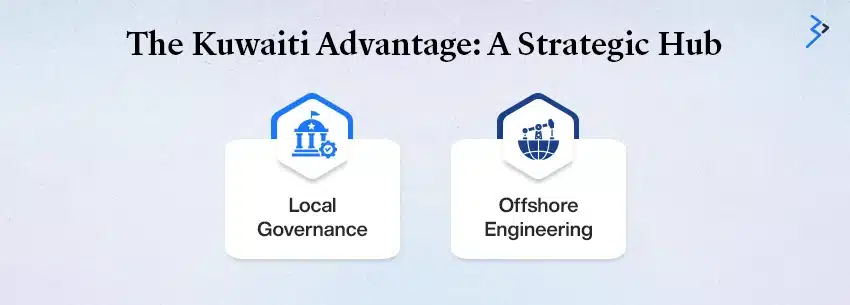
While other regions grab headlines, Kuwait has quietly become one of the easiest places to do business in MENA. It serves as a sophisticated gateway for firms wanting a foothold in the Saudi market while benefiting from Kuwait’s robust legal frameworks.
However, the market is tight. Tech Behemoth notes that currently, only about 28 specialized software firms in Kuwait are equipped to handle large-scale enterprise gateways. This scarcity has led to the rise of the hybrid model, which has become the gold standard for regional success:
- Local Governance: On-ground experts who navigate Arabic UX and Sahel (Kuwait’s government app) integrations.
- Offshore Engineering: High-output teams that cut Total Cost of Ownership (TCO) while maintaining 24/7 velocity.
Regional Pitfalls: Why Projects Stall
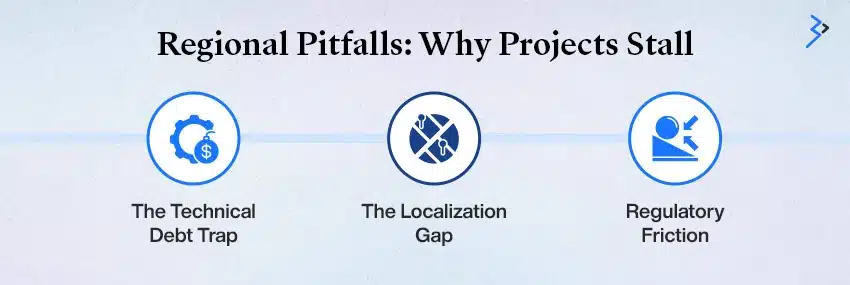
Navigating the Middle East digital landscape requires more than just technical skill; it requires a blend of cultural empathy and regulatory fluency. Projects often stall not because the code is bad, but because the context is missing. Here are the primary deal-breakers we see:
- The Technical Debt Trap: Many organizations succumb to the lowest bidder siren song. Scale Computing reports that in specialized sectors like banking or eCommerce, budget vendors often prioritize speed over structure. According to industry insights, these shortcuts accrue over $100,000 in technical debt within just three years. This manifests as brittle code and weak security patches that require a total (and expensive) overhaul just when you’re ready to scale.
- The Localization Gap: Arabic is a Right-to-Left (RTL) language, but true localization goes deeper than mirroring a layout. It affects visual hierarchy, the psychological weight of certain colors, and even how users navigate a menu with their thumb. If your partner lacks Arabic-first UX expertise, your app will feel translated rather than native, causing user retention to plummet as regional competitors offer a more intuitive experience.
- Regulatory Friction: Middle Eastern markets are tightening their digital borders. Kuwait-specific hurdles, such as data residency requirements (where certain data must stay on local servers) and CITRA-mandated cybersecurity protocols, can freeze a project entirely. If these aren’t baked into the initial architecture, you’ll find yourself retrofitting security at the eleventh hour, a move that is both costly and high-risk.

The Evidence-Based Selection Scorecard
Stop hiring based on portfolios; they are essentially greatest hits reels that hide the scratches and failed deployments. Instead, use a weighted scorecard to vet your next partner based on tangible, technical proof. This shifts the conversation from “what have you done?” to “how do you do it?”
| Criterion | Weight | Validation Evidence (What to demand) |
| Technical Depth | 25% | Demand to see live CI/CD pipelines (Continuous Integration/Continuous Deployment), actual sprint plans from active projects, and comprehensive architecture diagrams. |
| Compliance and Security | 20% | Request recent ISO certifications, redacted third-party penetration test reports, and evidence of successful CITRA audits. |
| Team Continuity | 15% | Review the CVs of the actual devs assigned to you. Validate that the firm’s attrition rate is <15%; you don’t want your project changing hands every two months. |
| QA and Post-Launch | 15% | Look for test coverage exceeding 80%. Ask for a Runbook example that details how they handle post-launch bugs and server scaling. |
| Contract and IP | 15% | Ensure you have a clear Service Level Agreement (SLA), code escrow options (protecting your source code if the vendor disappears), and transparent exit clauses. |
| Localization | 10% | Review live Arabic RTL samples. Check for accessibility audits to ensure the app works for all regional users, including those with visual impairments. |
Pro Tip: Always demand a Pilot MVP (Minimum Viable Product) under an NDA. Think of it as a trial marriage. If a team cannot deliver a small, functional feature in a two-week sprint, they lack the internal discipline to build your enterprise platform over six months.
The Strategic Partner Checklist: 10 Questions for Your Initial Consultation
Before you sign a Master Service Agreement (MSA), you need to cut through the sales pitch and look for operational substance. Use this checklist as your litmus test during your first deep-dive meeting with a potential Kuwaiti or regional partner. If they cannot answer at least eight of these with specific evidence, they likely lack the regional fluency required for a high-stakes deployment.
Regulatory and Technical Foundation
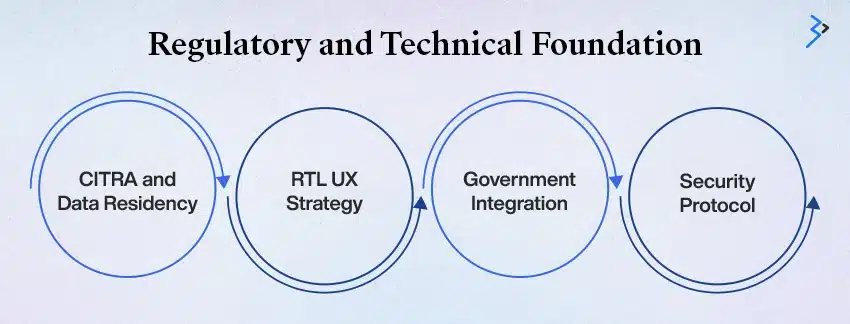
- CITRA and Data Residency: Can they point to a specific project where they implemented local data hosting to comply with Kuwaiti regulations?
- RTL UX Strategy: Do they treat Arabic as a translation layer, or can they demonstrate Right-to-Left mirroring in complex UI elements like navigation drawers and data tables?
- Government Integration: Have they successfully integrated with regional APIs like Sahel (Kuwait) or Absher/IAM (Saudi Arabia)?
- Security Protocol: Do they follow a Shift Left security approach, where vulnerability testing starts during the initial coding phase rather than at the end?
Operational Transparency
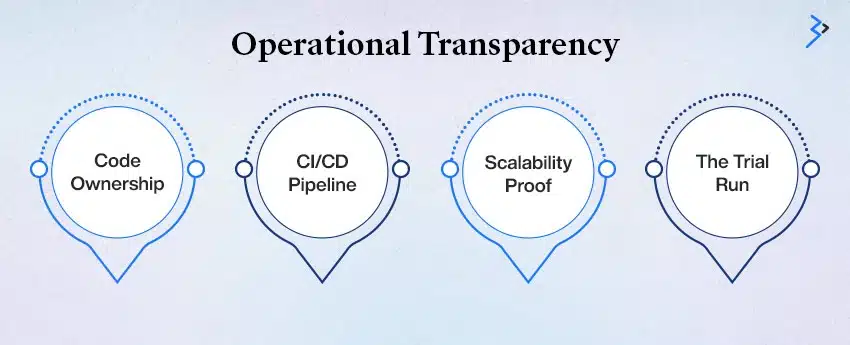
- Code Ownership: Will the contract explicitly state that you own the IP and the Full Stack documentation from the first sprint?
- CI/CD Pipeline: Can they show you a live deployment pipeline that automates testing and staging to minimize human error?
- Scalability Proof: Can they provide a case study where their architecture successfully handled a massive traffic spike (e.g., a Ramadan or Black Friday sale)?
- The Trial Run: Are they willing to execute a two-week paid Discovery Sprint or Pilot MVP to prove their team’s chemistry with yours?
Team and Continuity
- The Hybrid Balance: Who are your boots on the ground? Ensure you have a locally-based Project Manager who speaks your language and understands regional business etiquette.
- Retention Data: What is their developer attrition rate? A partner with revolving-door staffing will kill your project’s momentum and institutional knowledge.
Future-Proofing: The 2026 Horizon
The digital landscape of 2026 will not be defined by monolithic software, but by composable architecture, systems built from interchangeable blocks that help you swap out a payment gateway or an AI module without breaking the entire platform.
Furthermore, AI-native operations are becoming the new baseline. When selecting a partner, look beyond their current list of features. Ask them:
- “Can your architecture handle a 5x traffic surge during a high-stakes Ramadan sales event?”
- “Do you use AI-driven testing to automate your QA cycles and catch vulnerabilities before they reach production?”
At Brainvire, we don’t just find vendors; we curate a partner ecosystem designed to bridge the gap between Kuwaiti regulatory nuances and global engineering scale. With over 350 successful deliveries and a 95% on-time rate, we ensure your digital assets aren’t just built for today, but are ready for the next decade of Middle Eastern growth.
Contact Brainvire today for a Global ERM Maturity Audit or a vetted partner match. Let’s turn your risk into an asset.
Frequently Asked Questions
To prevent Vendor Lock-In in Kuwait, ensure your contract includes an explicit IP handoff and a code escrow clause. You must own the source code and technical documentation from day one. This guarantees the freedom to transition to a new partner without losing your entire digital investment.
As the official regulatory gatekeeper, CITRA mandates strict data residency and security standards. If your app handles financial data or government integrations and fails to comply, you face heavy fines, legal blocks, or total removal from the Kuwaiti market.
Absolutely. A pilot project mitigates significant procurement risks by acting as a trial run. It helps you evaluate a vendor’s real-world communication, coding standards, and speed before committing to a high-stakes, six-figure enterprise contract.
Rarely without local experts. Right-to-Left (RTL) design involves more than mirroring text; it dictates icon placement, font legibility, and user psychology. A partner with a proven Middle Eastern track record is essential for achieving a native, intuitive user experience.
For mid-complexity applications, expect a development cycle of 3–6 months. This helps with necessary security audits and CITRA compliance checks. Any vendor promising a fully compliant, enterprise-grade solution in just a few weeks is likely compromising on essential quality or security.

Related Articles
-
 Top 15 EV Charging Software Platforms To Consider in 2025
The transition to electric vehicles (EVs) is revolutionizing transportation, with EV charging infrastructure advancing rapidly to meet growing demand. Reliable, innovative charging solutions have become essential for businesses, cities, and
-
Top Retail Software Platforms to Use in 2025
In 2025, retail businesses will leverage cutting-edge software platforms to streamline operations, enhance customer experiences, and stay competitive in a dynamic market. These platforms provide solutions for inventory management, point-of-sale