How Hyper-Personalization is Rewriting the CX Rulebook in 2026
-

Bharat Patel
Imagine entering your favorite local coffee shop. The barista doesn’t just know your name; they know you’ve had a long week, that you prefer oat milk only on Thursdays, and that you’re likely running five minutes late for a Zoom call. Now, imagine a global brand with ten million customers doing that same thing, at scale, across every digital and physical touchpoint.
That is Hyper-Personalization.
We are officially past the era of “Dear Valued Customer.” Today, Frizbit notes that 71% of consumers expect personalized interactions, and 76% get vocally frustrated when they encounter generic, one-size-fits-all messaging. The rulebook hasn’t just been updated; it’s been entirely rewritten. If you aren’t predicting what your customer wants before they even know they want it, you aren’t just behind, you’re invisible.
The Great Leap: From Basic Segments to Predictive AI
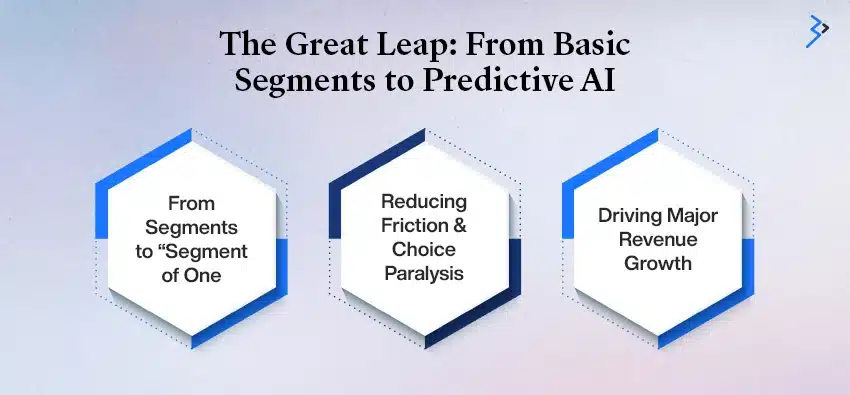
For years, marketing was built on “segments.” We lumped people into broad buckets like “Millennial Moms” or “Midwest Tech Enthusiasts.” It was better than nothing, but it was still a guess.
Hyper-personalization is different. It uses AI and real-time data to treat every customer as a “segment of one.” Instead of looking at what someone did six months ago, it analyzes what they are doing right now, their current location, their browsing speed, their device type, and even the local weather, to adjust content, pricing, and messaging on the fly.
This approach solves the “choice paralysis” problem by presenting exactly what a user needs at the exact moment they need it, removing the friction of decision-making. It’s no wonder that a majority of high-growth firms now prioritize unified data over almost any other tech investment. Experts forecast a shift toward “Hyper-Individualization,” where one’s emotional IQ meets technical precision. This isn’t just concerning efficiency; it’s about massive financial gains. McKinsey has noted that companies attaining this level of intimacy see revenue increases of up to 40% and marketing spend multipliers of 5x to 8x.
The 2026 Strategy: 5 Pillars of the New CX Rulebook
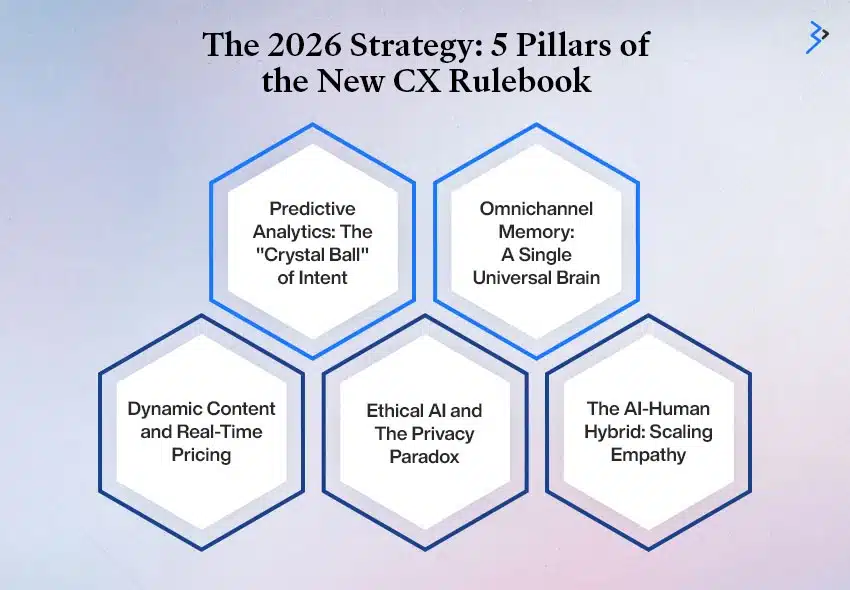
How do global leaders actually execute this without appearing “creepy”? It needs a strategic roadmap that balances data with ethics, resulting in staggering returns like a 2000% ROI, essentially $20 for every $1 spent, according to data from Amra & Elma. To reach this level of efficiency, brands are anchoring their strategy on these five non-negotiable pillars:
01 | Predictive Analytics: The “Crystal Ball” of Intent
In 2026, looking at past purchases is like driving a car while only looking at the rearview mirror. High-velocity brands now use ML to anticipate future needs before customers even articulate them.
- The Application: If your data shows a customer usually exhausts their supply of protein powder every 45 days, sending a discount after they’ve already run out is a missed opportunity. The “2026 move” is an automated, helpful reminder on day 40 with a pre-filled cart and a one-click reorder link. You aren’t selling; you’re assisting.
02 | Omnichannel Memory: A Single Universal Brain
Nothing kills a customer’s mood faster than having to repeat their story to three different departments. Your brand needs a “universal brain” that follows the user’s context.
- The Application: If a customer abandons a cart in your mobile app at 10:00 AM and then walks into your physical store at 2:00 PM, the sales associate’s tablet should instantly recognize them and offer a “finishing the look” suggestion based on that abandoned cart. This fluid persistence of context is a primary driver behind the big lift in web conversions seen by top-tier retailers.

03 | Dynamic Content and Real-Time Pricing
Static websites are vestiges of the past. Today’s interfaces are “living” entities that change their layouts, hero images, and even pricing in real time based on each user’s specific “Buyer DNA.”
- The Application: This isn’t only about changing a name tag. It’s about contextual tailoring. A loyal, high-spending VIP might see a “Concierge” interface emphasizing exclusive early access. At the same time, a first-time, price-sensitive window shopper is greeted with value-driven bundles and “limited-time” welcome offers. This relevance is why personalized CTAs now see a 202% higher conversion rate than generic buttons, as corroborated by Hubspot.
[ Read More: AI-Powered Banking: Enhancing Human Expertise for Improved Customer Experience ]
04 | Ethical AI and The Privacy Paradox
With GDPR, CCPA, and now even stricter 2026 regulations, privacy has become a competitive feature rather than a legal hurdle. MarTech notes that 75% of leading brands are now shifting their budgets away from third-party tracking toward Zero-Party Data.
- The Application: This is data the customer willingly shares, such as style preferences in a fun “Style Quiz” or skin concerns in a “Consultation Bot.” Because this data is built on an explicit value exchange (my info for your better service), it fuels email campaigns that deliver a much higher ROI than traditional list-blasting.
05 | The AI-Human Hybrid: Scaling Empathy
While AI excels at speed and pattern recognition, it still lacks the “Emotional IQ” required for high-pressure problem-solving. Customer Experience Dive reports that 82% of customers still prefer human contact for complex or sensitive issues.
- The Application: The new rulebook uses AI as an “Intelligent Triage.” AI handles the routine, tracking orders, processing simple returns, and answering FAQs, which frees up your human agents to act as “Brand Ambassadors.” These humans can then provide high-touch, caring support that builds long-term loyalty, while the AI provides them with real-time “Next Best Action” prompts in the background.
The Proof: Who’s Winning the Hyper-Personalization War?
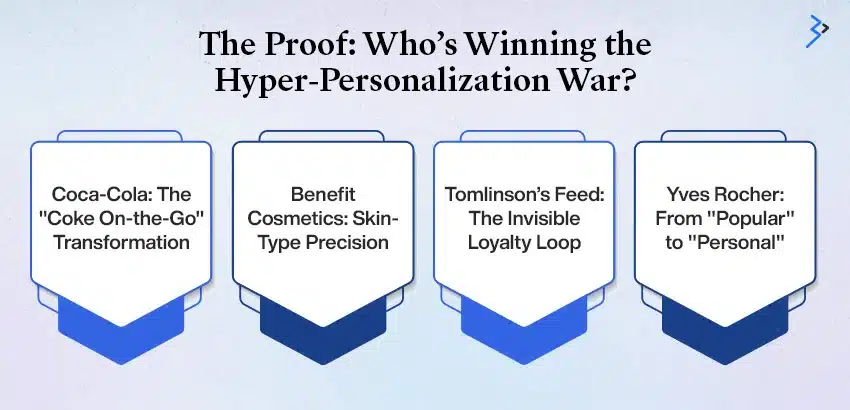
To see the practical impact of these strategies, we look at brands that have moved beyond basic automation into true behavioral intelligence. These companies aren’t simply selling products; they are using data to remove the “tax on time” that customers pay when navigating irrelevant options.
01 | Coca-Cola: The “Coke On-the-Go” Transformation
Coca-Cola shifted from mass-market advertising to a localized, data-centered approach using its AI-powered platform. Through analyzing regional data, weather patterns, and event schedules, they began delivering hyper-local promotions to mobile users.
- The Strategy: Using AI to predict when a user is expected near a retail point and giving a real-time, contextually relevant incentive (like a cold drink on a record-breaking hot day).
- The Result: Amra & Elma reported a 30% increase in Coke’s sales and a 25% jump in engagement, confirming that even global giants can feel like a “local” brand through smart data usage.
02 | Benefit Cosmetics: Skin-Type Precision
In the beauty industry, “generic” is the enemy of “effective.” Benefit Cosmetics recognized that a customer with dry skin has zero interest in oil-control primers.
- The Strategy: They implemented hyper-personalized email workflows. Instead of a single weekly newsletter, they sent customized content tailored to individual skin types, past beauty concerns, and purchase history.
- The Result: This meticulous accuracy led to a 50% boost in Click-Through Rates (CTR) and a massive 40% increase in overall revenue, as reported by Amra & Elma.
[ Read More: Transform Customer Journeys with AI-Driven Audience Activation in Adobe Experience Platform ]
03 | Tomlinson’s Feed: The Invisible Loyalty Loop
This pet retail chain realized that the biggest friction point in-store was the “loyalty check”, that awkward moment where customers hunt for key fobs or phone numbers.
- The Strategy: Through integrating their Shopify POS with deep customer loyalty data, they automated the rewards process. The system recognizes the customer via their payment method or app, automatically applying historical discounts and pet-specific rewards.
- The Result: Shopify reported that checkout times were slashed by 56%, and the brand had a significant rise in “omnichannel” customers who spend more frequently across both web and physical stores.
4. Yves Rocher: From “Popular” to “Personal”
Yves Rocher, a global botanical beauty brand, moved away from showing “Best Sellers” to every visitor and opted for an AI-driven recommendation engine instead.
- The Strategy: Their AI analyzes real-time browsing behavior to predict which product category a user is currently interested in (e.g., anti-aging vs. hydration).
- The Result: Amra & Elma showed a staggering shift: 17.5x more clicks on recommended products and 11x more purchases. When the AI stops showing what’s “trending” and starts showing what’s “needed,” the customer journey accelerates instantly.
The Roadblocks: Why 50% Brands Still Struggle
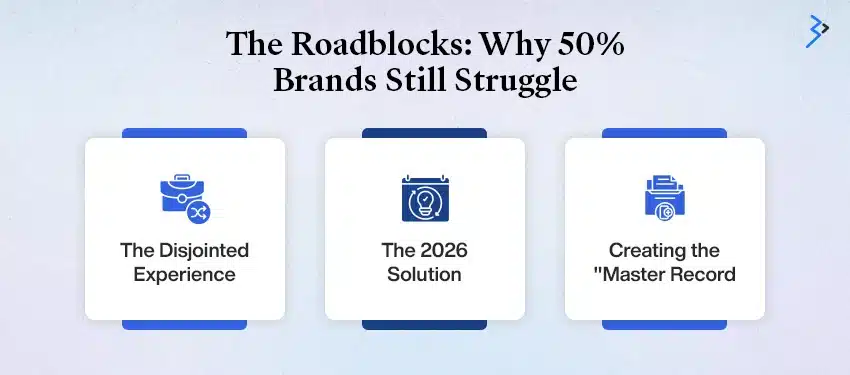
If the ROI is so undeniable, why isn’t every brand a hyper-personalization powerhouse? The truth is that, although the vision is simple, the execution hits a massive wall: The Data Silo. Medium shows that nearly 50% of CX leaders admit their customer information is trapped in “departmental islands” that don’t talk to each other.
- The Disjointed Experience: This is the primary reason you still get targeted ads for a pair of shoes you returned three days ago. The marketing engine is looking at your “click” data, but it has no idea what the returns department or the in-store POS system just recorded. This absence of communication makes your brand look disorganized and out of touch.
- The 2026 Solution – Unified Data Platforms (UDPs): To survive, brands are shifting toward a “Single Source of Truth.” A UDP acts as the central nervous system for your business, pulling real-time signals from your Shopify store, your Odoo ERP, your social media ads, and even your customer support tickets.
- Creating the “Master Record”: By breaking apart these walls, you create a unified profile for every customer. This assures that when your AI engine makes a “Next Best Action” recommendation, it’s doing so with a complete picture of the customer’s history. Without this merging, your personalization efforts will always feel like a series of lucky guesses rather than an integrated strategy.
Conclusion: Rewriting Your Brand’s Future
As we move through 2026, hyper-personalization is no longer a “competitive advantage”; it’s the price of entry. Brands that master this will see higher conversion rates and a good boost in Average Order Value (AOV) as a standard outcome.
At Brainvire, we bridge the gap between digital agility and physical presence through mastering the “Hard Middle” of retail integration. We specialize in connecting high-performance storefronts with robust back-end systems like Odoo and SAP, ensuring real-time inventory and AI-powered personalization flow seamlessly across every touchpoint to build a high-velocity customer journey.
Ready to stop guessing and start predicting? Connect with Brainvire’s AI & CX Specialists to upgrade your digital presence.
FAQs
Traditional personalization uses broad data (like a name). Hyper-personalization uses real-time, contextual data (like browsing speed, current location, and AI-predicted intent) to create a unique experience for that exact moment.
AI improves CLV by reducing “churn.” It identifies patterns of dissatisfaction before a customer leaves and triggers “save” actions, such as a personalized offer or an anticipatory support outreach, keeping the customer engaged longer.
It only feels creepy when it’s irrelevant. While most consumers expect personalization, they want it to be helpful. The key is honesty and focusing on “Zero-Party Data,” where customers choose to share info because they value the tailored result.
You don’t need a massive budget. Many modern platforms (like Shopify) have built-in AI tools. The secret is starting with data unification, guaranteeing your customer info is in one place so you can start small with automated, personalized email campaigns.
Agentic AI are systems that can take action, not just provide data. In CX, this means an AI that doesn’t just flag an unhappy customer but automatically initiates a resolution, like a credit or a specialized support ticket, based on that individual’s history.
Related Articles
-
 The best remote UX and UI design conferences to attend in 2020
Dynamically reinvent market-driven opportunities and ubiquitous interfaces. Energistically fabricate an expanded array of niche markets through robust products. Appropriately implement visionary e-services vis-a-vis strategic web-readiness.
-
 Top 26 UI/UX Design Companies in the USA for 2025
Recent statistics highlight the rising importance of UX/UI design services, with the market projected to surpass $1 billion by 2030, growing at an annual rate of 11%. Investing in user
-
 Top UI /UX Mobile Trends for 2021
Staying on top of the UI/UX mobile trends is important to keep your mobile app ahead in the competition, Always! and with UI/UX design, you can make your mobile app