How GCC & European Businesses Are Using Intelligent Automation to Cut Costs and Improve Operational Resilience
-

Pratik Roy

The math of corporate survival has fundamentally changed. When the average data breach cost climbs to USD 4.4M as reported by IBM, and SQ Magazine noting that AI-powered cyberattacks surge by 37% in a single year, reactivity is no longer a management style, it is a balance-sheet liability.
In the GCC and Europe, the risk landscape has evolved into an AI-driven arms race where the traditional defensive moat has been rendered obsolete by deepfake fraud and instant regulatory shifts.
As a leader in digital transformation, Brainvire has seen the era of static spreadsheets and annual audits come to a definitive end. Today’s most resilient global brands aren’t just trying to keep up; they are leveraging Intelligent Automation (IA) to outpace volatility. By integrating AI-powered RPA with predictive intelligence, these organizations are turning potential crises into a quantifiable competitive advantage. If your global operations are still trapped in disconnected silos, you aren’t just managing risk, you are hosting it.
Let’s explore how the market leaders in the GCC and Europe are using hyperautomation and self-healing workflows to achieve maximum resilience in a world that never sleeps.
Defining the Dual Impact: IA vs. Traditional RPA
To master the 2026 landscape, we need to first distinguish between simple automation and true cognitive intelligence. For years, Traditional RPA served as “the hands” of the enterprise, digital workers capable of following rigid, rule-based instructions to move data from point A to point B. It was efficient for repetitive tasks, but it was fragile; the moment a form changed or a non-standard invoice appeared, the bot broke.
Intelligent Automation (IA) represents the evolution of “the brain.” By weaving together RPA with Artificial Intelligence (AI), Machine Learning Development (ML), and Natural Language Processing (NLP), IA doesn’t just execute tasks, it learns from them. It can interpret unstructured data, recognize patterns in a supply chain disruption, and make informed decisions without human intervention. This shift moves the needle from simple task-completion to total process ownership.
The Shift at a Glance
| Feature | Traditional RPA (The Hands) | Intelligent Automation (The Brain) |
| Cognitive Ability | Rule-based; follows fixed scripts. | Decision-based; learns and adapts. |
| Data Handling | Structured data only (Excel, DBs). | Unstructured data (Email, Voice, Images). |
| Resilience | Breaks when UI or inputs change. | Self-healing; adapts to environment shifts. |
| Core Value | Operational efficiency / Cost reduction. | Operational resilience / Predictive growth. |
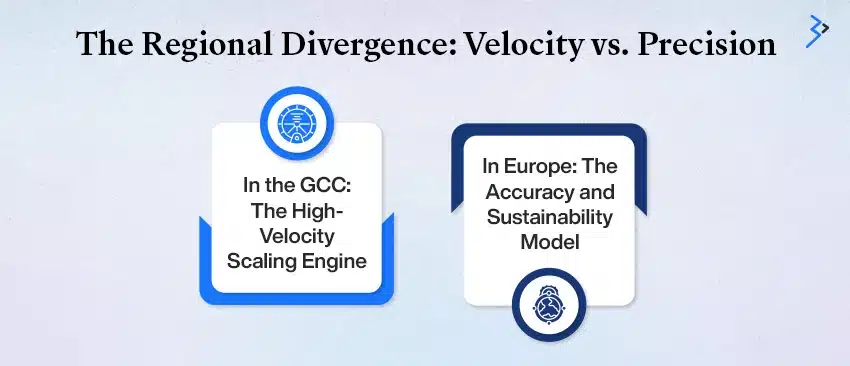
The Regional Divergence: Velocity vs. Precision
While the core technology remains the same, the strategic implementation of IA follows the unique economic pulses of the GCC and Europe.
- In the GCC: The High-Velocity Scaling Engine
Driven by the ambitious mandates of Saudi Arabia’s Vision 2030 and Dubai’s D33 agenda, GCC enterprises use IA as a multiplier for rapid growth. With massive capital inflows and a goal to double the size of Dubai’s economy, manual processes are simply a bottleneck. In the banking sector specifically, IA is being used to automate complex back-end cash management and KYC (Know Your Customer) protocols, slashing manual errors and helping institutions onboard customers at a scale previously thought impossible. - In Europe: The Accuracy and Sustainability Model
In Europe, the focus shifts toward the Industry 4.0 ethos, where efficiency meets environmental mandates. With strict ESG (Environmental, Social, and Governance) reporting and high labor costs, European firms utilize Intelligent Process Automation (IPA) to create self-healing manufacturing workflows. These systems monitor energy consumption and equipment wear in real-time, adjusting output to minimize waste. This focus on accuracy is why the European IPA market is on an aggressive trajectory, projected to reach USD 57.8B by 2033 with a 14.5% CAGR, according to Persistence Market Research.

GCC Case Study: Cost-Cutting in the Desert Heat
UAE and Saudi enterprises are no longer just adopting tech; they are leapfrogging the West. Roland Berger shows that by deploying AI-driven ATMs and POS (Point of Sale) optimizations, finance and utility sectors are seeing a 1.5x ROI.
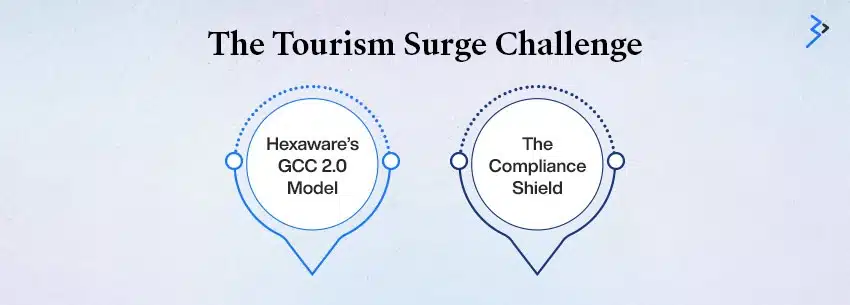
The Tourism Surge Challenge
In Qatar and Dubai, tourism demands real-time operational pivots. During peak seasons, automation handles the surge in throughput, boosting sector efficiency by 40%, according to Charter Global reports.
- Hexaware’s GCC 2.0 Model: This approach embeds AI agents from the start, delivering sharp resource efficiencies that counter the annual inflation pressures currently felt in the region.
- The Compliance Shield: In the GCC, staying compliant with DIFC or Saudi central bank regulations is a moving target. Automated GRC (Governance, Risk, and Compliance) tools ensure that Vision 2030 projects don’t stall due to regulatory friction.
| Sector | IA Application | Impact |
| Banking | Automated Spend Analytics | Error Reduction |
| Utilities | AI-driven Grid Management | Improved ROI |
| Tourism | Automated Guest Throughput | Increase in Capacity |
Europe’s Operational Edge: Hyperautomation and Sustainability
In Germany, the UK, and France, Hyperautomation is the buzzword of 2026. It’s the philosophy that anything that can be automated should be automated.
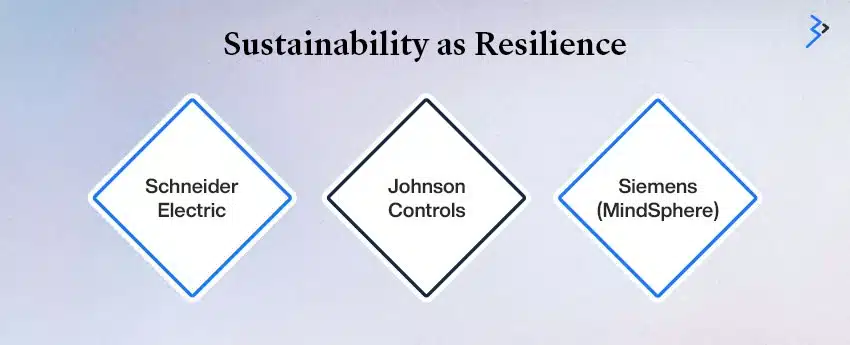
Sustainability as Resilience
The EU’s strict sustainability mandates mean that energy efficiency is now a survival metric.
- Schneider Electric: Using their EcoStruxure platform, they retrofit legacy buildings with IA to slash energy costs.
- Johnson Controls: Their OpenBlue AI in HVAC systems predicts mechanical failures before they happen, ensuring maximum uptime for data centers that power the continent’s digital economy.
- Siemens (MindSphere): In their analog-to-digital manufacturing pivots, AI platforms have cut unplanned downtime. This mirrors the enterprise integrations we facilitate at Brainvire, where we unify legacy hardware with cloud-native AI machine learning services.
The 2026 Implementation Roadmap: A 4-Stage Deployment
At Brainvire, we recommend a phased approach for global carriers looking to shed legacy risk models:
| Phase | Timeline | Strategic Focus | Key Objectives |
| 1. Assess Maturity | Months 1–3 | Process Mining | Identify high-volume friction points in Finance, HR, and Supply Chain. |
| 2. Integrate GRC | Months 4–8 | Unified Truth | Consolidate cybersecurity and operational data into one AI-monitored stack. |
| 3. Embed Predictive AI | Months 9–14 | Pilot Hybrids | Start with AI-RPA hybrids for due diligence and high-risk logistics. |
| 4. Continuous Ops | Months 15+ | Agentic AI | Deploy autonomous agents to monitor risks 24/7 and trigger freezes. |
Overcoming the Human Factor and Hurdles

Technology is only half the battle. To reach the gold standard of 2026 risk management, leadership must address the human friction:
- Breaking Silos: Establish Risk Centers of Excellence (CoEs). If your IT team doesn’t talk to Legal weekly, your automation will fail.
- Filtering the Noise: Avoid over-automation. Use risk-adjusted KPIs to ensure you aren’t automating bad processes, fix the process first via Process Mining.
- The Skills Gap: Finding IA experts in the GCC and Europe is tough. Hybrid models, combining strategic oversight with offshore execution, deliver savings without sacrificing quality.
Outlook: The Rise of Autonomous Resilience
As we move through 2026, the definition of business resilience has changed. It is no longer about how quickly you recover, but how effectively you avoid the crisis. We have entered the era of Autonomous Resilience.
In this landscape, market leaders are defined by their Predictive Intelligence. Modern systems now utilize Self-Healing Compliance to identify regulatory shifts and automatically update protocols. Proactive risk management is no longer a luxury; it is the primary requirement for global survival.
Ready to turn your risk into a strategic asset? Contact Brainvire today for a Global ERM Maturity Audit. Let’s build your predictive edge.
Frequently Asked Questions
Traditional RPA acts as “the hands,” executing rigid, rule-based tasks. Intelligent Automation (IA) serves as “the brain,” integrating AI and Machine Learning to handle unstructured data, learn from patterns, and make complex decisions, moving from simple automation to total process ownership.
With the average cost hitting USD 4.4M, the price reflects more than technical recovery. It includes massive regulatory fines, expensive legal defenses across multiple jurisdictions, and the devastating long-term loss of customer trust that follows AI-powered cyberattacks and deepfake fraud.
Self-healing compliance uses AI to monitor real-time regulatory shifts in regions like the GCC or Europe. The system automatically identifies new requirements and updates internal protocols or API logic instantly, ensuring maximum resilience without waiting for manual human intervention.
Under strict EU mandates, firms use IA to monitor energy consumption and equipment wear in real-time. Platforms like Schneider Electric’s EcoStruxure use these insights to retrofit legacy buildings, slashing energy costs and predicting mechanical failures before they cause downtime.
The primary hurdle isn’t technology, but human friction and siloed cultures. Success requires a Risk Center of Excellence (CoE) where IT, Legal, and Finance share data. Without this cross-functional alignment, automation risks digitizing inefficient processes rather than optimizing them.
Related Articles
-
 Unveiling AI Opportunities in Healthcare: From Research to Diagnosis
This blog explores the potential of AI in healthcare, from research to diagnosis. It explores how AI is revolutionizing research methodologies and enhancing diagnostic precision. The blog explores how AI
-
 Highlights and Challenges surrounding Machine Learning
Machine Learning, yes, this word might have flooded your mind with a number of questions, so here we are with answers to them by highlighting the advantages and disadvantages of
-
 Driving Efficiency By Harnessing AI for Cloud Optimization
AI in cloud computing enhances security measures, proactively identifying and mitigating threats before they can impact operations. This level of protection is crucial in today’s digital landscape, where cyber threats