Why Multi-Agent AI is the Secret to 24/7 Operations
-

Pratik Roy

Imagine it’s 3:00 AM on a Tuesday. While your entire team is fast asleep, your company is busy closing deals, rebalancing global supply chain inventories, detecting a microscopic fraud attempt in a European transaction, and onboarding a new hire in Singapore. No one is monitoring a dashboard. No one is “on call.”
The business isn’t just running; it’s thinking.
Welcome to the era of the Autonomous Enterprise. For years, we’ve talked about AI as a tool, a clever chatbot, or a faster way to write an email. But in 2026, the game has changed. We have moved from single, lonely AI bots to Multi-Agent AI Systems: coordinated teams of specialized digital agents that work together just like a high-performing human department.
According to Gartner, we are in the middle of a massive explosion: 40% of enterprise applications will embed AI agents by the end of 2026, up from less than 5% just twelve months ago. This isn’t merely a tech upgrade; it’s a fundamental rewrite of how work happens, expected to drive 17% of total AI value globally.
The Rise of Multi-Agent AI: When One Bot Isn’t Enough
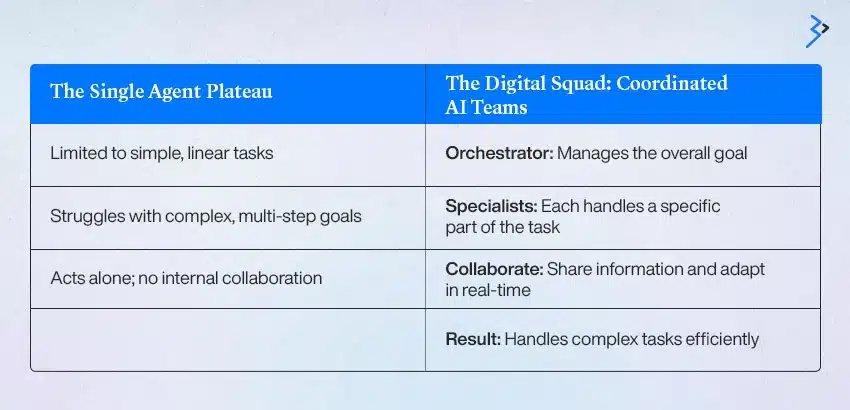
We’ve all hit the “Single Agent Plateau.” You ask a basic AI to handle a complex task, say, managing an insurance claim, and it struggles. Why? Because that one task requires four different types of expertise: extracting data from a messy PDF, validating legal rules, checking for fraud, and then writing a polite email to the customer. A single bot trying to do all that is like asking a solo intern to run an entire legal department.
Multi-agent orchestration mirrors a real-world office. Instead of one bot, you have a “Digital Squad”:
- One agent acts as the Data Researcher
- Another acts as the Compliance Officer
- A third acts as the Customer Liaison
They talk to each other, hand off tasks, and, most importantly, recheck each other’s work—coordinated through an Agent Engine. If the Compliance Agent sees a red flag, they “tap the shoulder” of the Customer Liaison to pause the process
While McKinsey reports that currently only 23% of companies have fully scaled these systems, the appetite is massive. About 84% of forward-thinking leaders are planning heavy investments this year, lured by the promise of ROI ranging from 1.7x to a staggering 10x.
At Brainvire, our AI services have moved past the “cool demo” phase; we are already prototyping these agent teams for sales forecasting and operational automation, making what used to be weeks of human labor into minutes of automated processing.

Efficiency by the Numbers: The ROI of 24/7 Ops
The financial argument for the Autonomous Enterprise is becoming increasingly difficult to ignore. Harvard Data Science Review shows that multi-agent systems are currently yielding a 40% increase in workflow effectiveness and general productivity gains of 20-30%.
To put that in perspective, a specialized AI agent team can generate roughly €812,000 in annual value for a department of just 50 workers. It’s no wonder the market is projected to skyrocket from $7.8 billion to $52 billion by 2030.
But it’s not simply about speed; it’s centered on precision. Production-grade multi-agent systems are now hitting excellent reliability. This helps human employees redirect their mental workload, the mental energy spent on boring data entry, toward high-level innovation and strategy. As early adopters are finding, when you stop treating your staff like data processors, they start acting like Growth Architects.
| Metric | Impact | Source |
| App Embedding (2026) | 40% of all apps | Gartner |
| Workflow Efficiency | +40% Increase | Industry Average |
| Productivity Gain | 20-30% | Harvard Data Science Review |
| ROI Range | 1.7x – 10x | McKinsey |
| Reliability | 95%+ | Production Benchmarks |
How the “Brain” Works: Architecture and Use Cases
How does a team of bots actually “talk”? Think of it as a Hub-and-Spoke model.
- The Orchestrator: This is the “Manager” agent. It receives a goal (e.g., “Onboard this new vendor”) and breaks it down into sub-tasks.
- The Specialists: The Orchestrator delegates tasks to specialized agents, one for KYC (Know Your Customer) verification, one for contract analysis, and one for ERP (Enterprise Resource Planning) data entry.
- The Shared Context: Using frameworks like the Model Context Protocol (MCP), these agents share a “communal memory.” Inquiries into these collaboration tools have risen recently because companies realize the “secret sauce” isn’t the AI itself, but how the AI agents collaborate.
Common 24/7 Use Cases
- Predictive Revenue Forecasting: Agents constantly analyze market trends and internal sales data to anticipate cash flow anomalies before they occur.
- Supply Chain Balancing: At Brainvire, we use Machine Learning to help agents automatically adjust inventory levels across global warehouses, flagging “leaks” or shipping delays in real-time.
- HR and Onboarding: Agents handle the entire “paperwork” phase of hiring, verifying IDs, setting up system access, and answering benefits questions, without a human HR generalist ever touching a file.
Real-World Deployments: From Wall Street to Wellness
This isn’t science fiction; it’s already on the balance sheets of top brands.
JPMorgan’s Coach AI
JPMorgan has deployed “Coach AI” to act as a multi-agent powerhouse for its advisors. It doesn’t just look up information; it anticipates the questions a client might ask, retrieves deep research, and suggests the next best action. It has turned the advisory process from a reactive search task into a preemptive strategic session.
CCB AI’s HIPAA-Compliant Healthcare Agents
In the sensitive world of mental health, CCB AI developed a 4-agent system on AWS to manage the different phases of therapy. One agent handles crisis detection with a significant success rate, while others handle administrative tracking. This ensures the human therapist can focus 100% on the patient while the “digital team” handles the legal and clinical paperwork.
The Home Services Voice Agent from ServiceAgent
Not all multi-agent deployments are in Fortune 500 companies. ServiceAgent shows how the same architecture can b e used by small and medium-sized home service businesses like HVAC, plumbing, roofing, and solar companies. Their AI call-answering agent is always on, so it can answer calls that would normally go to voicemail after hours. One agent qualifies the lead by checking to see if they own a home and what service they need. A second agent checks to see if they are available on the calendar, and a third agent books the appointment directly into the business’s CRM. All of this happens without a human dispatcher ever picking up. People say they can’t tell they’re talking to AI, and early users say they’ve cut down on 100 hours of administrative work each month. This is a small but powerful example of how autonomous, multi-role agent orchestration can change things for a two-person plumbing crew trying to get every lead while they’re working on a repair. It’s not just for Wall Street.
Your Guide to Autonomy: The Brainvire Approach
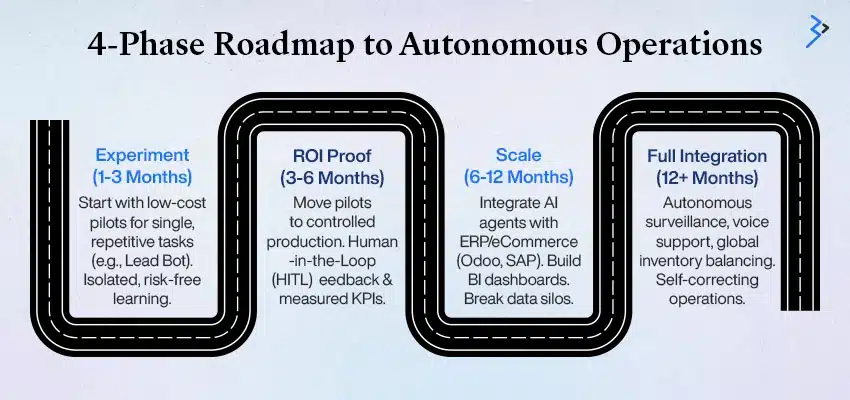
Building an autonomous enterprise isn’t a “flip the switch” moment; it’s a process of maturing your data and your culture. At Brainvire, we use a “Growth Architect” roadmap. This phased approach assures you aren’t just buying shiny tech, but building a sustainable engine that scales without breaking your existing operations.
Here is a deeper look at each step of that journey:
Phase 1: The Experiment (1–3 Months)
The Goal: Low-Risk, High-Learning Pilots
Before you automate your entire back office, you start with a “Proof of Concept” (PoC). We look for a “toil-heavy” task, something your team does repeatedly that follows a logical pattern but requires basic decision-making.
- The Blueprint: We deploy a single team of agents for a specific task, such as a Lead Engagement Bot.
- How it works: This isn’t just a static form. These agents monitor your website 24/7. When a prospect visits, one agent researches the visitor’s company, another analyzes their “buyer intent,” and a third engages them in a personalized conversation to qualify them.
- The Brainvire Advantage: We focus on “isolated environments” during this phase. This means the AI can play and learn without having “write access” to your core databases, ensuring zero risk to your live data.
Phase 2: The ROI Proof (3–6 Months)
The Goal: Moving from “Cool” to “Critical”
Once the pilot proves it can handle the workload, we move it into a Controlled Production environment. This is where we introduce the Human-in-the-Loop (HITL) safeguard.
- Feedback Loops: We create a dashboard that lets your human experts “grade” the AI’s work. Did the agent categorize that invoice correctly? Did it route the support ticket to the right person?
- Supervised Autonomy: Think of this like a “residency” for a new doctor. The AI does the work, but a human supervisor reviews the high-stakes decisions. This phase builds the trust necessary for the next step.
- The Brainvire Advantage: We help you define Deterministic KPIs. We don’t just measure “AI speed”; we measure things like Reduction in Human Toil and Accuracy vs. Previous Manual Methods.
Phase 3: The Scale (6–12 Months)
The Goal: Cross-Departmental Orchestration
Now that we have a proven model, we connect the “Digital Squad” to your company’s central nervous system, your ERP (Odoo, SAP) or eCommerce platform.
- Unified Data: This is where our team of experts shines. We break down the “data silos,” so your AI agents can see everything. For example, a Sales Agent can now check real-time inventory in Odoo before committing to a delivery date to a customer.
- BI Dashboards: We build custom Business Intelligence (BI) tools that monitor agent performance spanning departments. You’ll see exactly how much mental effort has been removed from your human staff.
- The Brainvire Advantage: We specialize in Modular Integration. We don’t rebuild your systems; we “wrap” AI agents around them, making the transition easy and cost-effective.
Phase 4: Full Integration (12+ Months)
The Goal: The Self-Correcting Enterprise
At this stage, your business is truly “Autonomous.” Your agents are no longer just handling tasks; they are managing exceptions and strategy.
- Advanced Ops: Your agents manage complex, multi-step operations. In the warehouse, agents handle Autonomous Surveillance, noting if a pallet is misplaced and automatically alerting a floor robot to move it.
- Voice and Global Support: We deploy voice-activated AI agents that handle customer calls in multiple languages and rebalance inventory across global regions in response to real-time demand changes.
- The Brainvire Advantage: We implement Agentic Governance. As your “digital workforce” grows to dozens or hundreds of agents, we provide tools to manage them as a unified fleet, guaranteeing they remain compliant with global regulations such as the GDPR and HIPAA.
The Human Element: Ethics and Guardrails
Let’s deal with the elephant in the room: Trust. About 50% of businesses cite “integration” as their biggest barrier, but the real concern is often “control.” To solve this, we utilize two main pillars:
- Federated Learning: This allows AI to learn from data patterns without ever actually “seeing” or storing sensitive personal info.
- Human-in-the-Loop (HITL): We always maintain a safeguard. For high-risk decisions, such as approving a $1M loan or diagnosing a medical condition, the AI agents handle all the preparation. Still, a human must provide the final “click” to proceed.
Research from the Capgemini Research Institute and KPMG report that 93% of leaders agree that these systems provide a massive competitive edge, but only if they are compliant. Whether it’s HIPAA for healthcare or GDPR for finance, your agents must be “compliance-first.”
Conclusion: The 2026 Vision
By 2028, Gartner predicts that 15% of all daily enterprise decisions will be made autonomously. The companies that start building their multi-agent teams today will be the ones that own their markets tomorrow.
The Autonomous Enterprise isn’t about replacing people; it’s about giving your people the freedom to be Growth Architects while the AI handles the 24/7 heavy lifting. It’s about moving from a business that reacts to one that anticipates.
Ready to pilot your first AI agent team? Contact the experts at Brainvire. Let’s build the future of your operations together.
Frequently Asked Questions
A chatbot follows a script to answer questions. An AI Agent has “agency”; it can use tools, access databases, and make decisions to complete a goal (like “book a flight”) without a human prompting every individual step.
While scaling can require investment, the “Experiment” phase is very accessible. Because these systems usually achieve 40% work efficiency, they pay for themselves within 6–12 months.
Actually, they redirect mental effort. Agents handle the 24/7 repetitive tasks (data entry, basic sorting), allowing your human team to focus on high-value strategy and advanced problem-solving that AI still cannot touch.
We use Orchestration Layers and human-in-the-loop guardrails. With a 95% reliability rate, these systems are often more accurate than manual data entry, but we always include a human “exception handler” for complex edge cases.
Yes. Modern agents are designed to “wrap around” your existing tech stack. They can read and write data to your ERP just like a human user would, making the integration much smoother than traditional software overhauls.

Related Articles
-
 Best Gen-AI-Based Customer Service Chatbots
In 2025, businesses will increasingly turn to Generative AI-based customer service chatbots to provide seamless and personalized customer experiences. These chatbots leverage advanced natural language processing (NLP) and AI algorithms
-
The “Zero-Loss” Retailer: Mastering Vertical AI for Demand and Security
Imagine a Monday morning when your stockroom is perfectly balanced: no overstocked winter coats gathering dust, yet every best-selling sneaker is ready for the morning rush. Across town, a suspicious
-
From Automation to Intelligence: AI & ML’s Role in Industry 4.0
What is AI & ML in Industry 4.0? “Industry 4.0” refers to the fourth industrial revolution, which combines digital technologies with physical processes in manufacturing and industry. Artificial Intelligence (AI)