Odoo Cloud vs. Odoo On-Premise vs. Odoo.sh: A Complete Odoo Hosting Comparison
-

Chirag Jogi
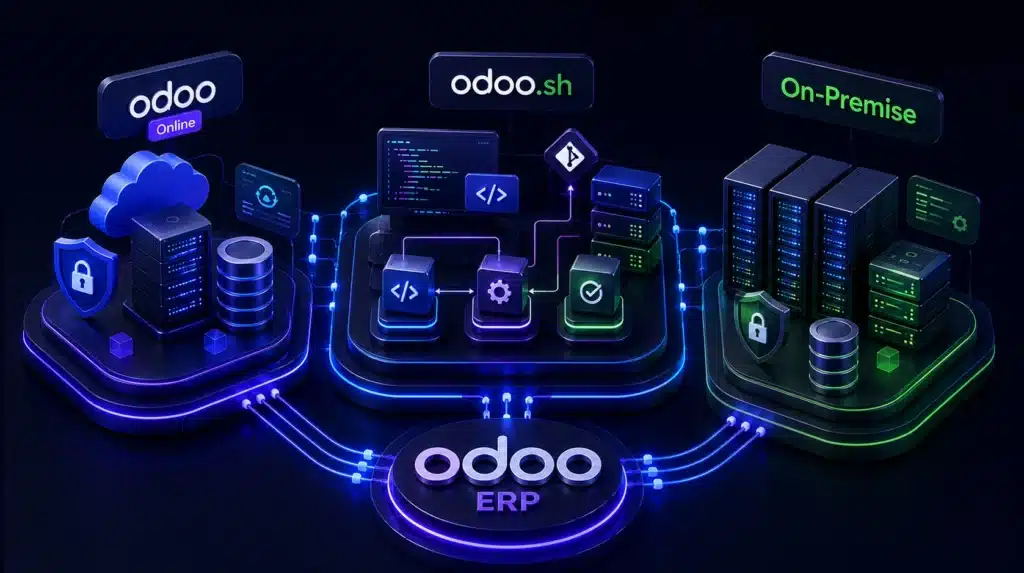
Selecting an Odoo ERP deployment model is much like choosing a place to live. You can rent a fully managed, turn-key apartment (Odoo Online), purchase a unit in a managed complex with custom renovation rights (Odoo.sh), or build a bespoke home from the ground up on private land (On-Premise). While each option provides functional shelter, their financial commitments, administrative demands, and operational trade-offs vary drastically. Making the wrong structural choice early on can quietly trigger months of costly migration and rework down the road.
For scaling organizations, this is far more than a technical formality. It dictates your Total Cost of Ownership (TCO), sets the ceiling on your workflow customizations, establishes your data compliance posture, and determines your actual time-to-market. With Odoo now powering over 170,000 enterprise customers globally and expanding at a 20–25% annual growth rate, as reported by AppVerticals, an increasing number of leadership teams are reaching this critical fork in the road.
This guide provides an objective breakdown of all three hosting architectures, evaluating cost, control, and technical complexity, so you can align your deployment with your operational needs rather than a sales presentation.
Why Hosting Type Matters More Than Most Businesses Realize
A lot of first-time Odoo buyers treat hosting as an afterthought, something to decide after modules and pricing tiers are locked in. That’s backwards. Your hosting choice determines:
- How much you can customize without hitting a wall six months into implementation.
- Who is accountable when something breaks at 2 AM.
- How your upgrade cycles work since Odoo Online, Odoo.sh, and On-Premise handle version upgrades very differently.
- Where your data physically lives, which matters enormously if you operate under GDPR, HIPAA, or regional data-residency laws.
- Your real total cost, since the sticker price of a subscription rarely reflects the full infrastructure and staffing cost behind it.
Getting this decision right early saves you a painful, expensive migration later. Getting it wrong means re-platforming mid-growth, which almost always costs more than doing the analysis upfront.
Exploring the 3 Odoo Hosting Types

Odoo officially offers three deployment paths, and Odoo itself frames the choice as a trade-off between convenience and control:
- Odoo Online (Odoo Cloud): A fully managed SaaS instance hosted and maintained entirely by Odoo.
- Odoo.sh: Odoo’s dedicated cloud platform, sitting between Online and On-Premise, built on a Git-based deployment workflow with dev, staging, and production branches.
- Odoo On-Premise: Self-hosted on your own servers or private cloud, giving you full control of infrastructure, data, and customization.
Each was designed for a different type of business at a different stage of technical maturity, and understanding that intent is the fastest way to narrow down your own decision.
01 | Odoo Online (Odoo Cloud): The Turnkey Option
Odoo Online is the “no headaches” choice. Odoo manages hosting, upgrades, backups, and security patching, and your team simply logs in and works. There’s no server to provision, no DevOps overhead, and no infrastructure bill to negotiate separately.
What you get:
- Automatic version upgrades handled by Odoo
- Built-in backups and disaster recovery
- Instant provisioning; you can be live within a day
- Predictable subscription-based pricing
Best for: Small and mid-sized businesses without dedicated in-house IT, or teams that want to be live in days, not months, and don’t need deep code-level customization.
Trade-off: You get limited server-level customization and no shell or SSH access, so heavy code modifications, custom server-side integrations, or non-standard third-party apps are constrained.
Silvertouch data shows that Cloud ERP now represents roughly 70% of the total global ERP market and is growing at a 14.5% CAGR, which tells you where the market’s center of gravity has already shifted. If you’re weighing whether cloud-first is a safe long-term bet, the market has largely already answered that question.
02 | Odoo.sh: The Middle Ground for Growing Teams
Odoo.sh is Odoo’s own cloud infrastructure, but with developer-grade flexibility layered on top. It uses a Git-based workflow, meaning every commit automatically spins up a build, tests it, and deploys it across dedicated development, staging, and production branches. You get shell access to containers, the ability to configure custom routes, and Odoo still handles the underlying server monitoring and maintenance.
What you get:
- Full source-code access and custom module deployment
- Automated CI/CD-style testing on every commit
- Dedicated staging and development environments before anything touches production
- Flexible architecture you can scale up as workers, storage, and users grow
Best for: Companies actively customizing Odoo (custom modules, third-party integrations, industry-specific workflows) who still want Odoo to own infrastructure, scaling, and uptime.
Trade-off: It costs more than Odoo Online, and someone on your team needs to be comfortable with a Git-based deployment flow, since the entire platform is built around branch-based commits rather than a simple admin panel.

Both Odoo Online and Odoo.sh run on Tier III-certified data centers backed by a 99.9% uptime SLA, so reliability isn’t really the differentiator between them, customization depth and deployment control are. What’s worth noting is that this uptime bar isn’t unique to Odoo’s own platforms. Third-party managed Odoo hosting providers increasingly compete on the same enterprise security baselines (ISO 27001, SOC 2) to stay credible in this space.
03 | Odoo On-Premise: Maximum Control, Maximum Responsibility
On-Premise means Odoo lives entirely on infrastructure you own or lease. Nothing is off-limits: source code, server configuration, network architecture, data residency, and integration design are fully in your hands.
What you get:
- Complete control over data location and residency, critical for regulated industries
- Unlimited customization potential, including deep integrations with legacy systems
- No dependency on Odoo’s infrastructure or release schedule
- Full autonomy over security architecture and access controls
Best for: Enterprises with strict data-residency or regulatory requirements (finance, government, healthcare) and an in-house IT team capable of managing servers, security patching, and scaling independently.
Trade-off: You own every operational risk too, uptime, backups, disaster recovery, and version upgrades all become your team’s job, not Odoo’s. Upgrading a self-hosted instance to a new Odoo version, for example, requires your own migration planning rather than a managed rollout.
The Hidden Cost Factor Most Comparisons Skip

Sticker price comparisons between hosting types are misleading if they stop at the subscription number. Odoo On-Premise looks cheap until you price in servers, a sysadmin’s salary, security audits, and downtime risk. Odoo.sh looks expensive until you realize it eliminates most of that overhead. And Odoo Online, while cheapest upfront, can force costly re-platforming later if your customization needs outgrow it.
The real comparison isn’t “which is cheapest,” it’s “which total cost curve fits your growth trajectory over the next 3–5 years.”
Cloud, Hybrid, or Home-Built? The Hosting Face-Off
| Criteria | Odoo Online (Cloud) | Odoo.sh | On-Premise |
| Setup Speed | Fastest (instant) | Fast (Git-based deploy) | Slowest (infra build-out) |
| Customization | Limited | High (full code access, staging) | Full (unrestricted) |
| Maintenance | Handled by Odoo | Handled by Odoo | Handled by your team |
| Infrastructure Cost | Included in subscription | Mid-range | Highest (servers, IT staff) |
| Data Control/Residency | Odoo-managed regions | Choice of region | Full control |
| Upgrade Management | Automatic | Automated via CI/CD | Manual, your responsibility |
| Ideal For | SMEs, fast go-live | Growing teams customizing Odoo | Regulated enterprises, custom infra needs |
How to Choose the Right One
Ask yourself these questions before deciding:
- Do you need to modify Odoo’s core code or build custom modules regularly?
If yes, Odoo.sh or On-Premise gives you the room; Odoo Online will feel restrictive fast.
- Do you have in-house IT capacity, or do you want Odoo to own uptime and patching?
Odoo Online and Odoo.sh both take that burden off your plate; On-Premise puts it back on you.
- Are you bound by data-residency or compliance mandates that require your own infrastructure?
That usually tips the decision toward On-Premise, or Odoo.sh with a specific hosting region.
- How fast do you need to go live?
Odoo Online wins on speed every time; On-Premise almost always takes the longest to stand up properly.
- What does your growth curve look like over the next 3 years?
A hosting type that fits today might not fit at double your transaction volume; plan for where you’re headed, not just where you are.
There’s no universally “best” option here, only the one that matches your team’s technical capacity, compliance obligations, and growth stage.
From Hosting Choice to Go-Live: How Brainvire Bridges the Gap

Picking a hosting type is the easy part on paper. The harder part is migrating cleanly, customizing without breaking future upgrade paths, and scaling the setup as your business grows, which is exactly where a certified Odoo partner earns its keep.
As a certified Odoo Gold Partner, Brainvire has guided implementations across Odoo Online, Odoo.sh, and On-Premise environments for clients across North America, the Middle East, and APAC, matching hosting architecture to real operational needs rather than a one-size-fits-all template.
If you’re evaluating your options, our Odoo consulting services can walk you through a hosting-fit assessment before you commit to a migration path, so you’re not choosing based on price alone, but on what actually supports your operations three years from now.
Frequently Asked Questions
Yes, generally. Odoo.sh costs more because it includes dedicated infrastructure, staging environments, and Git-based deployment tooling that Odoo Online doesn’t offer.
Yes. Odoo supports migration between hosting types, and in some cases Odoo SA offers this for free, though complexity varies depending on your source and destination platform, and non-standard apps often need to be uninstalled before transfer.
All three can be secure, but Odoo Online and Odoo.sh benefit from Odoo’s own Tier III-certified infrastructure and managed patching. On-Premise security depends entirely on how well your own team hardens and maintains the servers.
Not necessarily a full-time one, but someone comfortable with Git workflows will get far more value out of Odoo.sh’s staging and deployment features. Without that familiarity, the platform’s biggest advantages go underused.
Odoo Online is usually the easiest entry point, since it requires no infrastructure setup and lets teams get operational within days, with the option to migrate to Odoo.sh or On-Premise later as needs grow.
Yes, to some extent. Odoo Online restricts non-standard, custom-coded apps that require server-level access, while Odoo.sh and On-Premise support them fully since you control the underlying environment.
Related Articles
-
 Odoo VoIP – Everything You Need to Know!
Let’s face it: business owners are often welcomed with an overflow of emails every morning. Adding to it are other crucial aspects of operations like piled-up voicemails and your team
-
 How Odoo ERP is Transforming Manufacturing Operations Today
The age of the internet and technology is changing every industry it comes in contact with! Think about it: hardly any sector remains untouched by the possibilities of technological prowess,
-
 How to Choose the Right Odoo Partner in Kuwait in 2026
Picture a mid-sized trading company in Kuwait City migrating its entire inventory, invoicing, and payroll operations onto Odoo. The demo looked flawless. The sales pitch promised a six-week go-live. Then