What’s New in PHP 8.5: Making Your Code Cleaner, Faster, and Easier to Debug
-

Saumil Kalaria
In the current landscape, digital velocity is the single greatest competitive advantage. The performance of your foundational technologies, like PHP, which currently underpins nearly 75% of all websites according to W3Techs, is a direct indicator of your operational efficiency and capacity for growth.
The newest release, PHP 8.5, officially made available in November 2025, is not a radical change but a strategic commitment to optimization. This update delivers critical, data-centric improvements focused on maximizing Instruction Per Cycle (IPC) and refining memory management. This translates directly to quantifiable gains: enhanced application responsiveness and a lower Total Cost of Ownership (TCO) for cloud infrastructure.
By prioritizing highly targeted, non-breaking enhancements over disruptive overhauls, PHP 8.5 enables developers to write cleaner, more maintainable code, reducing debugging time and accelerating feature rollout. It’s an investment in technical debt reduction that ensures the core engine, which processes billions of daily transactions globally, is running faster, more reliably, and with optimal resource utilization, securing a tangible return on engineering time.
The 4 Big Stars of PHP 8.5
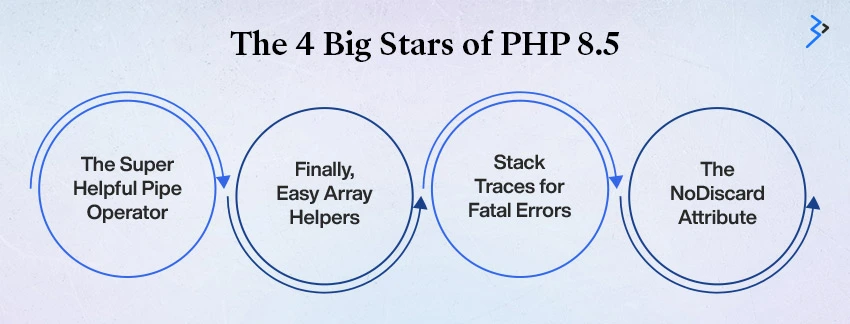
PHP 8.5 has some great new features that help make the code easier to read and understand. These tools simplify complicated tasks, making mistakes less likely.
1. The Super Helpful Pipe Operator ($|>$): For Cleaner Function Chains
Have you ever written code that uses one function’s output as the input for another, then passes that result to a third function? It can end up looking like a confusing Russian nesting doll of parentheses:
// Code BEFORE the Pipe Operator $result = capitalize(trim(calculate_tax(getUserData($userId))));
It’s hard to read because you have to start from the inside and work your way out.
Inspired by other modern languages, the Pipe Operator ($|>$) solves this.
The text explains a programming concept in which you can take a value and pass it directly as the first input to the following function. This approach makes the code easier to read, almost like following simple instructions from left to right.
PHP
// Code WITH the Pipe Operator (|> )
$result = $userId
|> getUserData(…)
|> calculate_tax(…)
|> trim(…)
|> capitalize(…);
Enhancing code readability significantly improves understanding for others and makes the code easier to follow. When you look at the code, you can immediately follow the data flow as it transforms, reducing mistakes and making collaboration easier.

2. Finally, Easy Array Helpers: array_first() and array_last()
Before PHP 8.5, getting the first or last value from an array was clunky. You often had to use tricky workarounds or a combination of functions, which wasn’t always obvious or safe if the array was empty.
PHP 8.5 introduces two dedicated, simple functions that do exactly what their names suggest:
- array_first($array): Safely gets the value of the first item in the array
- array_last($array): Safely receives the value of the last item in the array
If the array is empty, they return null, a safe, predictable result. Eliminating the need for complex, error-prone code simplifies everyday array-based tasks, making them quicker and more efficient.
3. Stack Traces for Fatal Errors: Debugging Just Got Way Faster
PHP used to show you where a “Fatal Error” happened, but not how it got there. It was challenging to identify what went wrong. You could see the crash point, but couldn’t trace the steps that led to it.
Starting with PHP 8.5, the system automatically generates stack traces for fatal errors and sends notifications just before a crash occurs.
Why is this helpful? When something goes wrong, you immediately get all the information you need. Reduced debugging time lets you identify and resolve underlying issues more quickly.
Read More-: What’s New in PHP 8.3 – Key Highlights and Features
4. The #[NoDiscard] Attribute: Preventing Silly Mistakes
Sometimes, a developer creates a function to return a crucial result, like a new object or a status code indicating success or failure. If a developer accidentally calls that function and forgets to use or check the result, they could introduce a hard-to-track-down bug.
The new #[NoDiscard] attribute lets you tag a function’s return value as “too important to ignore.”
PHP
[NoDiscard(“The new User object must be saved or returned.”)]
function createNewUser(string $name): User
{
// … logic to create user …
return $user;
}
// If you call this function and ignore the result, PHP warns you!
createNewUser(“Alice”); // Warning in PHP 8.5! You forgot to use the result.
This small but powerful feature uses the PHP website development engine to warn developers about potential logical errors, making the code safer and more robust.
Other Notable Improvements for a Smoother Experience
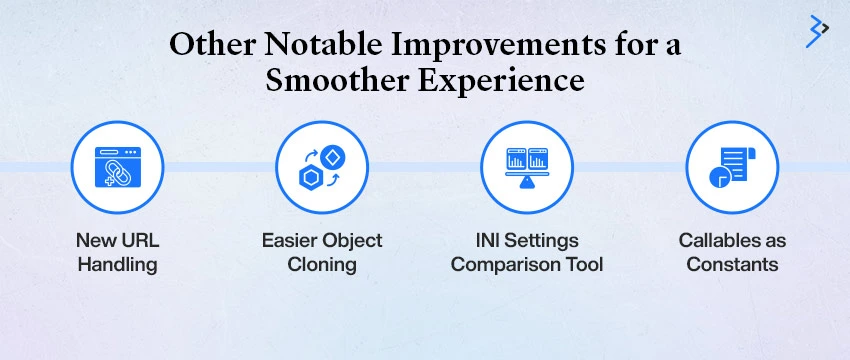
Beyond the headline features, PHP 8.5 brings several other improvements that clean up the language, improve tooling, and boost modern development patterns:
- New URL Handling: PHP has introduced an easy way to work with URLs that follows the latest web standards. This makes it simpler and safer to manage web links, which is important when using APIs and handling online data.
- Easier Object Cloning: You can now copy an object in PHP and change a property or two without hassle. This is helpful for those using immutable objects, giving you more flexibility in your coding.
- INI Settings Comparison Tool: There’s a new command-line tool called `php—- ini=d` that shows you which settings in your PHP configuration file (php.ini) have been changed from the original defaults. This tool helps you quickly check if your server setup meets the requirements for running your code.
- Callables as Constants: PHP now lets you define a callable (like a function) as a constant. This makes your code cleaner and more efficient, which is especially useful for advanced programming and helps create better-organized designs.
Why the PHP World is Still Thriving
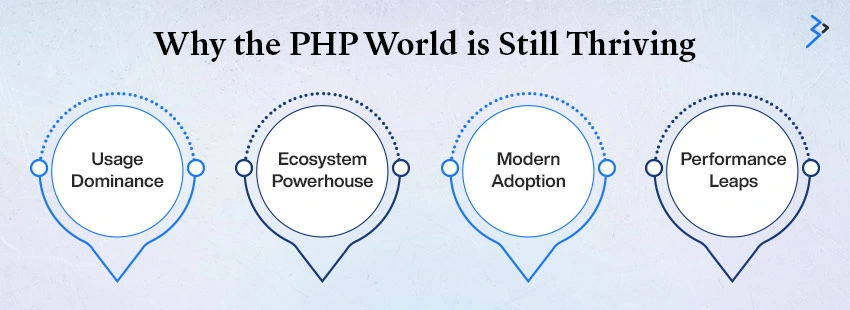
The ongoing improvements in PHP, like the ones in 8.5, show why the language continues to be a dominant force on the web. It’s constantly getting faster, more expressive, and more aligned with modern development best practices. Here are a few compelling statistics that show just how much of the internet relies on PHP:
- Usage Dominance: As discussed earlier, W3Techs shows that 73.1% of all websites that use a known server-side programming language run on PHP.
- Ecosystem Powerhouse: Colorlib states that as of 2025, around 43.6% of all websites (≈ 472 million sites) are powered by WordPress.
- Modern Adoption: According to Zend Technologies’ “2025 PHP Migration and Version Adoption Trends” report, about 71.18% of surveyed applications used PHP 8.X.
- Performance Leaps: Kinsta reported that a Laravel 10.16.1 application ran at 611 requests/second on PHP 8.1, 670 requests/second on PHP 8.2, and 925 requests/second on PHP 8.3, representing an uplift of around 51% from PHP 8.1 to PHP 8.3.
These numbers are a clear signal: PHP is not only alive but is evolving rapidly, offering stability, speed, and a massive community that supports virtually half the web.
Conclusion: Ready for the Upgrade?
PHP 8.5 makes things easier for developers. Its new tools, like the Pipe Operator and better debugging options, help them write code more efficiently. When code is straightforward and easy to manage, it becomes simpler to fix problems when they come up.
With PHP 8.5, you can expect cleaner code and quicker development, which is great for teamwork. This version keeps PHP strong and dependable for any web project.
If you want to upgrade your app or start a new project with the latest PHP features, the Brainvire team is here to help you. We will guide you through the upgrade process and ensure you get the most out of PHP 8.5.
Frequently Asked Questions
Yes, PHP 8.5 mostly works well with older PHP 8.x versions. However, developers should check the official migration guide before upgrading to ensure that any outdated features or small changes don’t cause issues with old code.
PHP 8.5 includes new tools like the Pipe Operator, helpful array functions, and better error messages. These features help clean the code, speed up debugging, and improve teamwork. This means less repetitive coding and shorter development times.
Businesses should consider upgrading to PHP 8.5 for better performance, security, and compatibility with new frameworks. However, to prevent problems, testing existing applications in a safe setting is a good idea before upgrading the main systems.
Big frameworks like Laravel and Symfony, and popular CMS platforms like WordPress and Drupal, are quickly getting ready to support PHP 8.5. These platforms often keep up with PHP updates to make the transition easier.
PHP 8.5 is great for web tasks like CMS development, building APIs, and eCommerce sites. While Node.js and Python are strong for things like microservices and AI projects, PHP is still faster to set up, simpler to host, and often more affordable for web-related work.

Related Articles
-
 Your Ultimate Guide to Fullstack Web Development
Full-stack developers. Whether you are looking to hire or become one, there is a lot of confusion surrounding this domain. In fact, I know people who confuse full-stack developers with
-
 A Guide to Selecting the Best Java Framework for Your Microservices
Java is a programming language framework for web development which was first introduced in 1995. It is a flexible framework with multiple varieties that can be used for microservices. It
-
Unleashing Insights: Python’s Dominance in Data Analytics
Data is the lifeblood of modern businesses. To thrive, organizations need to extract meaningful insights from this vast resource. That’s where Python comes in. Python’s impact on data analytics is