The 2026 Phygital Playbook: Merging In-Store Sensory with Online Speed
-

Bharat Patel
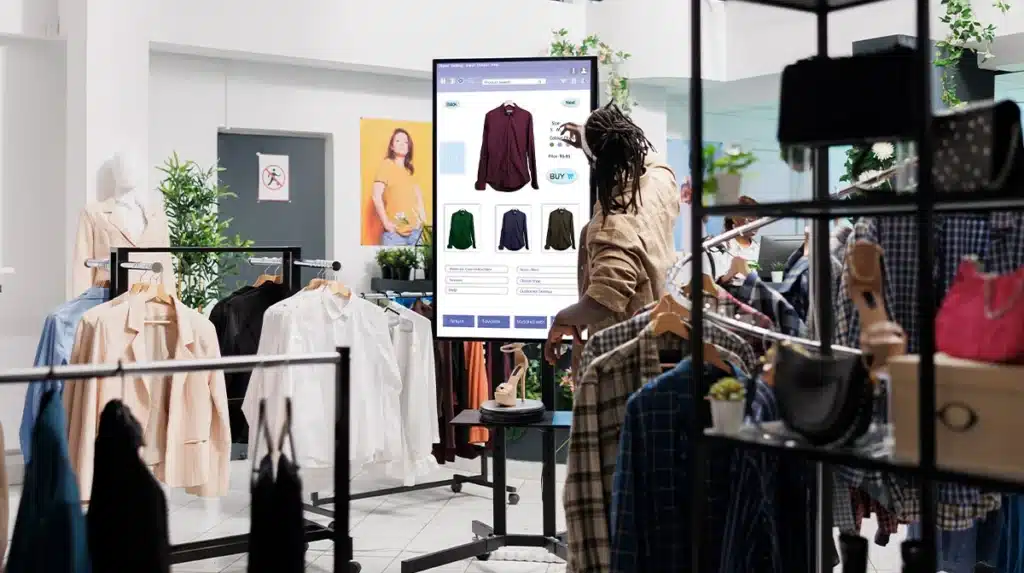
The doorbell used to be the primary signal of a successful purchase. Today, it can be your smartwatch vibrating, letting you know your online order is ready for pickup, barely 15 minutes after you clicked “buy.” It can also be an AR app that lets you “place” a new sectional in your living room before guiding you to a physical showroom to test the fabric in person.
It’s 2026, and the “online vs. offline” debate is officially dead. We’ve entered the era of Phygital retail, where the digital and physical don’t just coexist; they are fused into a single, fluid experience.
Shoppers now don’t want to choose between a store and a hyper-speed app. They want both. Retailers who fail to close this gap aren’t just losing clicks; they’re losing customers to a new breed of “Growth Architects.”
What is Phygital Retail?
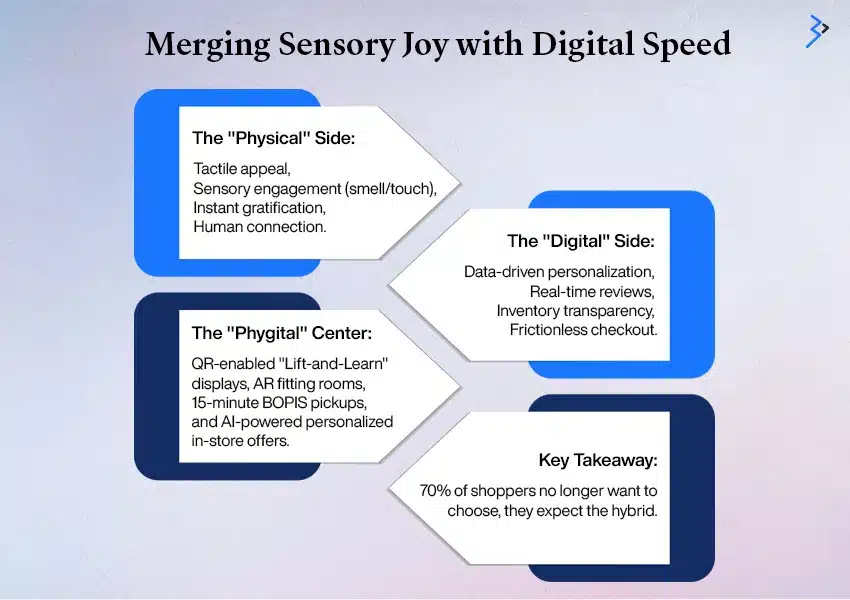
“Phygital” is a portmanteau (a word blending the sounds and meanings of two others, e.g., motel or brunch) of “physical” and “digital.” But it’s beyond a word mash-up. It represents a strategic fusion of immersive physical stores with the data-driven personalization of online channels.
Imagine a shopping experience where:
- You get personalized recommendations on your phone the moment you walk through the door, based on your browsing history.
- You “try on” a complete wardrobe virtually with an AR mirror, without ever entering a fitting room.
- You scan a QR code to view tutorial videos or compare technical specs instantly.
- Your order is ready for pickup in minutes, authenticated via a smooth mobile app.
This is the essence of Phygital. It uses multiple high-velocity technologies: AR/VR for interactive storytelling, IoT smart shelves to track real-time inventory, and Agentic AI to power automated fulfillment.
Importantly, Phygital counters “eCommerce fatigue.” While pure online shopping is convenient, it usually lacks the instant gratification of physical interaction. Phygital provides both, with Shopify data revealing that AR experiences alone drive a 94% higher conversion rate than traditional online paths.
Why Global Markets are Pivoting Now
This isn’t simply a trend for the “Big Tech” elite; we are seeing a massive 27% CAGR in Phygital sectors, as reported by Research and Markets. Why? Because it drives measurable resilience.
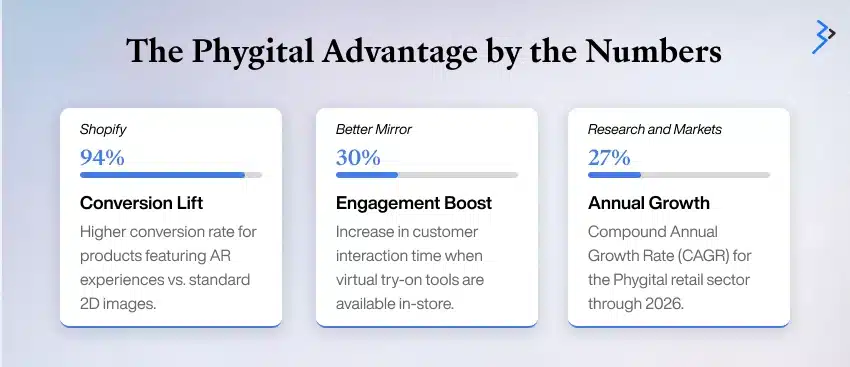
In the US, AR and IoT integration has transformed the store from a warehouse into an “Experience Center.” Better Mirror reports that when you provide a virtual try-on tool, engagement jumps by 30%. Moreover, brands using unified Phygital platforms are seeing a significant increase in content publishing speed, updating in-store digital displays as quickly as they change a social media caption.
Master the 4 Winning Tactics for the Digital-Physical Hybrid War
If you’re building your own roadmap, these core tactics are leading the charge:
- Lift-and-Learn Displays: Imagine lifting a bottle of wine and having a nearby screen instantly show tasting notes. Brands like Meijer and Purina are already converting simple physical actions into data-rich decision moments.
- The BOPIS Standard: “Buy Online, Pick Up In-Store” is now a baseline expectation. Locus shows that U.S. leaders are hitting 30-minute pickup windows, turning physical stores into hyper-local fulfillment hubs.
- Virtual “Fitting Rooms”: From Chewy’s “Fur-tual Boutique” for pet costumes to high-end furniture visualization, AR is the ultimate “de-risker” for modern shoppers.
- Mobile POS and Cashless Flows: Tablets and self-service kiosks eliminate the dreaded checkout line. If you can pay on your phone at a gas pump via apps like Kum & Go, you shouldn’t have to wait 10 minutes for a t-shirt.
These moves don’t just look sleek; they lower costs. Companies see a reduction in staff training time because digital tools act as a constant guide for both employees and customers.
Proof in Practice: How These Global Brands are Owning the Hybrid Space
To understand how Phygital works in practice, we need to look at brands that have moved beyond the “gimmick” stage to functional, revenue-driving integration. These innovators use technology to solve specific friction points in the customer journey.

01 | Chewy: Gamifying the “Fur-tual” Fitting Room
Pet apparel is notoriously difficult to sell online due to sizing uncertainty and the “fidget factor” of pets. Chewy solved this by launching an AR-powered costume try-on experience.
- The Phygital Bridge: Owners can virtually overlay costumes onto their pets in real time using a smartphone camera.
- The Impact: This wasn’t just for social sharing; it addressed the #1 purchase barrier: “Will this fit, and how will it look?” Leveraging that 94% AR conversion uplift, Chewy turned a high-return product category into a high-engagement viral campaign, proving that sensory “fun” can directly drive sales.
02 | Meijer x Purina: The “Lift-and-Learn” Pet Aisle
Grocery shopping can be a rushed, autopilot activity. Meijer and Purina teamed up to break that trance using IoT-enabled smart shelves.
- The Phygital Bridge: When a customer lifts a bag of specialized Purina Pro Plan from the shelf, an integrated overhead screen instantly triggers a tailored video. It displays nutritional benefits, ingredient transparency, and even a “Compare to Other Formulas” chart.
- The Impact: This transforms a passive “grab-and-go” moment into an informed, interactive consultation. It provides the deep-dive information of a website without requiring the customer to pull out their phone or hunt down an associate, effectively bringing “Search Speed” to the physical aisle.
03 | Lidl and Empik: Solving the Checkout and “ROPO” Friction
European giants Lidl (grocery) and Empik (multimedia/books) have mastered the operational side of Phygital with advanced kiosks and a unified inventory system.
- The Phygital Bridge: They’ve championed the ROPO (Research Online, Purchase Offline) model. Customers can browse Empik’s massive digital catalog at home, verify real-time stock at their local branch, and use in-store self-service kiosks that handle both cash and card, a rarity in early digital retail.
- The Impact: By offering mPOS (Mobile Point-of-Sale) and hybrid kiosks, they’ve eliminated the checkout line, the single biggest deterrent to physical shopping. This ensures the speed of an “Amazon-style” checkout is available in a high-street store, boosting customer loyalty through convenience.
04 | Kum & Go: The Frictionless Forecourt
Convenience retail is often a race against time. Kum & Go integrated its mobile app directly into its gas stations’ physical infrastructure.
- The Phygital Bridge: Through their app, customers can activate the pump, pay for fuel, and even order in-store fresh food before they’ve even stepped out of their vehicle.
- The Impact: This helps transition from the digital interface to the physical service effortlessly. By removing the need to interact with a traditional PIN pad or wait in line inside, they’ve captured the “speed-first” consumer, proving that Phygital is just as effective for quick-service utilities as it is for high-end fashion.
[ Read More: How Hyper-Personalization is Rewriting the CX Rulebook in 2026 ]
Your Strategic Implementation: A 3-Pillar Roadmap for Leaders
01 | Unified Measurement and Compliance
- Metrics: Move beyond siloed KPIs. Focus on unified Net Promoter Scores (NPS) across all touchpoints and deflection rates (how many online queries are resolved by in-store Phygital tools).
- Compliance: Invest in platforms supplying robust nexus tracking and data privacy (GDPR/CCPA) across blended channels.
02 | Strategic Roadmap
- Phase 1 (Audit): Map the journey and identify where the physical and online touchpoints are disconnected.
- Phase 2 (Pilot): Start with a focused program, such as rolling out BOPIS to select stores and measuring the granular impact on foot traffic.
- Phase 3 (Scale): Integrate agentic AI to foresee customer needs and automate real-time fulfillment.
03 | Advancing Tech Stack
- IoT and Edge Computing: Deploy sensors for live tracking and invest in edge infrastructure to ensure latency-free AR experiences.
- Modular CMS: Opt for headless commerce platforms that allow for flexible integration without high upfront costs.
The ultimate aim for 2026 is “Agentic Shopping,” in which AI anticipates customer needs and guides them across channels to a frictionless experience.
FAQS
Phygital retail is the intentional blending of physical and digital experiences to create an effortless, immersive customer journey. It goes beyond having a website and a store; it’s about using technology like AR, IoT, and AI to bring online speed and data-led personalization directly into the sensory environment of a brick-and-mortar location.
While omnichannel focuses on brand consistency across separate channels, Phygital focuses on interaction and integration within a single moment. Omnichannel ensures you can buy online or in-store; Phygital assures that, while you are in-store, digital tools like “lift-and-learn” screens or mobile AR improve your physical experience in real time.
The returns of the Phygital strategy are multi-dimensional: brands see massive conversion lifts (up to 94% with AR), improved customer loyalty through hyper-personalization, and significantly lower operating costs. By uniting these worlds, you reduce friction in the buying process, decrease product returns through better visualization, and capture key data on in-store customer behavior.
A solid Phygital stack includes Augmented Reality (AR) for visualization, IoT sensors and smart shelves for live inventory tracking, and QR/NFC connectivity for instant access to information. Importantly, these must be anchored by a flexible, headless commerce platform and an AI-driven backend for smooth data flow across all touchpoints.
Absolutely. Small retailers can start with high-impact, low-cost “micro-moments.” This might include using QR codes in window displays to enable 24/7 “after-hours” shopping or adopting mobile POS systems to eliminate checkout lines. By focusing on modular, cloud-based tools, smaller brands can scale their Phygital presence incrementally without a massive upfront investment.
Related Articles
-
 4 Actionable Ways to Improve Your E-Commerce Business Strategy
With customers increasingly turning towards smartphones and the internet for making various purchasing decisions, economies are witnessing huge changes where brick and mortar stores are evolving into “click and order”
-
10 Ecommerce Trends to Boost Business Growth in 2020
Adapting to the dynamic needs of consumers is something that every eCommerce business owner does every day. It’s 2020 and if you own such a business, then get prepared! This
-
 10 Pain Points Of eCommerce Customers and Their Possible Technology Solutions
The $5.2 trillion eCommerce market has altered the retail industry, providing consumers with flexibility in shopping. E-commerce development is not without its challenges, and customers can experience pain points such