Self-Supervised Learning: The Secret Sauce Behind Smarter Generative AI
-

Pratik Roy

You hold a wealth of valuable information, customer conversations, engineering designs, and factory sensor data, yet much of it remains unorganized and unlabeled, limiting its potential.
For years, building AI systems depended on Supervised Learning, where humans painstakingly labeled data to teach models what each piece of information represented, for example, “This is a fake transaction” or “This is a customer complaint about product X.” While effective, this process is both slow and expensive, creating a major bottleneck in AI advancement.
But the landscape is changing. Imagine a world where AI doesn’t just analyze data but learns from it independently, helping businesses generate insights, create high-quality content, and even accelerate scientific breakthroughs.
This is the promise of Generative AI and Self-Supervised Learning (SSL). These models can learn patterns and relationships directly from raw, unlabeled data, transforming them into active partners in creativity and innovation.
According to the Stanford AI Index Report 2025, private investments in artificial intelligence in the United States reached $109.1 billion in 2024, underscoring the scale and confidence driving this new era of AI-powered transformation.
The Problem with Traditional AI: The Labeling Bottleneck
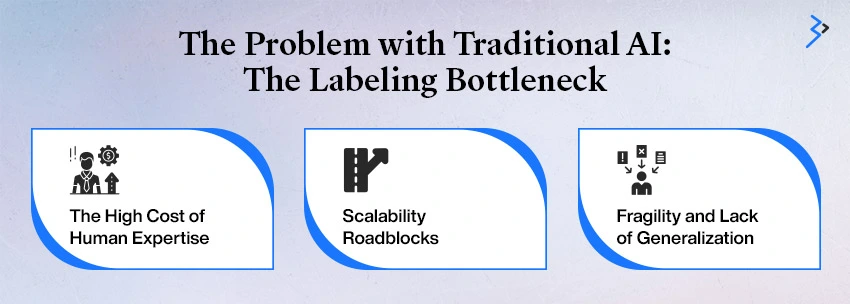
Early AI models succeeded with supervised learning, but businesses face three main challenges as Generative AI grows and demands more data.
01 | The High Cost of Human Expertise
Labeling data is not just tedious; it often requires specialized human knowledge. For instance, creating a dataset to train an AI model to detect flaws in a microchip requires a highly paid engineering expert to annotate thousands of images. According to Coherent Market Insights, the global data labeling market is projected to reach USD 29.11 billion by 2032.
02 | Scalability Roadblocks
Modern businesses generate massive amounts of data, from IoT sensors to customer interactions, and it grows every second. No team of human annotators can keep up. Relying on manual labeling creates a hard limit on how large and how quickly an enterprise can scale its proprietary AI models.
03 | Fragility and Lack of Generalization
A model trained only on labeled data learns to perform one specific task very well, but is fragile. It struggles to adapt to new tasks, meaning its transfer learning ability, the capacity to quickly adjust to a new, specialized function, is highly limited.
Read More -: Elevate your Adobe Experience Manager Sites Website with Generative AI Chatbots
Understanding the New AI Paradigm: Self-Supervised Learning
Self-supervised learning (SSL) is changing the game in AI. Instead of relying on humans to painstakingly label data, SSL lets AI learn directly from raw data, text, images, audio, without explicit instructions, making it a powerful approach behind modern generative AI tools for content writing.
How SSL Teaches Itself
The idea is surprisingly clever: the AI creates its own “puzzles” using the data, and solving these puzzles helps it learn. These puzzles generate what are called pseudo-labels, letting the model practice and improve without extra human effort.
- For text (like large language models): SSL often hides words in a sentence. The AI’s job is to guess the missing words. By doing this over and over, it learns grammar, context, and relationships between words, all without anyone telling it the answers upfront.
- For images: Techniques like image inpainting block out parts of a picture. The AI then predicts the missing sections using the surrounding pixels. This teaches it about shapes, textures, and visual patterns, all from the image itself.
By solving these self-created tasks, AI models develop a deep understanding of data. The best part? Once trained this way, they can quickly adapt to new tasks, needing very little labeled data to perform at a high level.
Unlocking the Power: Key Benefits of Enterprise AI via Self-Supervised Learning
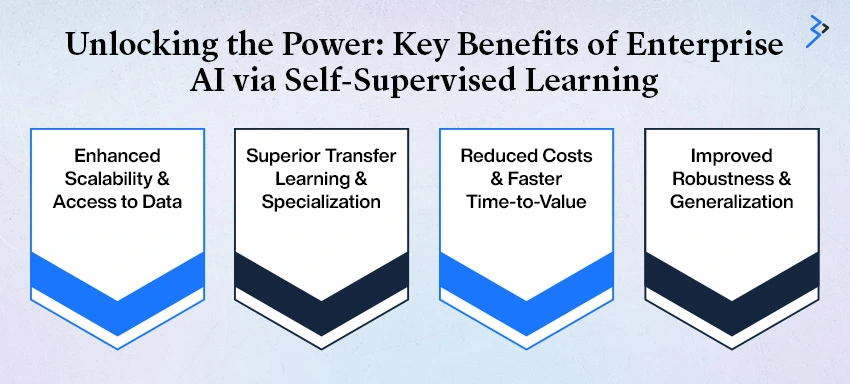
Integrating self-supervised learning (SSL) isn’t just an academic exercise; it delivers tangible business advantages by making AI model development more robust, faster, and cheaper.
01 | Enhanced Scalability & Access to Data
Large volumes of internal data (customer chats, sensor logs, engineering drawings) are unused in many enterprises because they’re unstructured or unlabeled.
According to a report by Veritas Technologies, on average, 52% of all data stored by organizations remains unclassified or ‘dark data’.
According to Deloitte, predictive maintenance can increase equipment uptime by 10-20%, reduce maintenance costs by 5-10%, and cut maintenance planning time by 20-50%.
Read More-: How Generative AI Is Revolutionizing Contract Review: Faster Approvals, Lower Risk
02 | Superior Transfer Learning & Specialization
Once an SSL pre-trained model has learned broad representations (language patterns, image features, sensor rhythms), it only needs a few labeled examples to fine-tune for a specific task (e.g., defect detection, sentiment classification).
According to a 2021 study by Microsoft Research, using large language models such as GPT-3 for automated data labeling reduced annotation costs by 50% to 96% compared to traditional human labeling methods.
According to Google Research, the study Big Self‑Supervised Models are Strong Semi‑Supervised Learners reported achieving 73.9% top‑1 accuracy on ImageNet while using just 1% of labeled data (around 13 images per class).top-1 accuracy on ImageNet using a ResNet-50 with their self-supervised pre-training + fine-tuning pipeline.
03 | Reduced Costs & Faster Time-to-Value
Because SSL reduces or eliminates the need for extensive manual labeling, enterprises can accelerate time-to-value and reduce costs. According to research from Massachusetts Institute of Technology, access to the chatbot ChatGPT reduced task‑completion time by 40 % and increased output quality by 18 % in writing and cost‑benefit analysis assignments.
According to McKinsey & Company’s, The Right Mix of Humans and AI in Contact Centers, a conversational AI provider reported that implementing AI agents reduced the cost per call by 50%.
04 | Improved Robustness & Generalization
SSL encourages models to learn representations (patterns, correlations) rather than purely mapping inputs to labels. According to Google’s Machine Learning Crash Course, Generalization ensures that your model can make good predictions on never‑before‑seen data.
In fraud detection and predictive maintenance, spotting subtle anomalies is more critical than recognizing familiar patterns. SSL models that understand context can effectively identify new types of failures or fraud.
SSL in Action: How Self-Supervised Learning is Transforming Enterprise AI
Self-supervised learning (SSL) is powering some of the most impactful business applications today. It enables AI to learn from unlabeled data and deliver smarter insights.
Financial Services: Smarter Fraud Detection
Traditionally, financial analysts had to label transactions as “fraudulent” or “safe.” But fraud schemes evolve constantly. SSL models learn patterns from millions of unlabeled transactions, helping them spot unusual activity faster and detect new types of fraud more accurately.
Manufacturing: Faster Product Design and Maintenance
Manufacturers rely on digital twins, virtual replicas of factories powered by sensor data. SSL models can be trained on images of parts to learn what “normal” looks like. This enables early detection of wear or defects, letting technicians fix problems before they cause expensive downtime.
Customer Experience: Personalized AI Assistants
Generative AI can handle customer queries, but standard large language models (LLMs) may not understand a company’s unique details. By training an LLM on internal data, such as customer chats and support documents, companies can build accurate, on-brand chatbots that deliver better customer experiences.
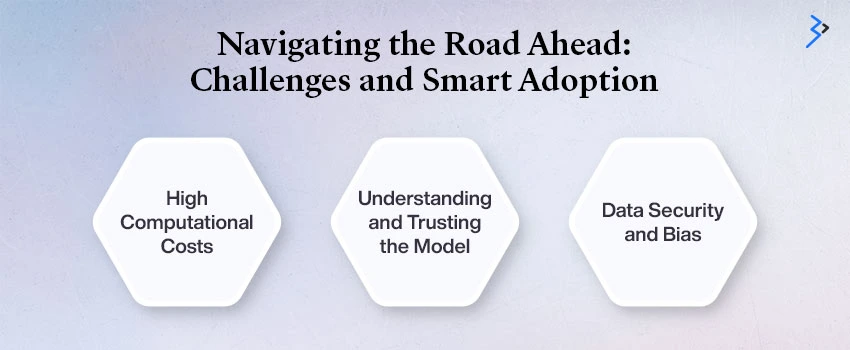
Self-supervised learning (SSL) is a game-changer for AI, but successfully adopting it takes careful planning. Organizations need to understand and address key challenges to make the most of this powerful technology.
Challenge 1: High Computational Costs
Training large SSL models can be resource-intensive, requiring specialized hardware and significant computing power. Instead of building massive models from scratch, businesses can start with smaller, task-specific models or leverage cloud-based AI services that handle the heavy lifting. This approach saves time, money, and resources.
Challenge 2: Understanding and Trusting the Model
When models learn on their own, it can be tricky to know why they make certain decisions — a real concern in regulated industries. Choosing AI solutions that provide clear explanations and visualizations of what the model has learned is essential. This transparency helps detect biases and ensures the AI’s outputs are fair and reliable.
Challenge 3: Data Security and Bias
Even unlabeled internal data can contain sensitive information or hidden biases. Strong data governance is critical. Organizations should carefully clean and monitor their datasets, run tests to detect any unintended leakage of sensitive information, and check for biased outputs before deploying models in the real world.
Human Oversight Remains Key
SSL doesn’t replace humans; it amplifies our abilities. Experts are still needed to define tasks, curate datasets, and validate critical outputs. Think of SSL as a partner: it learns from vast amounts of data, but human guidance ensures its insights are safe, fair, and actionable.
According to McKinsey, with strong governance and oversight, AI has the potential to reduce 25% to 40% of organizational costs across functions.
Conclusion: Partnering for a Smarter Future
Self-supervised learning (SSL) is changing the game for Generative AI, helping models learn from unlabeled data and generate valuable insights and content on their own. This means businesses can now build AI solutions that truly fit their unique needs.
At Brainvire, we know that getting the most out of SSL isn’t just about having the right technology; it’s about smart strategies for data management, cloud optimization, and fine-tuning AI models. We work alongside you to craft a personalized plan that drives growth, strengthens security, and turns your data challenges into real business opportunities.
FAQs
Supervised Learning uses labeled data with expert tags, while Self-Supervised Learning uses unlabeled data. The former creates “puzzles” to solve with the original data as answers. This method helps build foundational knowledge from large amounts of unlabeled data.
In its initial training, SSL learns from much unlabeled data to understand a domain, like language or images. The framework enables fine-tuning for specific tasks, such as coding or classifying schematics, using minimal labeled data. This method is called Transfer Learning.
SSL (semi-supervised learning) helps companies save time and money by using unlabeled data for AI training. Reducing the effort required for labeling minimizes development time and leads to quicker results for AI projects.
SSL, or self-supervised learning, is very adaptable. In text, it predicts missing words, while in images, it guesses hidden or scrambled parts. This ability to work with different data types, such as text, code, photos, and audio, makes SSL essential for today’s advanced multimodal AI systems.
No. While Self-Supervised Learning (SSL) automates data labeling, it shifts the role of human experts. They now focus on strategic tasks like defining learning goals, managing raw data, ensuring ethical compliance, and providing a small amount of labeled data to customize the model for specific business needs.

Related Articles
-
 Various Applications of AI-powered Customer Contact Centers Across Industries
In today’s fast-paced digital world, businesses increasingly use artificial intelligence (AI) to revolutionize customer contact centers. AI applications are reshaping the customer service landscape, enhancing operational efficiency and the customer
-
Creating a Simple Chatbot: Shaping the Future of Conversational AI
We have seen a tremendous shift in artificial intelligence in the last several years, especially in conversational bots. Thanks to advancements in Large Language Models (LLMs), Conversational AI has emerged,
-
 Top Logo Design Tools to Elevate Your Brand Identity in 2025
Introduction Creating a unique and professional logo is essential for any business or individual looking to build a strong brand identity. A logo is often the first thing people notice,