Why Your Shopify Store’s Conversion Data May Be Wrong, and What to Do About It
-

Hiren Raval
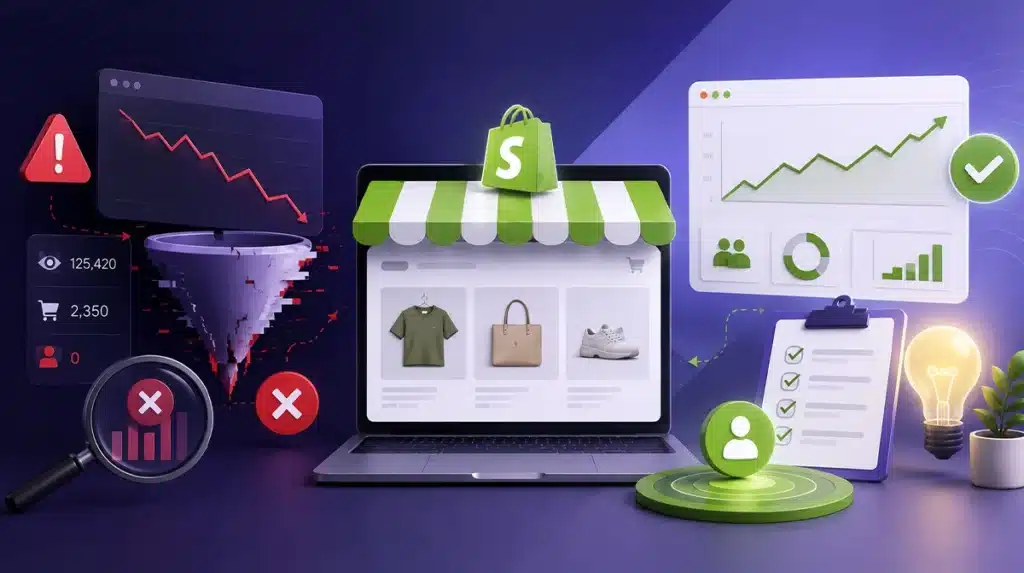
Bad conversion data doesn’t look like a failure; it looks like a winning campaign. It presents itself as a healthy ROAS that justifies next month’s spend and fuels a false sense of confidence, right up until your Shopify payout tells a different story.
The gap between what your ad platforms report and what actually lands in your bank account isn’t just a minor inconsistency. In 2026, for most Shopify brands, this data lag is a silent tax on growth.
When your data is broken, your strategy follows:
- Misallocated Spend: Budgets shift toward “zombie” campaigns that look profitable on paper but lose money in practice.
- Missed Opportunities: High-performing ads are killed prematurely because the tracking failed to credit them.
- Flawed Foundations: Decisions that feel data-driven are actually built on a collapse of logic.
Your dashboards aren’t intentionally lying to you. The reality is that Meta, Google, TikTok, and Shopify each use their own proprietary language to measure a conversion. They operate on different schedules, use conflicting attribution windows, and prioritize their own ecosystems.
These systems were never designed to sync. They provide fragments of a story, but no one is piecing the narrative together for you. Here is exactly why your reporting is breaking, and the steps you need to take to fix the foundation.
The Scale of the Invisible Tax

Before dissecting the causes, it is vital to acknowledge that data discrepancies are no longer edge cases; they are the baseline. If you are scaling a Shopify store in 2026, you aren’t just managing ads; you are managing a deficit.
The following figures illustrate the gap between what is happening in your warehouse and what is appearing in your Ads Manager:
| Metric | Impact Figure | Source |
| iOS Tracking Opt-outs | 75–85% | MHI Growth Engine, 2026 |
| Meta Attribution Blackout (Post-iOS 14) | 30–50% of purchases | MHI Growth Engine, 2026 |
| Ad-Blocking Adoption (Standard User) | 36% | UK Gov / QZM Data |
| Pixel Capture Rate (Average Efficiency) | Dropped to 60–70% | Pen and Paper AI, 2025 |
| Ghost ROAS Decline (Stable Revenue) | 20–40% reported drop | MHI Growth Engine, 2026 |
The New Reality
The numbers don’t lie, but they often fail to tell the whole truth. These statistics confirm a difficult reality: standard browser-based tracking is essentially a leaky bucket. If you are running paid traffic today, your conversion data has significant blind spots. The strategic question for 2026 is no longer if your data is missing, but how much that missing data is skewing your high-level decision-making.
Why the Discrepancy is Inevitable

The friction exists because no two platforms speak the same language. Each ecosystem defines a conversion through its own lens, creating a fragm ented view of the customer journey.
1. The Timing Gap: Real-Time vs. Historical Credit
Shopify is a ledger of truth for sessions and transactions. It records exactly when a sale occurs. If a customer browses on Monday but buys on Wednesday, Shopify development services records the revenue on Wednesday. It doesn’t look back; it simply marks the moment the card was charged.
2. The Attribution Conflict: Who Claims the Win?
Ad platforms like Meta, Google, and TikTok operate on attribution windows. They are incentivized to claim credit for the sale to prove their value. If that same customer clicked a Meta ad on Monday and then searched for your brand on Google on Wednesday to buy:
- Meta claims the sale because of the Monday click
- Google claims the sale because of the Wednesday search
- Shopify records one sale on Wednesday
Suddenly, you have two platforms claiming 100% credit for a single order, while your store only shows one transaction.
3. The Data Filling Problem
When tracking is blocked by privacy settings or ad-blockers, platforms use modeled reporting. They essentially guess based on historical patterns to fill in the blanks. Shopify doesn’t guess; it only counts what it sees. This creates a fundamental rift: you are comparing estimated data from ad managers against hard revenue in your store.
The Bottom Line: You have three or four competing narratives for a single customer journey. They aren’t designed to agree, and none of them provide the complete story. This fundamental disagreement is the root cause of every misallocated dollar in your budget.
3 Reasons Your Conversion Data is Lying to You

1. The iOS Privacy Blackout
Apple’s privacy updates fundamentally broke traditional attribution. With MHI Growth Engine showing 75% to 85% of users opting out of tracking, Meta lost visibility into nearly half of all purchases. Compounding this, the attribution window was slashed from 28 days to just 7.
The Result: A ghost decline. While reported ROAS often plummeted by 20–40%, actual Shopify revenue frequently remained stable. The ads didn’t stop working; the infrastructure under them simply collapsed.
2. Ad-Blockers are Hijacking Your Data
When a customer uses a privacy-focused browser like Brave or an extension like uBlock Origin, your Meta Pixel never fires. The order reaches Shopify, but the ad platform remains blind.
The Scale: As of 2024, 36% of UK adults used ad-blocking software according to the UK Government and QZM Data; a number that is significantly higher among tech-savvy and younger demographics. This isn’t a niche issue; it’s a massive, growing gap that widens every time a browser updates its default privacy settings.
3. The “Double-Counting” Inflation
Many stores inadvertently count the same sale twice, once through a native integration and again through a manual tag or third-party tool. When your ad dashboard looks legendary, but your Shopify payouts look average, you’re likely a victim of duplicate tracking.
The Reality: Duplicate tags don’t create more sales; they just create a dangerously optimistic hallucination of your performance.
How to Fix It: A Practical 5-Step Plan

Step 1: Conduct a 30-Day Data Audit
Standardize your data. Pull 30 days of numbers from Shopify, Google, and Meta into a single sheet to identify the discrepancy gap.
| Platform | Reported Conversions | Shopify Orders | The Gap |
| Meta Ads | 200 | 90 | +110 |
| Google Ads | 150 | 90 | +60 |
| TikTok Ads | 80 | 90 | -10 |
The Gap is where your budget is being misallocated. If your platforms claim more sales than your store actually fulfilled, you are making decisions based on fiction.
Step 2: Migrate to Server-Side Tracking (CAPI)
Server-side tracking bypasses the browser entirely, sending data directly from your server to the ad platform. This makes it immune to ad-blockers and iOS restrictions.
- The Impact: Research shows that moving from pixel-only setups to Meta’s Conversions API (CAPI) and Google’s Enhanced Conversions can boost match rates from 60% to as high as 95%.
Step 3: Align Your Attribution Windows
Stop comparing apples to oranges. Standardize your accounts to a 7-day click window and pivot your primary focus to Blended Metrics.
| Metric | Calculation | Why It Matters |
| Blended ROAS | Total Shopify Revenue ÷ Total Ad Spend | Provides a platform-agnostic truth. |
| MER | Total Revenue ÷ Total Marketing Spend | The best pulse-check for overall business health. |
Step 4: Purge Duplicate Tags
Use tools like Meta Pixel Helper and Google Tag Assistant to audit your site in real-time. If you see multiple IDs firing for the same event, you are inflating your data. Removing these won’t increase your orders, but it will finally give you an honest view of your acquisition costs.
Step 5: Focus on the Metrics That Move the Needle
Instead of chasing platform-specific vanity ROAS, build your strategy around these business-level truths:
- New Customer Acquisition Cost (nCAC): What it actually costs to buy a new customer.
- Repeat Purchase Rate: Whether your accurate data is bringing in loyalists or one-off shoppers.
- Shopify Admin Revenue: Your ultimate ledger of truth.
Conclusion: Data-Driven, Not Dashboard-Driven
Your data isn’t wrong because of a mistake you made; it’s off because pixels, cookies, and privacy laws are all pulling in different directions. The good news? This is a solvable problem.
By auditing your tracking, embracing server-side APIs, and focusing on blended metrics, you can stop gambling with your budget.
As a certified Shopify Plus Partner with over 500 successful projects, Brainvire specializes in closing these data gaps. From Checkout Extensibility migrations to complex ERP/CRM syncs, we ensure your tech stack tells the truth.
Ready to see the real story behind your spend? Start by quantifying your gap today. Once you see what bad data is costing you, fixing it stops feeling like a “tech task” and starts feeling like a business priority.
Frequently Asked Questions
Every platform, Shopify, Meta, and Google, uses its own method to count and attribute conversions, and none of them was built to agree with each other. Layer in Apple’s iOS privacy changes and the growing number of users running ad blockers, and the gap widens fast.
According to MHI Growth Engine (2026), anywhere from 30–50% of purchases can go completely untracked, meaning the data you base your budget on is missing nearly half the picture.
When Apple rolled out its iOS privacy updates, it gave users the choice to opt out of app tracking, and most of them did. That one shift cut Meta’s ability to attribute purchases significantly, with MHI Growth Engine (2026) reporting that 30–50% of purchases became unattributable as a result. The real-world impact hit hard: many brands watched their reported return on ad spend drop by 20–40%, even though their actual Shopify revenue hadn’t moved. The ads didn’t stop working; the tracking infrastructure just stopped seeing them.
Pull 30 days of conversion data from Shopify, Meta, Google Ads and GA4 into one spreadsheet and compare the totals. If Meta shows 100 conversions but Shopify shows 70, that difference is the gap costing you money every month.
Switch from client-side pixels to server-side tracking. It sends conversion data directly from your server to ad platforms, bypassing ad blockers and iOS restrictions entirely. According to Cometly, match rates jump from around 60–70% (pixel only) up to 85–95% when you run server-side alongside your existing pixel.
Related Articles
-
 Headless Shopify vs. Traditional Shopify: Which Architecture Is Right for Your Growth Stage?
A question circulating in every serious enterprise eCommerce meeting right now is: Do we go with Headless Shopify or do we stay traditional? It sounds like a technical debate, but
-
 How Shopify Plus Powers Unified Commerce for the B2B Retail Industry
Running B2B retail on separate, disconnected systems costs far more than most businesses realize. When pricing lives on one platform, inventory on another, and customer data somewhere else, inefficiency thrives.
-
 Unlock eCommerce Growth: The Power of Shopify Magic & Sidekick
Introduction Shopify is turning eCommerce business owners’ dreams into reality by announcing its latest suite: Shopify Magic. Integrated into its products, Shopify Magic comes with free AI-enabled features to reduce