How Conversational AI & NLP are Streamlining Patient Scheduling and Post-Care Follow-ups
-

Pratik Roy

As a healthcare leader, you’ve likely invested millions in digital transformation, yet a persistent gap remains: the ability to scale high-touch, consistent communication without bloating your administrative overhead.
We often see operational breakdowns in scheduling and post-care follow-ups, but these aren’t clinical failures; they are communication failures. The industry has spent years trying to scale human dialogue using tools built for rigid transactions. The result? Patient friction, staff burnout, and leaked revenue.
Conversational AI and Natural Language Processing (NLP) have moved past the “futuristic” phase; they are now the primary engines for operational continuity.
Consider the Mayo Clinic. By integrating conversational AI to manage patient inquiries and scheduling, they didn’t just add a “chatbot”; they reclaimed thousands of clinical hours. The results speak directly to the bottom line: a massive reduction in administrative friction and a measurable lift in patient satisfaction.
The question is no longer about the technology itself, but about how quickly you can pivot from transactional tools to intelligent dialogue to secure your organization’s financial and clinical future.
The Scale of the Communication Problem in Healthcare
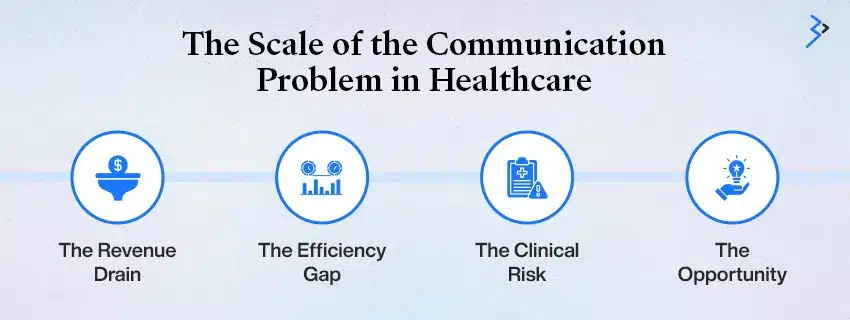
Communication gaps are no longer just an administrative hurdle; they are a direct threat to clinical outcomes and fiscal health.
- The Revenue Drain: According to a Harvard Business Review study, missed appointments cost the U.S. healthcare solutions system $150B annually, with specialized no-show rates reaching up to 30%.
- The Efficiency Gap: Administrative tasks consume 25–30% of total healthcare spending, according to the Jama Network, mainly due to manual patient outreach.
- The Clinical Risk: Communication failures are a primary driver behind the 20% of patients who suffer adverse events within 30 days of discharge, as noted by the CDC.
- The Opportunity: A report by Accenture found that strategic, automated follow-up can boost treatment adherence by 47%, drastically lowering readmission penalties.
Why Scheduling and Follow-Ups Are the First Workflows That Truly Benefit From AI
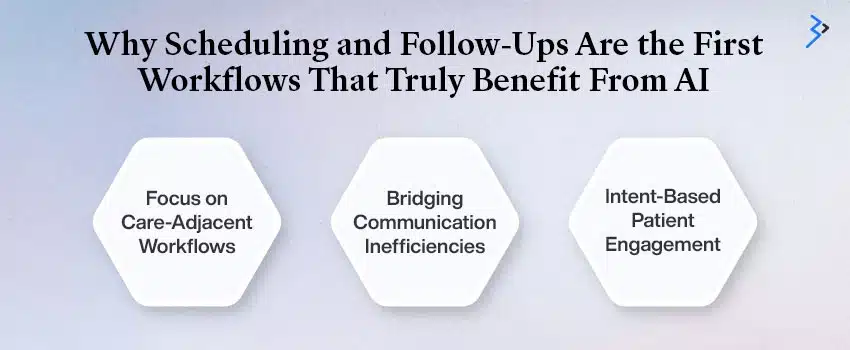
According to a report from Axios, Artificial Intelligence is widely valued for administrative tasks like scheduling and record management, while clinicians remain cautious about its role in high-stakes decisions. Its real impact lies in care-adjacent workflows that quietly consume time and resources at scale. A significant share of healthcare inefficiency stems from communication breakdowns: missed conversations, lost context, and unaddressed follow-ups that lead to no-shows and underused capacity.
Conversational AI is well-suited to close these gaps because scheduling and follow-ups are inherently conversational. Patients express intent, uncertainty, and constraints, not workflows. By interpreting this intent and translating it into action, conversational systems improve coordination, access, and follow-through.
Read More-: From Manual to Intelligent: How AI and RPA Are Redefining Customer Support
What Conversational AI and NLP Actually Change in Healthcare Operations
Conversational AI doesn’t just automate tasks; it orchestrates the care journey by interpreting the nuance of human dialogue. Unlike rigid systems, AI-driven NLP thrives on the ambiguity of patient behavior, handling hesitation and context changes with clinical precision.
| Feature | Traditional Automation | Conversational AI & NLP |
| Logic | Fixed, rule-based paths | Intent-driven & context-aware |
| Input | Rigid forms/fields | Free-text & spoken language |
| Flexibility | Struggles with exceptions | Adapts to revisions & ambiguity |
| Impact | Isolated task execution | End-to-end workflow orchestration |
The Executive Advantage: By absorbing high-volume interactions, Conversational AI acts as a 24/7 communication layer. It ensures continuity and preserves context within your enterprise systems, enabling clinical teams to reallocate their time toward high-empathy, high-judgment care.
Patient Scheduling Is a Conversation, Not a Workflow
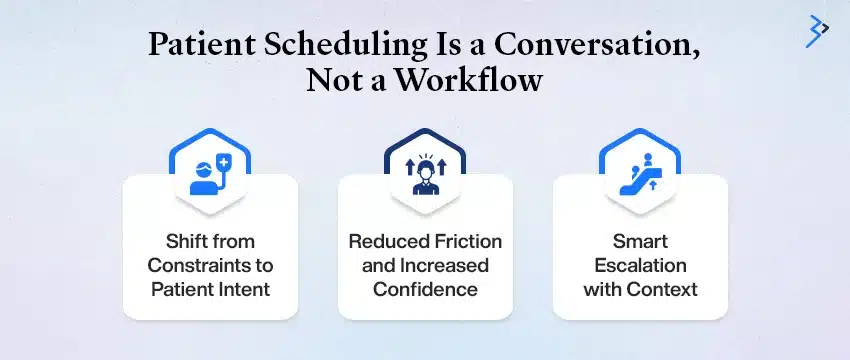
Traditional healthcare scheduling is designed around internal constraints, provider availability, visit types, rooms, and insurance rules, leaving patients to navigate uncertainty. They aren’t thinking in workflows; they’re expressing intent, availability, and concern.
Conversational AI shifts scheduling from rigid forms to natural dialogue. By listening to patient needs, constraints, and hesitation, it translates intent into the right scheduling actions. The result is faster bookings, less friction, and greater patient confidence. Organizations seeing the best results enable always-on access, treat rescheduling as a regular part of care, and escalate complex cases to staff with full conversational context, reducing call volume while preserving trust.
No-Shows Are a Behavioral Signal, Not a Patient Problem
Healthcare has responded to no-shows by simply increasing reminder frequency – earlier, more, and louder reminders.
This approach overlooks the underlying causes. Missed appointments often stem from unresolved questions, scheduling conflicts, transportation issues, or patient hesitation.
Conversational AI enables two-way engagement. CADTH suggests that artificial intelligence systems used in patient scheduling and follow-up can interpret when a patient raises concerns or expresses uncertainty and may respond by offering to reschedule, providing clarification, or flagging the appointment for further attention.
The shift is not about persistence. It is about relevance.
Read More-: The Next Wave of B2B: How AI Agents Are Transforming Marketing and Sales
Post-Care Follow-Ups Are Where Outcomes Are Decided
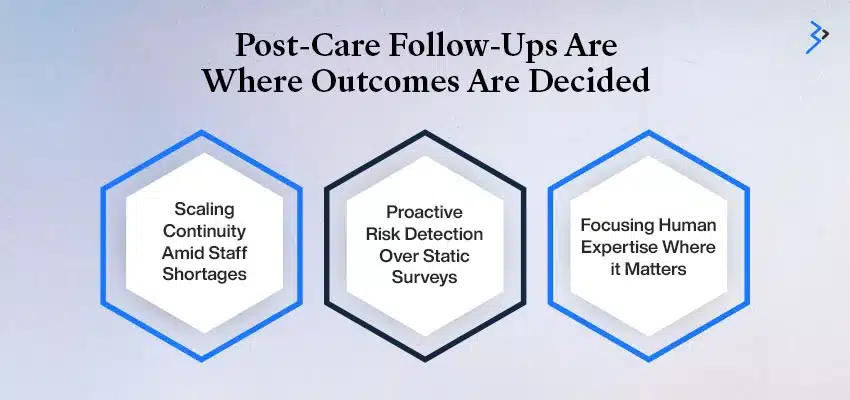
The post-visit period is where care most often breaks down. Patients leave with instructions, medications, and good intentions, but daily life quickly intervenes. Many post-discharge complications stem from communication gaps, while manual follow-up is increasingly unsustainable amid staff shortages.
Conversational AI provides a scalable way to maintain continuity after visits. Instead of one-time calls or static surveys, conversational systems enable brief, ongoing check-ins that surface concerns early. Simple, frequent interactions outperform lengthy questionnaires, while language-based risk detection helps identify patients who need attention before issues escalate.
Human teams intervene only when judgment or clinical expertise is required. This approach does not reduce care, it focuses it where it matters most.
The Real Value Is Prioritization, Not Automation
The principal value of Conversational AI is not just cost reduction but accurate prioritization. Its strategic strength lies in understanding which patients need immediate attention, transforming team allocation, and improving outcomes. For example, several healthcare organizations have reported measurable improvements, including lower no-show rates, better appointment utilization, and reduced readmission risk, following the adoption of conversational AI-enabled engagement models. The power is knowing which patients need attention, which appointments are at risk, and which follow-ups need clinical review.
Conversational AI turns unstructured communication into operational and clinical signals. These signals reshape how teams allocate time, resources, and attention.
Governance, Safety, and Integration Are Where Success Is Won
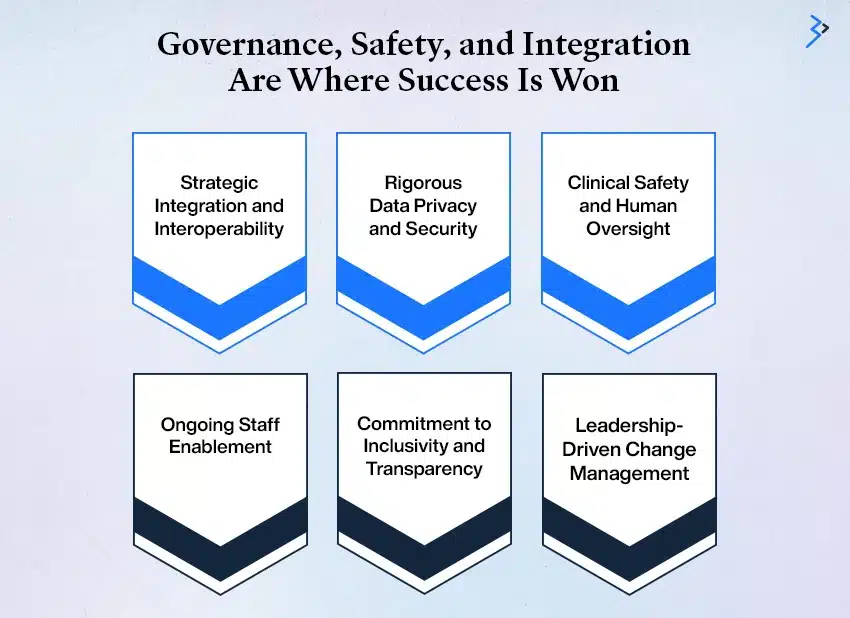
- Not plug-and-play: Conversational AI requires strong governance, safety, and integration planning for sustainable adoption.
- System integration: Must seamlessly connect with existing EHRs, scheduling platforms, and care management systems, supported by clear technical documentation.
- Interoperability: Reliable operation across systems is essential to maintain continuity and prevent fragmented workflows.
- Staff training and enablement: Role-specific training, ongoing support, and change enablement are critical beyond initial rollout.
- Data privacy and security: Patient communication data must meet regulatory requirements, with encryption and continuous monitoring to maintain trust.
- Clinical safety and oversight: Clear escalation paths and human-in-the-loop processes ensure clinical judgment in sensitive or high-risk situations.
- Transparency, bias, and inclusivity: Continuous evaluation is needed to address bias, support inclusive language access, and ensure transparent AI interactions.
- Change management: Leadership alignment and workflow integration are key to embedding conversational AI into daily operations.
Organizations that approach governance, safety, and integration strategically achieve far stronger outcomes than those treating AI as a standalone deployment.
Measuring ROI Beyond Cost Savings
| ROI Dimension | What Improves | Why It Matters |
| No-show rates | Two-way reminders surface conflicts or hesitation early. | Improves capacity utilization and patient access. |
| Appointment utilization | Intent-based coordination aligns patients with schedules. | Increases throughput without added resources. |
| Readmission risk | Ongoing check-ins identify issues earlier. | Supports timely intervention and care continuity. |
| Patient satisfaction | Faster responses and preserved context. | Builds trust and long-term engagement. |
| Staff time allocation | Routine communication is handled digitally. | Frees teams for judgment-driven work. |
| Care prioritization | Language signals flag high-risk cases. | Improves resource allocation and decision-making. |
When viewed holistically, Conversational AI serves as a care-enabling layer, not just an administrative tool. Its value extends beyond efficiency metrics to how well organizations anticipate patient needs, prioritize care, and maintain continuity. By turning unstructured patient conversations into actionable signals, it improves access, strengthens workflows, and aligns care delivery with patient expectations, making ROI a measure of system-wide effectiveness rather than short-term cost savings.
Read More-: Agentic Chatbots: Empowering AI with Tools and Reasoning
What Comes Next for Conversational AI in Healthcare
The next phase is not better chatbots. It is better timing, intent recognition, and workflow alignment.
Emerging directions include proactive outreach driven by risk signals, multimodal interfaces, conversational summaries feeding clinician workflows, expanded language support, and deeper alignment with value-based care models.
AI-enabled workflows are increasingly becoming foundational infrastructure rather than experimental initiatives.
Conclusion: Fixing the Human Side of Healthcare Operations
Conversational AI and NLP succeed because they align healthcare systems with how people actually communicate. They do not replace clinical judgment. They protect it.
For healthcare leaders, the question is no longer whether these technologies belong in scheduling and follow-ups. The question is whether workflows are ready to be redesigned around conversations rather than forcing conversations into workflows.
That is where meaningful transformation begins.
Partnering for Intelligent Patient Engagement
Successfully deploying Conversational AI in healthcare requires more than technology. It depends on a clear understanding of clinical workflows, integration requirements, governance, and change management.
Brainvire works with healthcare organizations to design and scale Conversational AI solutions that strengthen access, continuity, and patient experience while maintaining safety and compliance.
The most significant impact comes when conversational capabilities are embedded into everyday workflows and refined over time. For healthcare leaders, starting with a clear assessment of communication gaps and operational readiness provides a strong foundation for informed decision-making and sustainable outcomes.
FAQs
Traditional automation relies on predefined rules and structured inputs to complete specific tasks. Conversational AI, powered by NLP, interprets free-text and spoken language, understands intent and context, and adapts to patient uncertainty, enabling more flexible, dialogue-driven interactions across scheduling and follow-up workflows.
Yes, when implemented with proper governance. Effective deployments include clear escalation paths, human oversight, privacy safeguards, and regulatory compliance. Conversational AI supports communication and coordination while ensuring that clinical decisions remain under the control of qualified healthcare professionals.
Conversational AI enables two-way engagement rather than one-way reminders. By identifying scheduling conflicts, unanswered questions, or patient hesitation early, systems can proactively offer rescheduling or clarification, improving appointment attendance and better utilizing provider capacity.
NLP helps systems interpret patient language during post-care interactions, detecting intent, symptoms, and contextual signals. This enables early identification of potential issues, supports timely escalation to care teams, and helps maintain continuity during the critical post-discharge period.
ROI is measured across multiple dimensions, including reduced no-show rates, improved appointment utilization, lower readmission risk, higher patient satisfaction, and better staff time allocation. When assessed holistically, Conversational AI is seen as a care-enabling capability rather than a simple cost-saving tool.

Related Articles
-
 Top 20 AI Product Description Generator Tools To Use in 2025
Introduction Artificial Intelligence (AI) is revolutionizing businesses’ operations and transforming processes across industries. Among its most impactful applications are AI Product Description Generator tools, which are reshaping how companies handle
-
Difference Between Artificial Intelligence and Machine Learning
The world of technology is evolving, but our approach to communicating these advancements are dated. As a result, we see a lot of people confused about key technological concepts. Generally,
-
The NLP Revolution: Tracing the Evolution of Transformer Models
AI has always aimed to understand human language, to write clearly, send personalized messages, and summarize complex information in seconds. For years, traditional Natural Language Processing (NLP) tried to do