Why European and UAE Legacy Insurers are Switching to Cloud, AI, and Chatbots
-

Pratik Roy

The moment of truth in insurance, the claims process, is being fundamentally rewritten in 2026. Imagine a sudden hailstorm battering the European countryside while, simultaneously, a flash flood stalls logistics in a busy Dubai district. In the old world of insurance, these events would have buckled the system under a week-long paper trail and frantic phone calls from frustrated policyholders.
But for the modernized carrier, the response is silent, digital, and remarkably fast. While the storm is still raging, satellite imagery is already pinpointing damage. Before a policyholder even reaches for their phone, Artificial intelligence models have triggered an automatic payout. If they do have a question, a multilingual chatbot is already available to handle most initial inquiries with instant, calm reassurance. This isn’t a futurist’s dream; it is the ROI of Insurance Tech Modernization in full swing, driving a significant increase in First Notice of Loss (FNOL) speeds globally.
Across Europe and the UAE, the industry has reached a critical tipping point. Given that the digital insurance market in the Middle East is expanding rapidly and that European Property & Casualty carriers report significantly stronger profitability, the message is clear: technical debt is not merely an IT headache; it is a threat to survival.
This guide breaks down how legacy carriers are shedding their past to unlock efficiency gains through the 2026 triple threat of Cloud, AI, and Chatbots.
The Legacy Anchor: Modern Challenges in Europe and the UAE
For decades, insurance was the industry that time forgot. Legacy systems, some running on code older than the interns hired to maintain them, have become a literal anchor on growth.
The European Bottleneck
In Europe, legacy architecture is responsible for a staggering delay in claims processing. These monolithic systems make it nearly impossible to launch new products quickly. When a nimble competitor launches a pay-as-you-drive model, a legacy carrier often takes 18 months just to update its backend. By the time they are ready, the market share has already evaporated. Furthermore, European P&C ROE, while rising, remains heavily bifurcated; gains are almost entirely concentrated among firms that have successfully migrated away from on-premises silos.

The UAE Fraud and Output Gap
In the UAE, the challenge is equally severe. Carriers face an estimated 15% revenue loss due to insurance fraud, according to Zawya. Without real-time data integration, spotting crash-for-cash schemes or medical billing inflation is like finding a needle in a digital haystack. However, the region is seeing a massive shift. Insurtech adoption in the UAE is now yielding efficiency gains, as firms move toward digital-first financial solutions to capture a piece of the digital insurance market.
The Solution: Modernization through Cloud and AI isn’t just a facelift; it’s a cost-cutting machine. Carriers moving to these stacks report significant reductions in operating expenses and a massive lift in Net Promoter Scores (NPS). This modernisation push is part of broader insurance technology trends, from AI-driven underwriting and real-time catastrophe modelling to automated commercial property data ingestion, that are reshaping how carriers price risk, manage exposure, and compete in an increasingly digital insurance market.
Cloud Strategies: Building the Foundation for Scale
You cannot run 2026 AI on 1996 servers. Cloud migration is a prerequisite for every other innovation, reducing IT maintenance spend by eliminating the need for expensive on-premises legacy systems.
Microservices over Monoliths
Leading carriers are migrating to AWS and Azure using a microservices architecture. This helps them to unbundle their services. Instead of updating the whole system, they can update just the Pricing Engine or the Payment Gateway.
Allianz (Europe) serves as a model here. Their shift to a cloud-native platform enabled real-time pricing adjustments, resulting in a 30% gain in organizational agility, according to Ledger Insights. They can now launch a specialized insurance product in weeks, not years. This agility enables them to sustain a competitive ROE even in a volatile European market.
The UAE’s Blockchain-Cloud Hybrid
In the UAE, ADNIC (Abu Dhabi National Insurance Company) has pioneered a unique approach: merging cloud scalability with blockchain (Hyperledger Fabric) for claims settlement. This permits seamless inter-insurer payouts, reducing the time it takes to settle a motor claim between two different companies by days. For the customer, this means their car is back on the road faster than with a traditional carrier.
AI and Analytics: The New Risk Prediction Powerhouse
Modernization shifts the insurance model from Repair and Replace to Predict and Prevent. By 2026, the most successful carriers will be using Predictive Modeling powered by satellite imagery and IoT sensors to detect anomalies before they turn into disasters.
Predictive Modeling in Action
- AXA (Europe): Their AI-driven fraud tools have successfully cut losses. By evaluating patterns across millions of claims in seconds, the AI flags suspicious activity that a human adjuster would miss.
- Risk Prevention Ecosystems: European carriers are now offering “Prevention as a Service.” By monitoring smart home sensors or wearable health tech, carriers can alert customers to a leaking pipe or a health risk before it becomes a claim. This creates a recurring revenue stream and slashes payout volumes, directly boosting ROE to 11.6%, as reported by Gambit Finance.
Chatbot-Led CX Revolution: The Death of the Queue
AI Customer experience (CX) is the new battleground. In a world of instant gratification, a “fill out this PDF and mail it” strategy is a death sentence. AI-driven bots are now deflecting major queries, enabling human agents to focus on high-value cases that need empathy.
Automating the FNOL
Modern AI chatbots are no longer simple “if/then” scripts. They use Natural Language Processing (NLP) and Agentic AI to handle the entire FNOL process.
- GroupBWT Success: Their insurance-specific bots have automated 70% of customer interactions, as noted in their case studies, while remaining fully compliant with local regulations, including GDPR and UAE data laws.
- AXA Gulf: In the UAE, they are piloting parametric chat-driven products. If a flight is delayed (tracked via real-time data feeds), the chatbot reaches out to the customer via WhatsApp to offer an instant lounge pass or payout, zero human involvement required.
The Implementation Roadmap: Your 24-Month Playbook
Modernization is a marathon, not a sprint. To avoid the “rip-and-replace” risks that often paralyze legacy firms, we recommend a phased approach. By breaking the transformation into workable six-month sprints, carriers can secure early wins, prove ROI to stakeholders, and maintain business continuity.
Based on successful global deployments, here is the four-stage framework to move from legacy constraints to digital dominance:
| Phase | Timeline | Primary Objectives | Key Outcomes |
| 1. Legacy Audit | Months 1–6 | Identify “low-hanging fruit” and map out technical debt. Locate the specific silos causing claims delays. | A prioritized modernization backlog and a clear baseline for current operational costs. |
| 2. Cloud Pilot and AI POC | Months 7–12 | Migrate a single line of business (e.g., Motor or Travel) to the cloud. Launch an AI Proof of Concept (POC) for fraud detection. | Evidence of shrinking fraud losses and proof that cloud-native microservices improve agility. |
| 3. Chatbot Rollout | Months 12–18 | Integrate an AI-driven bot into customer service channels to handle First Notice of Loss (FNOL) and basic quotes. | Significant query deflection, reduced pressure on call centers, and faster customer response times. |
| 4. Scale and Partner | Months 18–24 | Expand the proven architecture across all insurance lines. Integrate with external Insurtech partners and IoT ecosystems. | A fully unified, high-speed digital operation ready to dominate the 2026 market. |
The Modernization Dividend: Although the journey takes time, the financial rewards are front-loaded. Most carriers utilizing this roadmap can expect a full ROI and project payback within 18 to 24 months of the initial launch.
Risks and Best Practices for 2026
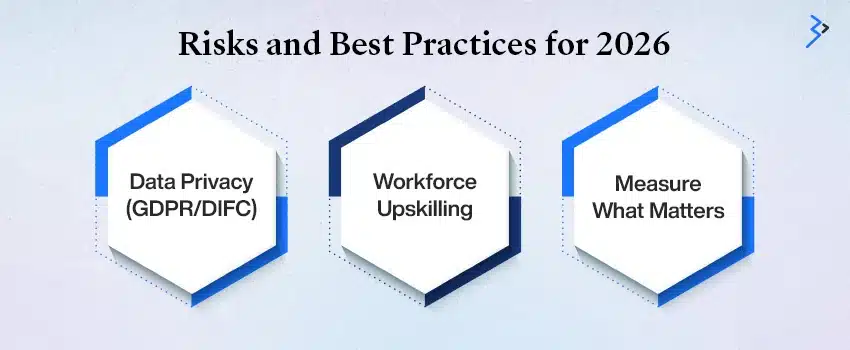
- Data Privacy (GDPR/DIFC): Use federated learning to train AI models without moving sensitive customer data across borders. This maintains compliance while still gaining global insights.
- Workforce Upskilling: Technology only works if your people use it. Upskill your traditional adjusters to become AI Collaborators who oversee the models rather than doing manual entry.
- Measure What Matters: Move beyond the Combined Ratio. Track Customer Lifetime Value (CLV) and post-chatbot interaction retention rates.
Conclusion: The Modernization Dividend
Insurance tech modernization is no longer an IT project; it is a core business strategy. With a 3x to 5x ROI potential, as noted by Gambit Finance, the shift to Cloud, AI, and Chatbots will separate industry leaders from laggards by the end of 2026.
Leaders like Allianz, AXA, and ADNIC have already laid the blueprint. They are seeing faster claims, lower fraud, and happier customers. The technology is ready. The question is: Is your legacy system ready to be retired?
Don’t let technical debt stall your growth. From cloud-native migrations to AI-powered automation, Brainvire provides the end-to-end enterprise solutions needed to transform legacy carriers into digital leaders.
Contact our experts to begin your journey toward a zero-lag, high-ROI future.
Frequently Asked Questions
AI improves ROE by reducing the Expense Ratio. By automating claims triage and using predictive analytics for underwriting, carriers can price risk more accurately and reduce the manual labor expenses associated with processing, directly boosting the bottom line.
Yes. Global providers like AWS and Azure now have local data centers in the UAE (Dubai and Abu Dhabi). By utilizing a Sovereign Cloud approach and local encryption, carriers can comply with UAE data residency laws while gaining the scalability needed for real-time AI.
While they may not settle complex industrial fire claims, they can handle high-volume, low-complexity claims such as motor glass, travel delays, or simple health inquiries. They act as a Digital Front Door, escalating complex cases to humans.
By moving your website rendering to the network edge, you achieve nearly instant page loads. This leads to a significant improvement in Time to Interactive (TTI), a key factor in converting mobile users into policyholders.
It is rarely the technology; it is usually cultural opposition and technical debt. Success requires leadership to view IT as a value center rather than a cost center, plus a commitment to upskilling the existing workforce to work alongside AI.
Related Articles
-
 From Manual to Intelligent: How AI and RPA Are Redefining Customer Support
Do you recall the days when customer service was on a never-ending series of phone menus, boilerplate mail answers, or days to wait to get a call back? Such days
-
Top 22 AI Product Description Generator Tools To Use in 2025
Introduction Artificial Intelligence (AI) is revolutionizing businesses’ operations and transforming processes across industries. Among its most impactful applications are AI Product Description Generator tools, which are reshaping how companies handle
-
Top AI-driven Image Generation and Editing Tools
AI-driven image generation and editing tools have revolutionized the creative industry by allowing users to create, modify, and enhance images easily. These platforms harness the power of artificial intelligence to