Generative AI in Manufacturing: 5 Operations That Are Already Being Transformed
-

Pratik Roy
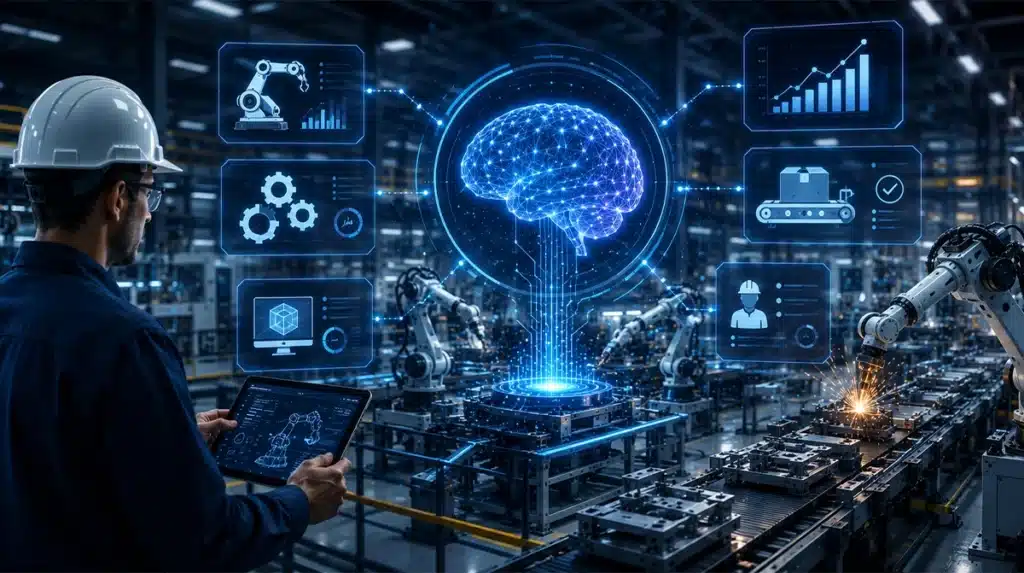
Most technology trends arrive with more noise than proof. Generative AI in manufacturing is one of the rare exceptions; the proof is already there, and it’s showing up in the numbers that factory operators actually care about.
According to Fortune Business Insights, this isn’t a story about what AI might do for manufacturing. It’s about what it’s already doing. The market reflects that shift: AI in manufacturing hit $7.4 billion in 2025 and is projected to reach $92 billion by 2034. Generative AI’s slice of that is growing even faster, from $630 million in 2025 to nearly $14 billion by 2034, a 41% annual growth rate reported by Precedence Research.
This massive capital influx isn’t just following a trend; it is chasing specific, high-yield efficiencies. To understand why manufacturers are moving so aggressively, we have to look past the balance sheet and onto the factory floor.
The following five operations represent the front lines of this transformation, where generative AI development services is moving from a pilot phase to a permanent competitive advantage.
5 Operations Seeing the Biggest Impact
01 | Predictive Maintenance: Knowing Before It Breaks

Unplanned downtime is one of the most expensive issues in manufacturing, and it’s getting worse. Each hour of unplanned downtime now costs around 50% more than it did in 2019, driven by inflation, tighter supply chains, and higher production demands. In high-precision environments, a single hour of equipment failure can run up to $1 million in losses.
Historically, maintenance relied on two models: Reactive (fixing it after failure) or Preventative (replacing parts on a fixed schedule). Generative AI introduces a superior third option: Predictive Maintenance.
The GenAI Advantage: Unlike conventional machine learning, Generative AI can create synthetic data to simulate rare failure scenarios. Because most high-end equipment doesn’t fail often enough to build a robust real-world dataset, GenAI fills this gap with realistic failure simulations. This allows predictive models to be trained far faster and more accurately than waiting years for actual incidents to accumulate.
| Metric | Impact |
| Downtime reduction | 35–45% average (McKinsey, 2024) |
| Maintenance cost savings | 25–40% |
| Equipment lifespan extension | Up to 20% |
| ROI timeline | 10:1 to 30:1 within 12–18 months |
| Companies reporting positive ROI | 95% of adopters |
The Result: According to Oxmaint, some manufacturers recover their full investment in under three months solely by avoiding downtime. This represents a fundamental operational shift: maintenance teams transition from reactive firefighters to predictive strategists, focusing on targeted interventions that cost a fraction of emergency repairs.
02 | Product Design: Compressing Years Into Weeks

Product design has traditionally been a time-intensive process that is difficult to accelerate without sacrificing quality.
- The Standard Cycle: Concept → Prototype → Test → Failure → Repeat.
- The Bottleneck: In complex sectors like aerospace or automotive, teams can burn six to twelve months in this loop. Every physical prototype is a capital drain, and every failed test sends the project back to step one.
Generative AI fundamentally re-engineers the front end of this cycle through Generative Design.
How it Works: Instead of engineers manually sketching designs to see what works, they input design constraints, materials, weight, load requirements, cost targets, and manufacturing feasibility. The AI then evaluates thousands of configurations simultaneously against these parameters. What once took weeks of manual iteration is now completed in hours.

The Impact in Numbers:
- Manufacturability: Up to 90% of AI-generated designs are manufacturable on the first pass.
- Cost Efficiency: Physical prototype costs plummet as high-fidelity simulations replace early-stage physical testing.
- Scalability: Custom orders and market-specific variants are handled instantly through automated AI project management without consuming limited engineering bandwidth.
Strategic Value: Accenture projects that Artificial Intelligence could raise average manufacturing profit margins by 38% by 2035. Optimized product design is a primary driver of that shift, turning R&D from a slow-moving cost center into a high-speed competitive advantage.
03 | Quality Control: Inspection That Doesn’t Fatigue
Manual inspection faces two persistent hurdles: human fatigue and subjective judgment. An inspector’s accuracy inevitably dips six hours into a shift, and no two humans see a borderline defect the same way.
AI-powered computer vision eliminates these variables, maintaining the same level of precision on the ten-thousandth part as it did on the first. However, Generative AI introduces a capability that standard machine vision lacks: Synthetic Data Generation.
The Proactive Advantage: In high-quality manufacturing, major defects are rare. This makes it difficult to train conventional AI, which requires thousands of examples to recognize a failure. GenAI solves this by creating realistic, synthetic examples of rare defect types. Manufacturers can now train inspection models in days rather than waiting years for enough real-world failures to occur.
The Impact:
- Reliability: AI-driven quality control reduces infrastructure-related failures by up to 73%.
- Waste Reduction: 78% of facilities using AI report measurable reductions in scrap and rework.
- Cost Avoidance: Catching a defect at the component stage costs a fraction of finding it after assembly, and an infinitesimal fraction of the cost of a customer recall.
04 | Supply Chain Optimization: Forecasting That Moves With Reality

The disruptions of recent years exposed a structural flaw: traditional forecasting is reactive and backward-looking. Relying on historical data fails when global conditions shift overnight, leading to a bullwhip effect of expensive overstock or empty shelves.
From Static to Adaptive: Generative AI transforms the supply chain from a static plan into a living model. It ingests real-time data from logistics networks, weather patterns, geopolitical shifts, and consumer behavior.
Key Statistics:
- Adoption: 94% of companies now plan to use GenAI for supply chain decision-making (ABI Research, 2025).
- Autonomy: 76% of professionals see immediate potential for AI agents to handle autonomous reordering and rerouting.
- Efficiency: One major electronics manufacturer used AI to cut inventory costs by 25% while simultaneously improving product availability.
Beyond prediction, GenAI excels at scenario modeling. It can simulate hundreds of “what-if” disruption scenarios, from port strikes to raw material shortages, and map out response options before they are ever needed.
05 | Worker Productivity and Knowledge Transfer: Closing the Skills Gap
The manufacturing industry faces a dual crisis: a chronic labor shortage and the Silver Tsunami of retiring experts. When an experienced technician retires, years of unwritten institutional knowledge, the “quirks” and manual-free fixes, often walk out the door with them.
Institutional Knowledge on Demand: Generative AI acts as a bridge for knowledge transfer. When a junior operator encounters an unfamiliar machine fault, they no longer have to wait for a senior tech to walk the floor. They can describe the issue to a GenAI interface and receive step-by-step guidance pulled from decades of maintenance logs, repair records, and engineering manuals.
The Productivity Lift:
- Time Recovery: Workers using GenAI recover an average of one full day per month in lost time (Federal Reserve, 2025).
- Efficiency: Teams report 77% faster task completion and a 45% overall productivity lift.
- ROI: Broad AI adoption in the workforce typically delivers a 200%–400% ROI.
The Bottom Line: The real value isn’t just speed; it’s resilience. By digitizing institutional knowledge, manufacturers ensure that their operational brain stays in the building, regardless of who retires.
Conclusion
The industrial AI market hit $43.6 billion in 2024. It’s heading toward $154 billion by 2030. AI software spending in manufacturing alone is projected to reach $34.5 billion by 2027. These aren’t exploration budgets anymore, they’re deployment budgets.
Across these five areas, the pattern holds: generative AI works best not as a standalone tool but as something wired into real workflows, pulling from live systems, operating with actual business context behind it. That’s when the decisions get faster, the outcomes get more consistent, and the ROI starts making sense on a spreadsheet.
Brainvire has been building AI and ML solutions for manufacturers for over years, across automotive, aerospace, consumer goods, and industrial equipment. Predictive maintenance, computer vision quality control, AI-driven ERP, supply chain optimization, delivered in production, not stuck in pilot.
Certified partnerships with Odoo, Microsoft, and SAP mean the technical depth is there when the complexity gets real. If you’re figuring out where generative AI fits in your operations, or trying to scale something that’s already working, that’s the conversation we’re set up to have.
Frequently Asked Questions
It’s in active production deployment. The global generative AI in manufacturing market hit $630 million in 2025 and is projected to reach nearly $14 billion by 2034, reflecting real adoption, not just pilot budgets reported by Precedence Research.
Predictive maintenance, product design, quality control, supply chain optimization, and worker productivity are the five areas with the most measurable, documented results at this point.
Organizations implementing AI-driven predictive maintenance report average downtime reductions of 35–45%, with maintenance cost savings of 25–40% and asset life extensions of up to 20%, according to McKinsey Global Institute analysis from 2024.
The Airbus example, 45% weight reduction on cabin components without structural compromise, is well-documented. The broader capability is evaluating thousands of design configurations in seconds, which compresses timelines that used to run months or longer.
The practical role of generative AI on the shop floor is augmentation, not replacement. It gives workers access to collective institutional knowledge in real time, speeds up decision-making, and closes skill gaps. The productivity lift to 45% by some measures comes from people working better, not people being removed.
Predictive maintenance alone delivers 10:1 to 30:1 ROI within 12–18 months in documented cases. Across broader AI adoption, manufacturers report 200%–400% ROI. The range depends heavily on use case selection and implementation quality.

Related Articles
-
 AI-Driven Fintech Apps: Preparing for the Next Generation of Digital Banking
The pace at which the financial sector is transforming is remarkable. Traditional banks with physical branches are being rapidly overshadowed by digital-first experiences that offer personalization, speed, and predictive intelligence,
-
 Highlights and Challenges surrounding Machine Learning
Machine Learning, yes, this word might have flooded your mind with a number of questions, so here we are with answers to them by highlighting the advantages and disadvantages of
-
Secrets to Stable Training for Large-Scale Generative Models
Artificial Intelligence (AI) is no longer just a futuristic concept; it’s the backbone of modern business innovation. Generative models are revolutionizing industries by enhancing chatbots with large language models (LLMs).