Generative Models Unpacked: The Innovations Powering Next-Gen AI
-

Pratik Roy

Envision a future where your business can rapidly produce everything it requires, whether it’s marketing strategies, tailored images, or code, within mere hours. This efficiency could revolutionize your operations.
In the past, technology mainly helped us analyze data, identify patterns, and automate tasks we were already doing. But now, thanks to a type of artificial intelligence known as generative models, we are entering a new era focused on creativity. This new technology is used to make things rather than analyze them.
The change is not merely a software upgrade but a fundamental shift in how we approach work, innovation, and creativity. Generative AI is rapidly moving from a fun tool for creating digital art to a core enterprise capability that can reshape entire industries.
According to a report from The Business Research Company, the global generative AI market is projected to grow from approximately USD 23.18 billion in 2024 to around USD 34.45 billion in 2025.
Looking closely at this technology, we see three key factors pushing innovation forward. Let’s break down the main improvements in generative models and see how they provide real benefits and affect competition for businesses worldwide.
The New Creative Core: What is a Generative Model?
At its simplest, a generative model is an AI system trained on vast amounts of data, such as text, images, audio, or code, to learn that data’s underlying patterns and structure. Once trained, it can generate entirely new content that is statistically similar to its training data yet wholly unique.
Think of it this way: instead of just classifying a cat in a photo (a discriminative task), a generative model can draw a new cat that has never existed. This creates unprecedented levels of automation, personalization, and rapid prototyping across every business function.
The 3 Pillars of Generation: GANs, VAEs, and Diffusion Models
Generative AI relies on several fundamental architectural foundations. Understanding these is key to knowing which tool is best for which business problem.
01 | GANs: The Generative Adversarial Networks (The Art Forgers)

Introduced in 2014, GANs revolutionized generation through a brilliant concept: adversarial competition.
How it Works
A GAN consists of 2 neural networks locked in a competitive “game”:
- The Generator: Creates new synthetic data (e.g., an image) from random noise, trying to make it look as real as possible.
- The Discriminator: Acts as a critic, trying to tell if the image is “real” (from the training data) or “fake” (from the Generator).
The Result
They train simultaneously, with the Generator constantly improving its ability to “fool” the Discriminator, resulting in incredibly high-quality, realistic outputs.
- The Trade-off: While fast at generating samples, GANs can be notoriously difficult to train. They are prone to a common issue called “mode collapse,” where they only generate a narrow subset of possible outputs.
- Enterprise Use: Creating hyper-realistic synthetic data for training other AI models, generating realistic faces for gaming or virtual reality, and enhancing image resolution.
02 | VAEs: Variational Autoencoders (The Blueprint Designers)
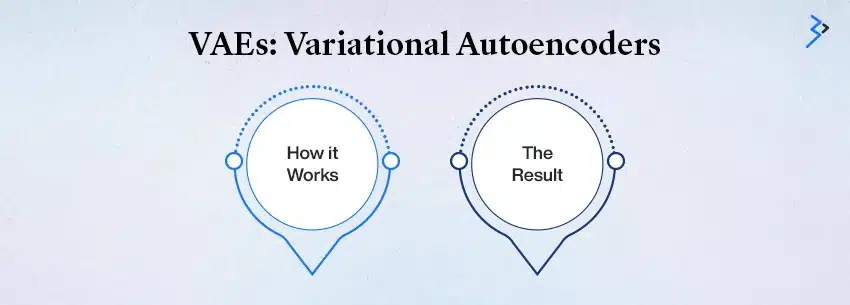
VAEs take a more structured, probabilistic approach to learning the data’s core blueprint.
How it Works
Unlike GANs, VAEs follow a single, stable training process. The “Encoder” step compresses input data into a compact numerical representation known as latent space. The “Decoder” then learns to reconstruct the original data from this compressed space.
The Result
VAEs excel at generating new data by navigating this structured latent space. Because they understand the underlying structure, they are excellent for smoothly morphing between different styles or concepts.
- The Trade-off: The outputs tend to be more stable than GANs, but historically, they can sometimes produce blurrier or less photo-realistic outputs because the model prioritizes a smooth distribution in the latent space.
- Enterprise Use: Anomaly detection, data compression, and creating structured, diverse data variations (e.g., for product design or catalog generation).
03 | Diffusion Models (The Master Sculptors)
The latest breakthrough, Diffusion Models, has dominated the high-quality image and video generation space (think DALL-E and Midjourney) and represents the cutting edge of generative fidelity.
How it Works
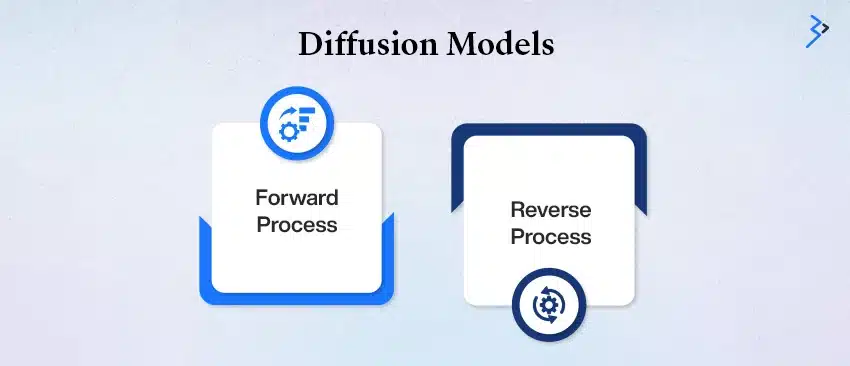
They work in two phases:
- Forward Process: The model systematically adds noise to an image until it is static.
- Reverse Process: The model actively reverses the noise process, step-by-step, transforming static into a coherent, high-quality image.
The Result
This iterative refinement process uses Diffusion Models to capture incredibly complex and subtle data distributions, leading to outputs that often surpass GANs in realism and diversity.
- The Trade-off: The main drawback is speed; since the generation involves many sequential “denoising” steps, they typically require more computational resources and are slower to generate samples than GANs.
- Enterprise Use: Unparalleled image creation, 3D asset generation for digital twin, and high-fidelity video synthesis.
Read More-: From Imagination to Automation: Generative AI’s Impact on Creative Workflows
Beyond the Hype: The Measurable Business Value
While the technology is impressive, the real excitement for businesses lies in the measurable return on investment (ROI). Generative AI is not just a creative tool; it’s a massive productivity booster.
The Federal Reserve Bank of St. Louis survey showed that American workers using generative AI saved an average of 5.4% of their work hours. This reduction translates to roughly 2.2 hours in the typical 40-hour work week. The findings highlight the potential efficiency gains from incorporating generative AI into the workplace.
Where are these gains coming from?
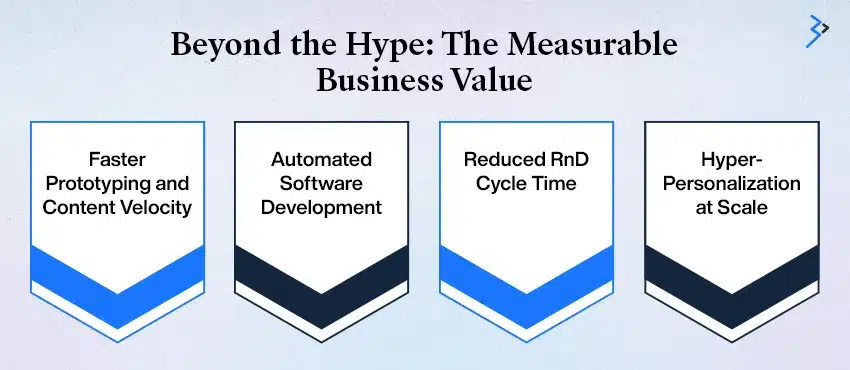
- Faster Prototyping and Content Velocity: Marketing teams can quickly create a variety of social media captions and images, streamlining the process significantly. This efficiency reduces the timeline from weeks to days from concept to campaign launch.
- Automated Software Development: According to a McKinsey study, developers using generative AI tools can complete many coding tasks nearly twice as fast. Documenting code or writing new functionality takes about half the time, translating into significant productivity gains for engineering teams.
- Reduced RnD Cycle Time: Generative models in science are revolutionizing drug discovery by simulating molecular interactions. They can even propose new compounds, significantly shortening the lengthy processes typically involved.
- Hyper-Personalization at Scale: Businesses can now quickly and efficiently generate unique product descriptions, tailored email copy, and personalized healthcare treatment plans. The ability to cater to individual customer preferences has never been better. As a result, companies can enhance customer satisfaction and loyalty on a larger scale.
Multimodal Magic: Real-World Enterprise Use Cases
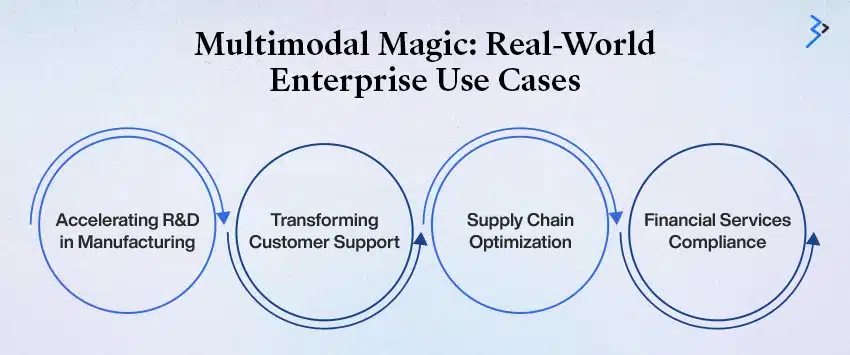
The next frontier is Multimodal Generative AI, where models can seamlessly process and generate content from a single prompt across different data types, text, images, audio, and video. Generative AI represents a significant transformation at the system level.
Accelerating R&D in Manufacturing
An engineer facing a broken machine part can utilize a multimodal AI to enhance the repair process. The AI scans a visual inspection photo of the damaged component and cross-references it with relevant technical schematics. The AI simplifies the engineer’s task by generating a 3D digital twin of the required replacement. This innovative approach ultimately saves valuable time and minimizes downtime for the machine.
Toyota Research Institute (TRI) designers use text-to-image generative AI tools in early concept phases to integrate sketches with engineering constraints, reducing design iterations.
Transforming Customer Support
Traditional chatbots only understand text. A multimodal model helps answer questions like, “My modem light is red,” by analyzing a photo of the LED and referencing a technical manual for a solution. Improving first-contact resolution significantly lowers operational costs.
Lyft’s customer-care AI assistant, powered by Anthropic via Amazon Bedrock, has reduced average resolution time by approximately 87%.
Supply Chain Optimization
Companies are building “digital twins” of their entire distribution networks. Generative AI runs simulations to optimize real-time logistics plans, boosting efficiency and resilience.
McKinsey & Company published an article showing how AI-powered digital twins are key to unlocking end-to-end supply-chain growth.
Financial Services Compliance
In a highly regulated environment, AI can review marketing materials (text and images) and instantly generate necessary disclaimers. Before you publish, tag all content accurately for usage rights and legal compliance.
According to Quartz, Mondelez International uses a generative-AI tool to reduce its marketing production costs by up to 50%.
Read More-: How Generative AI Is Revolutionizing Contract Review: Faster Approvals, Lower Risk
The Road Ahead: Challenges and Responsible Innovation
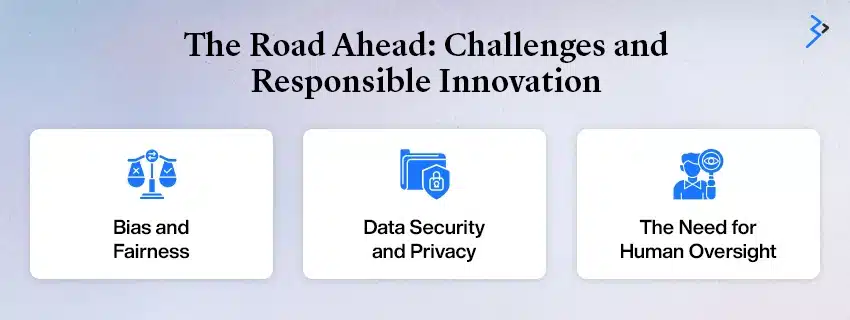
Generative AI’s power comes with significant responsibilities. While the benefits are clear, organizations must navigate key challenges for successful and ethical adoption:
- Bias and Fairness: The data used to train the models determines their unbiasedness. If the training data underrepresents specific demographics, the generated outputs can amplify existing societal biases, leading to unfair results.
- Data Security and Privacy: LLMs can sometimes “memorize” sensitive information from their training data. When using this technology, enterprises must follow strict protocols to prevent leaking proprietary data and customer information.
- The Need for Human Oversight: Generative models, especially early ones, can “hallucinate,” producing incorrect, nonsensical, or distorted information that sounds confidently correct. Human oversight is crucial for high-stakes decisions (legal, medical, or financial) to validate outputs and maintain accountability.
Conclusion: Partnering for a Smarter Future
Generative models are more than a passing technological trend; they catalyze unprecedented business transformation. They help businesses redefine what’s possible by automating creation and accelerating innovation.
At Brainvire, we understand that integrating this technology requires more than just deploying a model. A strategic plan is needed to address your data security needs, integrate with existing systems, and align technology with business goals. We partner with you to convert this cutting-edge capability into a sustainable, competitive advantage for your organization.
FAQs
GANs use an “adversarial” approach, where two neural networks (a Generator and a Discriminator) compete to create highly realistic data quickly. Diffusion Models, the current standard for quality, use an iterative process of adding and systematically removing noise from an image. While Diffusion Models often produce higher-quality and more diverse results, GANs are typically much faster at generating samples once trained.
Multimodal AI involves models that process and create content across different formats, like images, text, and videos. This ability is key to addressing complex business challenges beyond text analysis. For example, it can improve customer support by integrating screenshots with text in ticket triaging. It also enhances RnD by combining scientific diagrams with research papers.
A “hallucination” is when a Generative AI model produces false, nonsensical, or factually incorrect information while presenting it as fact. Since this is a known risk, businesses mitigate it by maintaining strict Human-in-the-Loop oversight, especially for high-impact outputs. They also often use Retrieval-Augmented Generation (RAG) to anchor the model’s answers to verified, internal company data sources.
Generative AI enhances productivity by automating repetitive tasks such as drafting emails and summarizing reports. With this technology, workers save over two hours a week, which lets them focus more on strategic and creative work.
Beyond the technical challenges, one of the biggest challenges is ensuring AI’s ethical and responsible use. Reducing bias, safeguarding privacy, and ensuring accountability for AI decisions are essential objectives.

Related Articles
-
 Level Up Your Game: Top Game Development Tools to Use in 2025
Introduction Game development tools have become indispensable for developers, artists, and studios looking to create visually stunning and engaging games. These tools provide cutting-edge features that enhance productivity, streamline workflows,
-
Top AI Workflow Automation Tools
AI workflow automation tools have transformed business processes by automating routine tasks, improving efficiency, and reducing manual errors. These platforms integrate artificial intelligence to streamline workflows, optimize operations, and enhance
-
 How Artificial Intelligence Trading Technology is Educating Stock Market Investors?
Have you seen the equations that experienced traders make in their heads? Or have you seen how recent trades are being recorded while current data is being monitored in movies?