How Shopify Plus Powers Unified Commerce for the B2B Retail Industry
-

Hiren Raval
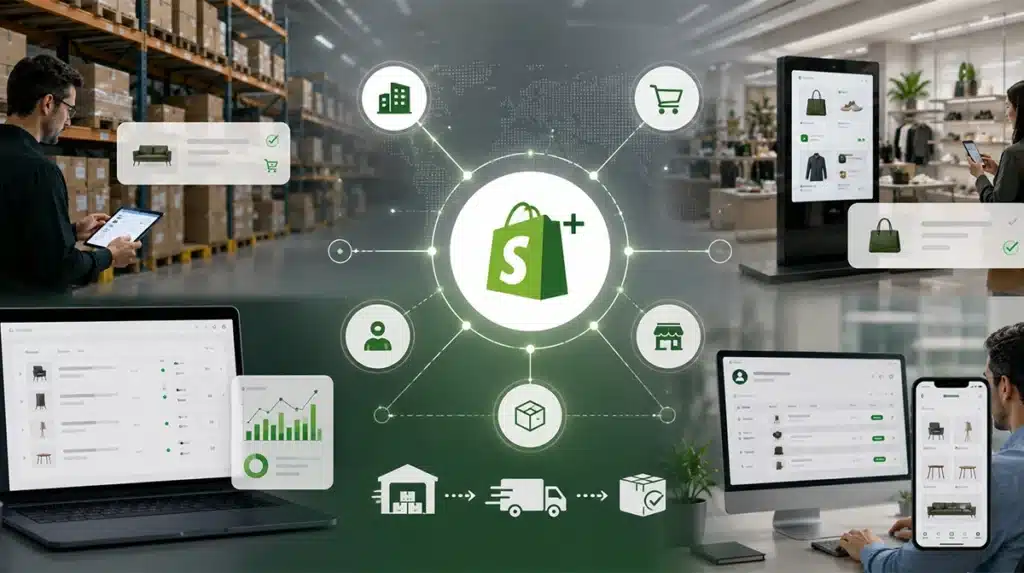
Running B2B retail on separate, disconnected systems costs far more than most businesses realize. When pricing lives on one platform, inventory on another, and customer data somewhere else, inefficiency thrives. Every connection between these silos was likely built at a different time, by a different team, and for a different reason, meaning your IT department spends more time keeping legacy integrations alive than building anything new.
The numbers make a compelling case. Retailers running fragmented commerce systems spend 22% more on maintenance without ever reaching the functionality of a single, unified platform. Furthermore, independent research cited by Shopify reveals that organizations face 34% higher data migration costs when operating disconnected systems.
This infrastructure lag directly impacts sales: while 72% of B2B buyers now expect real-time pricing and self-serve ordering, only 36% of vendors actually deliver it.
This is exactly where unified commerce changes the game. By bringing your entire B2B and DTC operations onto a single platform, you can eliminate integration failures, slash maintenance overhead, and finally deliver the seamless buying experience modern clients demand.
Read on to discover exactly how Shopify Plus powers unified commerce for the B2B retail industry, and how it can redefine your operational efficiency.
What is Unified Commerce for B2B, and Why Does it Matter?

Most B2B retailers already sell through a mix of channels: a wholesale portal, a retail website, physical storefronts, and a field sales team. The friction lies in the fact that each channel runs on its own isolated software stack.
When pricing updates in one place, it fails to sync elsewhere. Buyers see available inventory online that doesn’t match actual warehouse levels, while a sales rep quoting over the phone relies on different data than what the buyer sees on their screen.

Unified commerce fixes this fragmentation. It consolidates products, orders, inventory, pricing, and customer records into a single, centralized database that every channel accesses simultaneously. When an order is placed anywhere, every system updates everywhere, eliminating manual entries, data lags, and conflicting information.
Shopify Plus brings this exact model to both wholesale (B2B) and direct-to-consumer (DTC) operations from a single backend, helping your team manage one system instead of several.
Key Business Benefits of Shopify Plus for B2B Retail

1. Real-Time Inventory Accuracy Across Every Channel
When stock is tracked across separate systems, overselling isn’t a possibility; it’s a certainty. A buyer orders an item that shows as “in stock,” only to discover it was already allocated elsewhere. This leads to canceled orders, frustrated clients, and manual support tickets.
Shopify Plus maintains a single inventory record that updates in real time across online, in-store, and wholesale operations. As stock moves through your warehouse, every channel reflects it instantly. Sales teams, buyers, and fulfillment staff all work from a single source of truth. Built-in demand forecasting and stock planning tools let you manage inventory efficiently without relying on expensive, custom-built middleware.
2. Self-Serve Portals That Accelerate Sales
Modern B2B buyers prefer logging into a secure portal to manage their accounts independently rather than waiting for email replies or chasing sales reps. In fact, a recent Forrester-commissioned survey cited by Shopify reveals that 73% of B2B buyers want a fully digital buying experience, yet only 36% of suppliers currently offer one.
The native B2B portal on Shopify Plus bridges this gap. It gives each buyer account a dedicated space to view account-specific pricing, submit draft orders, reorder past purchases, check custom payment terms, and track shipments 24/7. This self-serve model reduces routine administrative requests, freeing your sales reps to focus on high-value account acquisition.
3. Automated Personalized Pricing and Catalogs
In B2B commerce, pricing structures, product availability, and payment terms vary drastically from client to client. Managing these rules manually across multiple platforms is slow, error-prone, and erodes buyer trust.
Shopify Plus automates this personalization at the account level. Each B2B customer is assigned their specific price list, product catalog, and net-payment terms. Once configured, the platform applies these rules automatically upon buyer login. No manual intervention is required at checkout; the right buyer sees the right pricing and inventory every time.
4. Code-Free Workflow Automation
Many B2B operations are weighed down by manual administrative tasks, from quote routing and purchase order creation to credit limit checks before fulfillment. These manual dependencies create operational bottlenecks and delay dispatch times.
Through Shopify Flow, the platform’s built-in automation engine, you can automate these complex workflows without writing code. You define the logic, and the system handles order routing, low-stock alerts, customer tier assignments, and immediate ERP updates. When routine administrative tasks execute automatically, overhead drops significantly.
5. Seamless Multi-Market Scalability
Expanding B2B operations into new regional markets traditionally required deploying entirely separate ecommerce instances. Managing different currencies, localized pricing, languages, and tax laws across independent platforms creates massive maintenance overhead.
Shopify Plus enables you to launch localized storefronts for different global markets from a single, unified backend. Multi-currency support, VAT compliance across 26 EU countries, and localized customs tools are natively integrated. This architecture drives real bottom-line growth: according to Shopify’s global commerce data, international revenue on the platform grew 42% year-over-year in Q2 2025.
6. Fully Flexible Front-End Control
Some B2B purchasing workflows don’t fit into standard ecommerce templates. Buyers may need to build complex product configurations, submit configurations for internal corporate approval, and request custom quotes against an active credit line all within a single transaction.
Shopify Plus supports headless commerce architectures, letting your development team build a completely custom, bespoke front-end user experience. Meanwhile, Shopify’s robust backend continuously handles the underlying inventory logic, order management, secure payment processing, and core customer data.
How Shopify Plus Transforms B2B Operations

To understand how unified commerce alters daily operations, consider how these native components function in practice:
- Unified Wholesale and Retail Backend: Products, inventory, pricing, and content are managed in one admin dashboard and pushed across all channels, eliminating duplicated efforts.
- Streamlined Bulk Ordering: Buyers can reorder past purchases with two clicks, upload CSV bulk order lists, or add hundreds of SKUs to their cart simultaneously, turning complex orders into a two-minute process.
- Enterprise ERP and CRM Integrations: The platform connects directly with SAP, Oracle, NetSuite, Microsoft Dynamics, Salesforce, and HubSpot via robust APIs. Orders sync to your ERP automatically, and customer data updates in real time without manual input.
- Granular Buyer Account Controls: Assign varied roles and permissions to buyer teams: distinguishing between procurement staff, finance managers, and store operators, each with distinct spending limits and approval workflows.
- Mobile-Optimized Conversions: Field service agents and buyers on warehouse floors can place orders on the move. Integrating Shop Pay, trusted by over 200 million users globally, delivers a 91% higher mobile conversion rate compared to standard guest checkouts.
Overcoming B2B Challenges: The Unified vs. Fragmented Framework
Operating on a single commerce engine directly resolves the most common operational roadblocks that plague fragmented B2B environments:
| Core B2B Challenge | Legacy Business Impact | The Shopify Plus Solution |
| Fragmented Inventory | Stockouts, accidental overselling, and damaged client trust. | A single, centralized inventory record that updates across all channels in real time. |
| Manual Ordering and Quoting | High sales team overhead, slow transaction cycles, and delayed fulfillment. | A native B2B portal offering self-serve ordering, draft quotes, and rapid bulk purchasing. |
| Split Systems (B2B and DTC) | Duplicated administrative workflows and fractured customer data profiles. | One unified platform admin that manages wholesale and retail lines simultaneously. |
| Complex International Scaling | Delayed market entry, regional compliance risks, and heavy margin pressure. | Multi-store architecture featuring localized pricing, currencies, and tax compliance built in. |
Market Realities: The Shift to Digital B2B Commerce

The data confirms that platform readiness is no longer a future consideration; it is an immediate operational necessity:
- Massive Digital Volumes: B2B ecommerce in the US reached $2.93 trillion in 2025, with over 90% of all B2B transactions now executing electronically.
- The Digital Mandate: Gartner predicts that 75% of B2B organizations will finalize their highest-revenue deals through digital channels by 2028.
- The Cost of TCO: Retailers utilizing unified commerce platforms report a 22% lower total cost of ownership (TCO) and 34% lower data migration costs compared to businesses running fragmented software stacks.
- Omnichannel Growth: Retailers leveraging Shopify’s unified point-of-sale (POS) systems report an average of 150% omnichannel GMV growth quarterly, year-over-year.
Build Your AI and Commerce Roadmap with Brainvire
The gap between what modern B2B buyers expect and what fragmented commerce systems deliver is widening. Every month spent maintaining an isolated, siloed software stack results in higher maintenance overhead, slower order cycles, and lost revenue to more agile competitors.
Successful digital adoption requires a disciplined, phased approach.
Instead of attempting an immediate, risky system overhaul, smart organizations partner with Brainvire to automate high-volume, low-risk friction points like admissions, self-serve portals, and automated FAQs, before safely scaling into deep backend enterprise integrations.
As a certified Shopify Plus partner with over 15 years of digital transformation experience, Brainvire specializes in helping mid-market and enterprise retailers migrate off restrictive legacy systems. Backed by a strong physical presence in Dubai, Saudi Arabia, and Kuwait, our team of 100+ technology experts manages everything from secure B2B portal deployment and custom ERP/CRM integrations to complex headless commerce builds.
Connect with our Shopify development team today to turn your operational bottlenecks into a highly scalable, permanent competitive advantage.
Frequently Asked Questions
Yes. Shopify Plus is designed to run wholesale and direct-to-consumer operations from one unified system. Both channels share the same product catalog, inventory, and order management infrastructure, while maintaining separate storefronts, pricing rules, and buyer-specific experiences where needed. Your team manages one backend instead of two.
Shopify Plus lets you assign individual price lists, product catalogs, and payment terms to each buyer account. When a B2B buyer logs in, they automatically see only the products and pricing relevant to their account, applied without any manual action from your team. This is managed natively in the platform and does not require custom development or third-party apps.
Shopify Plus integrates with all major ERP, CRM, and PIM platforms through its open API. This includes SAP, Oracle, NetSuite, Microsoft Dynamics, Salesforce, HubSpot, and Akeneo, among others. Orders flow into your ERP automatically. Customer data syncs with your CRM without manual input. Inventory stays accurate across every channel without anyone moving data by hand. Brainvire’s integration team handles the architecture, data mapping, and long-term reliability of these connections as part of a full Shopify Plus engagement.

Related Articles
-
 Unlocking eCommerce Potential with Shopify Magic: AI Tools That Do the Heavy Lifting
In the dynamic world of eCommerce, staying ahead means staying efficient, creative, and responsive. But let’s be real—running an online store is no walk in the park. Between writing compelling
-
 The Ultimate Guide to Optimizing Your Shopify eCommerce Store for Conversions
This guide aims to help Shopify eCommerce stores become conversion powerhouses by navigating Shopify’s ecosystem, exploring customer journeys, and utilizing tools for Conversion Rate Optimization (CRO). It covers building a
-
The Top 11 Strategic Shopify Plus Agencies for 2026 ROI
The truth is simple: By 2026, AI-driven demand and fierce competition are not just trends. They are the new operational environment. For enterprise leaders, the choice of a digital partner