Scaling US D2C Brands: Leveraging Headless Commerce for Superior Mobile Performance
-

Maharshi Pancholi

In an era where mobile commerce dominates digital retail, direct-to-consumer (D2C) brands are under immense pressure. Not only do they need to offer compelling products, but they must also deliver fast, seamless, and personalized mobile experiences that meet the expectations of modern shoppers. Traditional e-commerce systems with tightly coupled frontends and backends struggle to evolve quickly or deliver consistently high performance across devices. This is where headless commerce emerges as a strategic differentiator.
At its core, headless commerce decouples the frontend experience from backend commerce logic, empowering brands to innovate at the speed of their customers’ expectations. For US D2C brands targeting mobile users, this architectural shift isn’t just technical; it’s transformational. Let’s explore why this strategic move can instill confidence in your growth plans.
Why Headless Commerce Matters for D2C Brands
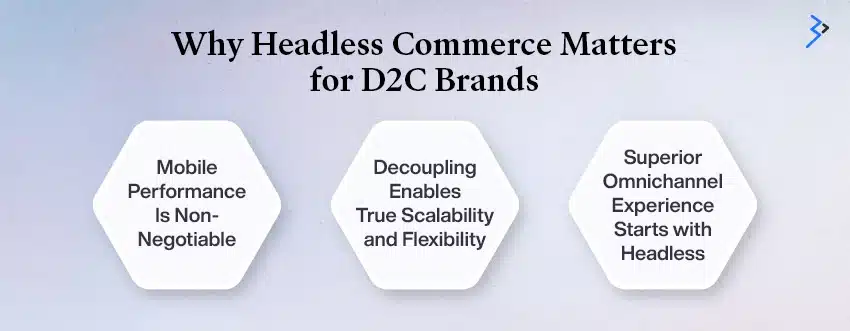
1. Mobile Performance Is Non-Negotiable
Market analysis suggests that 73% of online sales will occur on mobile devices in the near future. Slow mobile sites frustrate users and directly impact revenue, making mobile performance a critical strategic priority for D2C brands. Research shows nearly half of shoppers abandon carts due to poor performance, underscoring the need for speed.
Headless commerce enables brands to build lightning-fast mobile experiences by leveraging modern frontend technologies (like React or Next.js), progressive web apps (PWAs), and global CDNs. These technologies dramatically improve load times and responsiveness, critical factors for retaining mobile users and converting them into buyers.
2. Decoupling Enables True Scalability and Flexibility
Traditional e-commerce platforms force frontend and backend teams to work in lockstep. Any UI change or performance tweak often requires backend involvement, slowing innovation and time-to-market.
Headless commerce breaks that dependency. Frontend teams can iterate independently, testing new user interfaces and experiences without being bottlenecked by the backend. Backend improvements, inventory management, payment processing, or API enhancements can happen in parallel.
This separation is a significant advantage for fast-growing D2C brands that frequently launch new campaigns, seasonal experiences, or mobile-first features.

3. Superior Omnichannel Experience Starts with Headless
Today’s shoppers rarely engage with a brand through just one touchpoint. They might browse on mobile app development, add items via social commerce, complete checkout on a desktop, and receive promotions via email.
Headless commerce unifies these touchpoints by delivering consistent data, products, pricing, inventory, and customer history through APIs to any frontend experience. This means conversions no longer suffer due to fragmented or inconsistent experiences across devices.
The Business Benefits of Headless Commerce
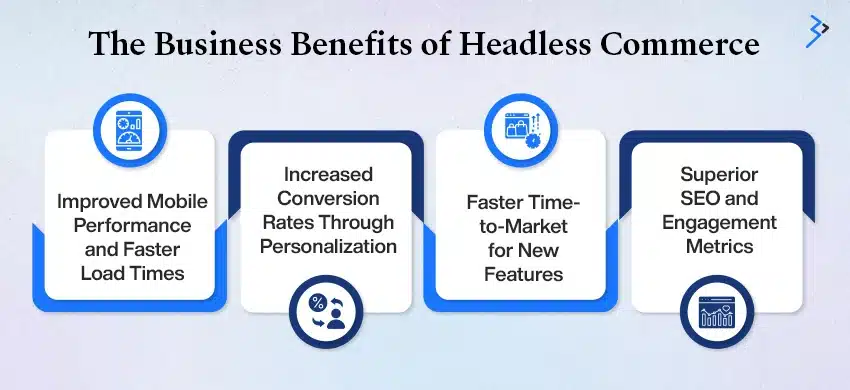
For US D2C brands specifically, headless commerce unlocks multiple strategic and commercial advantages:
Improved Mobile Performance and Faster Load Times
One of the most measurable benefits of headless commerce is site speed. Numerous brands report a 20–50% reduction in website load times after implementing a headless architecture, according to swell.is, directly impacting conversions, bounce rates, and SEO performance.
Faster mobile experiences also improve Core Web Vitals, which Google uses for ranking, strengthening discoverability, and ensuring D2C brands appear higher in search results.
Increased Conversion Rates Through Personalization
Speed is only part of the equation. Headless commerce also enables dynamic, personalized mobile experiences by decoupling the presentation layer. Brands can integrate real-time customer data (browsing behavior, purchase history, location) with tailored campaigns, CTAs, and recommendations without backend constraints.
This capability is significant for D2C brands whose competitive edge depends on differentiated, curated mobile experiences.
Faster Time-to-Market for New Features
Because frontend and backend teams can deploy independently, brands can achieve up to a 50% reduction in time-to-market for new features compared with monolithic platforms, as per essential data points from our research on ZipDo.
For a D2C marketer, that means launching and optimizing seasonal mobile offers, push-notification campaigns, or interactive product pages without lengthy developer cycles.
Superior SEO and Engagement Metrics
Additionally, optimized mobile performance boosts key engagement metrics such as reducing bounce rates and increasing session length. Some headless retailers even report Lighthouse performance scores increasing significantly post-migration, enhancing visibility and organic traffic.
These performance uplifts are amplified when mobile browsing becomes the primary channel for customers.
Real-World Headless Success Stories
Understanding the tangible impact of headless commerce is best illustrated through real brand examples:
Burrow – D2C Furniture Brand
Enterprise D2C case studies from Contentful and Bigcommerce, such as Burrow, a modular furniture innovator, adopted a headless architecture to support scalable frontend flexibility while maintaining a robust BigCommerce backend. The result? A 30% increase in conversion rate in just two months, coupled with a 50% improvement in site speed and overall performance.
The Challenge: Scaling a fast-growing D2C brand while enabling rapid site customization without developer dependency or template limitations.
The Headless Solution:
- Adopted BigCommerce as a scalable, low-maintenance backend commerce engine
- Implemented a custom headless CMS to enable flexible, template-free frontend experiences
- Decoupled frontend and backend to support modular products and rapid marketing experimentation
Results:
- 30% increase in conversion rate within two months of launch
- 50% improvement in site speed and overall performance
- Greater creative freedom to deliver modern, multi-channel digital experiences
For a brand with rich catalogs and complex product configurations, better performance and flexible presentation directly translated into higher customer engagement and revenue.
Koio – Premium Sneaker Brand
Practical headless commerce examples reveal that Koio leveraged a headless setup to quadruple page load speeds, reduce bounce rates by over 76%, and increase conversion rates by nearly 30%. These improvements came through a custom React frontend powered by a headless backend.
The Challenge: Koio required a high-end digital experience that reflected their premium craftsmanship while delivering ultra-fast performance to minimize bounce rates.
The Headless Solution: Koio implemented a headless architecture using:
- Shopify Plus as their commerce backend
- A custom React frontend for maximum performance
- A powerful CMS for content management
The Results:
- 4x faster page load speeds
- 28% increase in conversion rates
- 76% reduction in bounce rates
In premium D2C categories where brand experience is part of the value proposition, performance improvements directly influence consumer perception.
Brands from Broader Ecosystems
Other success narratives include brands like Lush and Crocs, which have reported significant mobile conversion gains after headless migrations, further validating that even large, established players reap mobile performance benefits when decoupling frontend experiences.
Lancôme: Reported a 17% boost in mobile conversion rates after adopting a headless strategy to better serve customers on the go better according to Noibu.com.
LARQ: Saw an 80% increase in conversion rate and a 400% revenue jump after moving to a headless build as reported by Bigcommerce.com.
Headless Implementation: Strategic Considerations
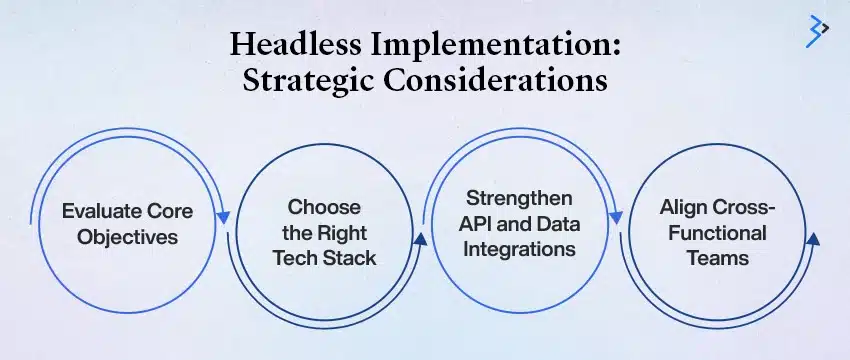
Rolling out a headless commerce architecture is not a plug-and-play exercise; it’s a strategic investment:
Evaluate Core Objectives
Start by defining clear business goals: Is the priority faster mobile performance? Personalized experiences? International expansion and multi-market frontends? This assessment steers your tech stack decisions.
Choose the Right Tech Stack
Selecting modern frontend frameworks, such as Next.js, for PWA and SSR capabilities, paired with robust backend engines (e.g., Commercetools, BigCommerce, Shopify Headless), ensures both performance and scalability.
Strengthen API and Data Integrations
APIs are the backbone of headless setups. Ensure your CDP, CRM, analytics, and third-party tools integrate seamlessly through the API layer to deliver unified mobile experiences and accurate customer data flows.
Align Cross-Functional Teams
Headless commerce requires collaboration across marketing, development, analytics, and customer experience teams. Aligning goals, KPIs, and deployment workflows ensures the architecture serves brand and performance objectives, not just technical ones.
Why Headless Is More Than a Trend
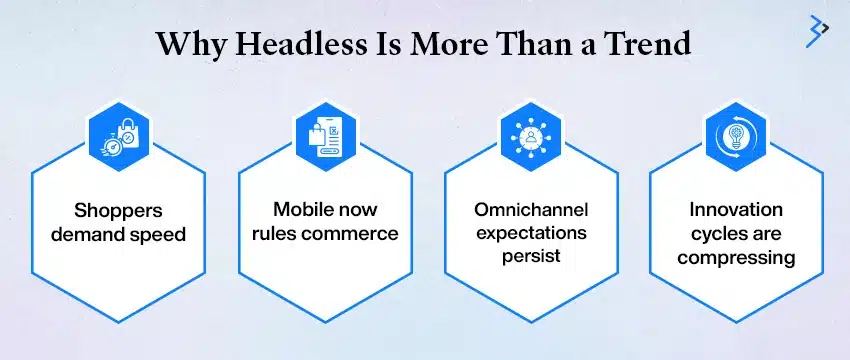
For US D2C brands, the shift toward headless commerce is rooted in market realities, not hype:
- Shoppers demand speed: Poor performance equals revenue leakage.
- Mobile now rules commerce: A mobile-first experience is a competitive advantage.
- Omnichannel expectations persist: Consistent experiences across devices elevate brand loyalty.
- Innovation cycles are compressing: Headless architecture shortens iteration timelines.
Ultimately, headless commerce empowers D2C leaders to meet both technical performance goals and customer experience expectations, and at Brainvire, we help brands architect, implement, and scale these headless ecosystems to drive sustainable growth in a mobile-first world.
Frequently asked questions
Headless commerce separates the frontend experience from the backend commerce engine using APIs. Unlike traditional monolithic platforms, this approach helps brands build faster, more flexible, and highly customized experiences without being constrained by predefined templates or coupled systems.
Mobile users expect speed, responsiveness, and personalization. Headless commerce enables brands to leverage modern frontend frameworks and PWAs, significantly improving mobile load times, performance, and user engagement—key factors for reducing bounce rates and increasing conversions.
While enterprise brands often benefit the most, headless commerce is increasingly adopted by growing D2C brands planning for scale. It’s particularly valuable for businesses with complex catalogs, omnichannel strategies, or aggressive experimentation and personalization goals.
Common challenges include selecting the right tech stack, managing multiple integrations, and aligning cross-functional teams. However, with the right implementation partner and a clear roadmap, these challenges can be mitigated while unlocking long-term scalability and performance gains.

Related Articles
-
 How COVID-19 Pandemic Has Boosted The Delivery Business Worldwide
The ongoing Coronavirus pandemic has disrupted countless businesses around the world. But the only one to witness a spurt in the market is the delivery business. With countries under months
-
 Mobile App Evolution Helps In Reaching Your Dreams Boundaries
We all learn new things by practice and it takes a whole lot of time to adopt new experiences. This is the same as your mobile devices, technology keeps developing
-
Investing In Your Business’s Future With True Value Of Ecommerce App Development
With the increasing growth of ecommerce in the modern digital age, companies must keep up with the newest developments in this field. Many companies are turning to ecommerce app development