How Using Edge Computing Can Help You Outrun the Competition
-

Hiren Raval

In the time it took you to read this sentence, a high-frequency trading algorithm executed 500 trades, a smart factory sensor prevented a catastrophic turbine failure, and an autonomous delivery drone recalculated its flight path twice. In 2026, the speed of business isn’t measured in hours or minutes; it’s measured in milliseconds.
If your data has to travel 1,000 miles to a centralized cloud server just to decide whether a credit card transaction is fraudulent, you’ve already lost. This “round-trip” delay, known as latency, is the friction that slows down innovation. Enter Edge Computing: the technology that processes data at the source, effectively “decentralizing” the brain of your digital operation.
By shifting processing to the periphery, right where the action happens, enterprises are slashing latency by up to 60%, according to IAEME. This isn’t just a technical upgrade; it’s the difference between a fluid customer experience and a “loading…” spinner that drives users to your competitors. At Brainvire, we’re seeing a massive shift where “Zero Lag” is becoming the standard for the next generation of global leaders.
Edge Computing Fundamentals: Processing at the Speed of Sight
Traditional cloud computing is like sending every question you have to a library in another state. It’s comprehensive, but the travel time adds up. Edge computing, by contrast, is like having the encyclopedia in your pocket.
Technically, edge computing is a distributed computing framework that brings enterprise applications closer to data sources such as IoT devices or local edge servers. Instead of data traveling across the vast expanse of the public internet to a centralized “hyperscale” data center, it is processed at the “edge” of the network. This proximity enables sub-50ms responses, a drastic improvement over the typical 100-200ms round-trip required by the cloud. In 2026, this difference is what separates a smooth autonomous operation from a lagging, inefficient one.
Comparison: Traditional Cloud vs. Edge Computing
| Feature | Traditional Cloud Computing | Edge Computing |
| Location | Centralized, distant data centers. | Decentralized, local (near data source). |
| Latency | Higher (100ms – 500ms+). | Ultra-low (typically <50ms). |
| Bandwidth | High usage (constant data uploads). | Low usage (local filtering/processing). |
| Connectivity | Requires stable, high-speed internet. | Can operate offline or with intermittent links. |
| Ideal For | Big Data analytics, long-term storage. | Real-time AI, IoT, and instant decisions. |
| Security | Centralized risk (one big target). | Distributed risk (localized data silos). |
Brainvire’s approach to the edge involves 3 core pillars that maximize this localized power:
- Sensor Fusion: Our embedded software handles several data streams (video, temperature, vibration) locally. It synchronizes these inputs on-site to create a single, accurate “truth” before any data is sent upward, reducing the “noise” in your system.
- Bandwidth Optimization: By processing data locally and only sending important insights or summarized reports to the cloud, we reduce backhaul bandwidth requirements. This results in massive cost savings on data transit fees.
- : We deploy “lightweight” machine learning models directly onto device firmware. This helps with real-time anomaly detection, such as identifying a faulty part on a conveyor belt, without needing a constant internet connection to “ask” a central server for permission.
The Momentum: Why 2026 is the Year of the Edge
The market for edge computing isn’t just growing; it is undergoing a fundamental structural shift. By late 2026, the global edge market is projected to reach a staggering $327.79 billion, according to Grand View Research. While the initial hype was around simple connectivity, the real catalyst today is the “Inference Economics” of AI.
As enterprises move from experimental AI pilots to full-scale “Agentic” operations, the cost of sending massive data volumes to the cloud for processing has become a financial bottleneck. For many, cloud costs now account for 60–70% of total AI operational spend, according to Deloitte. By moving AI inference, the part where the model actually makes a decision, to the edge, businesses are slashing these operational costs. Today, a significant number of large enterprises have officially moved beyond “cloud-only” models, adopting edge strategies to maintain a competitive lead in real-time responsiveness.
Industry-Wide Impact: The New Benchmarks
The shift to the edge is delivering measurable breakthroughs across every major vertical, changing what “efficiency” looks like in 2026:
Manufacturing: The Pursuit of 100% Uptime
On the factory floor, every minute of unplanned downtime can cost thousands. By deploying edge nodes that monitor high-frequency vibrations and thermal signals locally, manufacturers are seeing a significant increase in uptime. These systems catch “micro-anomalies” that cloud-based lag would miss, triggering maintenance before a failure even occurs.
Retail: Eliminating Transaction Friction
In the retail sector, speed is the ultimate currency. Edge-powered checkout systems and real-time inventory tracking have enabled 30% faster checkout times, according to Medium. By processing computer vision data locally, stores can offer “just-walk-out” experiences without the 2-second delay that frustrates customers.
Healthcare: Seconds Save Lives
In critical care environments, a 100ms delay is a lifetime. Edge devices at the bedside now analyze vitals in real time, enabling faster response to cardiac or respiratory events. Because the data is encrypted and stored locally, it also ensures total HIPAA compliance without the risks of public cloud transit.
Logistics: Precision Fleet Intelligence
Global logistics hubs are using edge AI to optimize routing at the “last mile.” By processing local traffic patterns and weather data on-vehicle, fleets have achieved a 15% fuel savings, according to HERE Technologies, effectively turning every truck into an autonomous decision-making node.
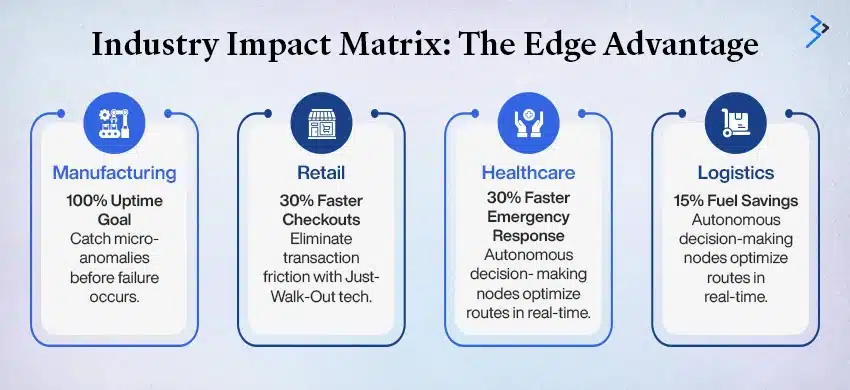
- Card 1:
Manufacturing:
100% Uptime Goal
Catch micro-anomalies before failure occurs.
- Card 2:
Retail:
30% Faster Checkouts
Eliminate transaction friction with Just-Walk-Out tech.
- Card 3:
Healthcare:
30% Faster Emergency Response
Real-time bedside vitals analysis saves lives.
- Card 4:
Logistics:
15% Fuel Savings
Autonomous decision-making nodes optimize routes in real-time.
Real-World Mastery: How the Giants Use the Edge
Top brands are already using the Edge to outpace their rivals:
- Walmart: The retail giant uses edge gateways to process video and IoT data from smart shelves. Scribd noticed that by analyzing stock levels locally, they’ve reduced stockouts by 20% and integrated POS systems for dynamic pricing that updates in seconds.
- Siemens (Manufacturing): Utilizing MindSphere, Siemens deploys edge AI to predict turbine failures. By catching microscopic structural flaws via local vibration sensors, they save millions in potential catastrophic damage and downtime.
- Cleveland Clinic (Healthcare): Health Informatics Journal noted that by processing patient vitals on edge-enabled bedside monitors, the Cleveland Clinic has reduced emergency response times by 40%. Local encryption ensures that even if a network is compromised, the primary data remains protected at the source.
Brainvire’s Zero-Lag Roadmap: Your Path to 50ms
Transitioning to the edge requires a “Cloud Continuum” strategy, a bridge between your local devices and your central cloud. Here is our four-step deployment framework:
- Assess and Audit: We identify latency bottlenecks in your current stack. Is the delay in the database? The network? Or the distance?
- Prototype (The Pilot): We deploy Edge AI models or AEM integrations on a small scale, one factory floor or one regional site, to prove the ROI.
- Scale (The Continuum): We integrate with global providers such as AWS and Azure to create a unified monitoring dashboard across all edge nodes.
- Optimize (MLOps): Continuous machine learning operations ensure your edge models stay accurate.
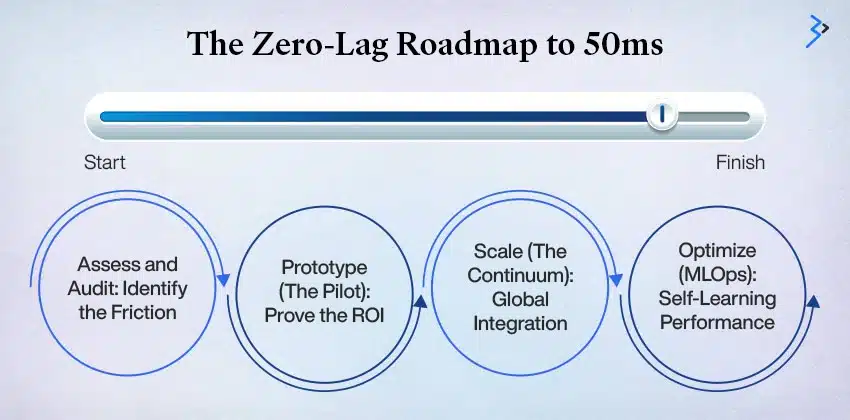
- Assess and Audit: Identify the Friction
- Prototype (The Pilot): Prove the ROI
- Scale (The Continuum): Global Integration
- Optimize (MLOps): Self-Learning Performance
Challenges and Mitigations: Tackling the “Edge Divide”
The road to zero lag isn’t without bumps. The biggest barrier is device heterogeneity; businesses struggle because their various IoT modules don’t “speak” the same language.
Brainvire solves this with Standardized Firmware and a Zero-Trust Security model. Since edge devices are physically distributed, they are more vulnerable. We treat every device as a potential threat, calling for continuous local authentication and encrypted “tunnels” for any data that must travel to the cloud.
2026 Competitive Horizon: The Edge Advantage
As we look toward the end of the year, the “AI Data Divide” will widen. Edge Impulse shows that 83% of market leaders are now utilizing Edge+AI hybrids to gain an unfair advantage in speed and cost. If your business is still waiting for the cloud to catch up, you are essentially leaving money on the table.
In a world wherein every millisecond counts, being “fast enough” is no longer an option. You need to be instantaneous.Ready to outrun the competition? Contact our team to start your latency audit today.
FAQs
Not at all. It is more of a partnership. The Edge handles “fast” data (real-time decisions), while the Cloud handles “big” data (long-term storage and heavy model training). We call this the Hybrid Cloud Continuum.
By processing data locally and sending only “meaningful” insights to the cloud, you can reduce cloud egress and storage fees by up to 40%, according to studies.
It moves the “rendering” of your website to the network edge (CDNs). This leads to nearly instant page loads, yielding a 70% improvement in Time to Interactive (TTI), which is a major Google ranking factor.
It can be. Because data is processed locally and often discarded, it never travels over the internet, where it can be intercepted. However, it requires a Zero-Trust security architecture to manage the physical hardware.
Any industry in which time is money: Manufacturing (downtime prevention), Healthcare (patient safety), Retail (customer experience), and Finance (transaction speed).

Related Articles
-
 Is It Worth Implementing Cloud Computing Solutions in Your Business?
Today, cloud computing has become all the rage and it is expected that its global market would reach nearly $623bn by the year 2023. Many IT businesses have already started
-
Check Out What Cloud Security has to Offer in 2021
In 2020, a study from Netwrix stated that 54% of companies that use Cloud services for data storage have reported security incidents. Initially, these were minor glitches but a few
-
 5 Benefits of Working with an AWS Partner Company
You might have often heard a discussion among your development team whether to hire an AWS partner for your next venture or not. Let’s find answers to this and start