Building Your Enterprise Automation Engine: A Guide to the AI-RPA Center of Excellence
-

Pratik Roy

Imagine handing the keys of a high-performance supercar to a toddler. This is precisely what happens when a global enterprise deploys Generative AI Development and Robotic Process Automation (RPA) without a Center of Excellence (CoE).
In this high-stakes scenario, the toddler isn’t your staff; it’s the unmanaged, scattered automation that, while fast, has no concept of safety guardrails, international data laws, or the high-speed risks of the digital road. To ensure your investment yields massive returns rather than massive risks, your organization needs a Control Tower.
Defining the Core Pillars
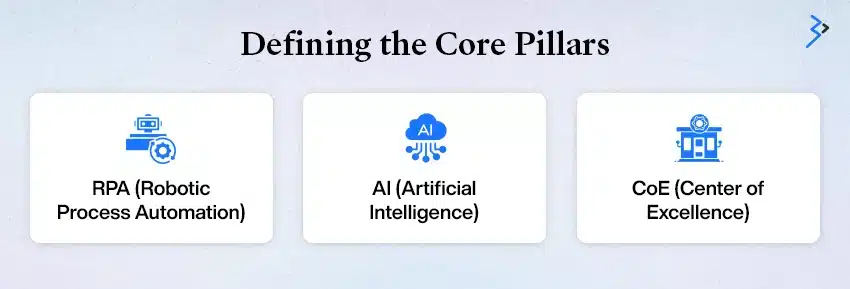
Before diving into the roadmap, it is essential to understand the tools at your disposal in 2026:
- RPA (Robotic Process Automation): These are software bots that handle repetitive, rules-based tasks. They are like digital hands that perform data entry, invoice processing, or report generation.
- AI (Artificial Intelligence): This is the brain. AI helps bots learn, understand language, and make decisions based on data patterns rather than just fixed rules.
- CoE (Center of Excellence): This is your specialized internal team. They set the rules, provide the standardized tools, and manage every automation project across the company to ensure they are safe, legal, and profitable.
In 2026, the stakes for automation have never been higher. According to Accountability Now, the global AI-RPA market has surged to a $31 billion valuation. Organizations are no longer asking if they should automate; they are racing to maintain a competitive edge in an instant-delivery economy. In fact, 58% of global enterprises have already adopted AI-RPA hybrids this year, as reported by Ramamtech.
However, there is a sobering reality: without a structured CoE, the failure rate for scaling these technologies sits at a dismal 70%, as noted by The Financial Express. AI adds a layer of complexity through hallucinations (when AI confidently provides a wrong answer) and security leaks. The secret to winning is the perfect balance between Governance (the brakes) and Innovation (the gas).
The Tug-of-War: Safety vs. Speed
The primary struggle in any digital transformation journey is the friction between the IT department, which prioritizes security and stability, and Business Units (like Marketing or Finance), which demand results and speed.
Legacy RPA was notoriously rigid. If a software update moved a button on a screen by an inch, the bot would break. AI has solved this by adding vision and judgment, helping bots adapt to changes. But this adaptability introduces unpredictability. This is why the Federated CoE Model has become the international gold standard for 2026.
| Model Type | Leadership Style | Best Suited For | Key Risk |
| Centralized | Headquarters controls everything. | Small to mid-sized firms with single locations. | Becomes a bottleneck that slows down innovation. |
| Decentralized | Every department does its own thing. | Very early-stage startups. | “The Wild West”, high risk of security leaks and wasted spend. |
| Federated | Central standards + Regional execution. | Global Enterprises & Scaled Organizations. | Requires strong communication between HQ and regions. |
In the Federated Model, the central CoE team sets the security protocols, selects the vendors (like UiPath or AWS), and provides the blueprints. Meanwhile, your regional teams in Europe, APAC, or the Americas build their own bots to fit local languages and customs, using those central blueprints to stay safe.
The Hard ROI: Why the CoE is Your Best Investment
A well-run CoE is not a cost center; it is a profit engine. Multiple studies show that these frameworks deliver a 3x to 5x return on investment (ROI) within the first 24 months.
Real-World Success Stories:
- Heritage Bank: This is a textbook example of scaling beyond a pilot. By creating a formal CoE, they didn’t just automate one or two tasks; they overhauled 80 complex processes, as noted by Itransition. This included high-stakes areas like daily payment reconciliations and financial crime detection. By moving to a 24/7 digital service model, they achieved multimillion-dollar savings and improved accuracy far beyond what human staff could achieve alone.
- Orange (Telecommunications): The European giant launched its Robot Factory CoE to democratize automation. Itransition reports that in just two years, they deployed 400 bots that saved the company €34 million ($37M+). Beyond the money, they significantly improved employee morale by removing soul-crushing repetitive data entry from daily jobs.
Building the Structure: A 3-Step Maturity Blueprint
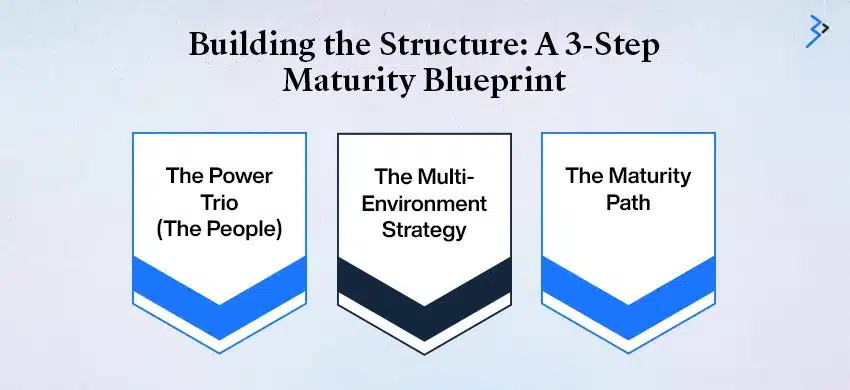
To scale across borders without breaking your systems, you must move through a specific maturity curve.
1. The Power Trio (The People)
You cannot build a CoE with just developers. You need three distinct roles to succeed:
- The CoE Lead: A visionary leader who can talk to the C-suite about budgets and to the engineers about technical hurdles.
- SMEs (Subject Matter Experts): The boots on the ground in HR, Finance, or Supply Chain who know exactly where the manual work is slowing down the company.
- AI Engineers: The technical architects who ensure the bots are integrated into your cloud stacks (AWS/Azure) and that the AI models are staying accurate.
2. The Multi-Environment Strategy
One of the most expensive mistakes a company can make is Testing in Production. A CoE enforces a strict three-tier environment:
- Dev (Development): Where engineers experiment and build the code.
- Test (UAT): Where the bot is put through stress tests to see if it breaks under heavy loads or weird data.
- Prod (Production): The high-security live zone where the bot performs its daily work for the company.
3. The Maturity Path
| Stage | Focus | Action Item |
| 1. Experiment | Proof of Concept (PoC) | Choose one small, high-volume task (like invoice sorting) and prove the tech works. |
| 2. Govern | Security & Standards | Set the Rules of the Road. Define who can build bots and how they must be audited. |
| 3. Scale | Citizen Development | Train regular employees to build their own mini-automations under CoE supervision. |
Governance: Making Security an Accelerator
In a modern CoE, governance is the Department of How, not the Department of No. Effective governance actually helps you move faster because the safety checks are built into the process.
Explainability and Confidence Thresholds
In 2026, “because the computer said so” is not an acceptable answer for regulators or customers. A CoE implements Confidence Thresholds:
- 95% Confidence: The AI bot is sure of the data; it processes the transaction instantly.
- 80% Confidence: The bot is unsure; it automatically flags the file and sends it to a Human-in-the-Loop (HITL) for a quick manual review.
This prevents AI Hallucinations from entering your official financial records.
Learning Loops
A CoE ensures that every time a human corrects a bot, that information is fed back into the AI model. This Learning Loop ensures that the system becomes smarter and more accurate every single day, eventually requiring less human intervention.
Common Challenges and Simple Solutions
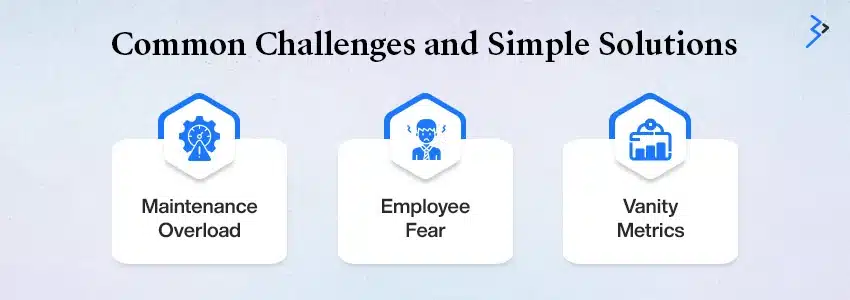
As you scale toward a “Zero-Lag” enterprise, you will face three common hurdles:
- Maintenance Overload:
As you grow from 10 bots to 100, keeping them all running becomes a full-time job.
The Solution: Implement Automated Monitoring Dashboards. These act like a hospital heart monitor for your bots, alerting the team the second a bot “flatlines” so it can be fixed before the business notices.
- Employee Fear:
Staff often worry that “AI + RPA = My Job is Gone.”
The Solution: Change Management & Upskilling. Use the CoE to communicate that bots are “Digital Assistants.” Their job is to take the “robot” out of the human, freeing your staff to do creative, high-value work that a machine can’t handle.
- Vanity Metrics:
Many companies brag about the number of bots they have. This is a mistake.
The Solution: Focus on Utilization & Value. One bot that saves 2,000 hours is worth more than fifty bots that only save 10 hours each.
Conclusion: The 2026 Horizon and the Brainvire Blueprint
The era of simple Click-and-Follow bots is officially ending. We are entering the age of Agentic RPA, advanced AI agents that don’t just follow a pre-set path; they navigate a digital landscape. These agents can reason, plan their own steps, and use various software tools autonomously to reach a goal.
For the global enterprise, this is a massive opportunity for efficiency, but it represents a catastrophic risk if left unmanaged. A Center of Excellence is the only thing standing between an Ethical, Profitable Scale and a Digital Disaster. By building your CoE today, you are preparing the foundation for the autonomous AI workforce of tomorrow.
Brainvire provides a comprehensive, turnkey AI-RPA CoE Strategy. We don’t just give you the software; we build the engine room. From strategic audits to setting up your UiPath or AWS infrastructure, we have delivered 350+ successful automations for global brands. We help you eliminate the friction between safety and speed, ensuring your automation journey is high-velocity and zero-risk.
Contact our team today to scale your automation globally.
Frequently Asked Questions
It is a regular employee, an accountant, an HR specialist, or a supply chain manager, who is trained by the CoE to use no-code tools. They build their own mini-automations to solve local problems, while the CoE ensures their work meets the company’s security and quality standards.
While small pilots can show value in weeks, most global enterprises see a full return on investment (3x to 5x ROI) within 18 to 24 months as the compounding effect of multiple bots takes hold.
If HQ controls everything (Centralized), local offices in different time zones get frustrated by delays. If everyone does their own thing (Decentralized), you end up with massive security holes. The Federated model offers the best of both: HQ sets the safety rules, and local offices move fast within those rules.
By embedding Auditability into the core of the CoE. Every single click and decision the bot makes is logged in a secure file. If a regulator asks why a decision was made, the CoE can produce a report in seconds showing the exact logic used.
No. While the term “Center of Excellence” sounds grand, for a mid-sized company, it might just be a two-person team and a set of standardized checklists. The goal is standardization, which is affordable for any company looking to scale.
Related Articles
-
 How to Hire the Top Healthcare Software & AI Developers in Europe and the GCC
Picture your company about to launch a game-changing AI tool for early cancer detection. The code works. The partnerships are set. Then, a compliance audit halts everything. Your platform isn’t
-
Generative AI: Redefining the Boundaries of Traditional Machine Learning
Artificial Intelligence (AI) has revolutionized industries worldwide, with machine learning (ML) driving automation, predictions, and data analysis. Traditional ML models rely on structured data to identify patterns and make decisions,
-
The NLP Revolution: Tracing the Evolution of Transformer Models
AI has always aimed to understand human language, to write clearly, send personalized messages, and summarize complex information in seconds. For years, traditional Natural Language Processing (NLP) tried to do