How Custom Adobe Commerce Builds Trust in Jewelry Ecommerce
-

Hiren Raval

Digital commerce has reshaped how customers discover, evaluate, and purchase products. Easy access to information, transparent comparisons, and seamless transactions are no longer differentiators; they are baseline expectations.
As luxury categories move online, these expectations extend to some of the most complex and emotionally significant purchases consumers make. Diamonds and fine jewelry are no exception. Customers now research stones, compare specifications, and engage with brands digitally long before stepping into a store.
Yet despite strong engagement and clear purchase intent, many high-value jewelry transactions stall late in the journey. The issue is not digital adoption. It is the level of confidence required to complete a decision involving emotional meaning, financial commitment, and long-term value.
Why Standard Ecommerce Falls Short for High-Value Jewelry
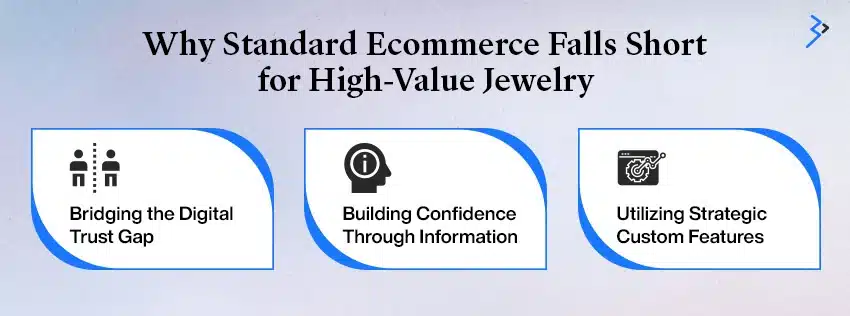
This hesitation reveals a broader limitation of standard ecommerce experiences. Platforms optimized for speed and scale often struggle to support purchases driven by authenticity, transparency, and trust.
For diamond and jewelry brands, digital commerce success depends less on visibility and more on the ability to reduce uncertainty at critical decision points. Confidence is built through how information is presented, how pricing is explained, and how assurance is delivered throughout the journey.

Custom Adobe Commerce features address this trust gap by embedding credibility, clarity, and reassurance into each stage of the buying experience. Capabilities such as dynamic product configurators support informed customization, while embedded certification reports from trusted authorities provide transparency that enables confident decision-making.
Why Trust Becomes the Primary Conversion Driver in Jewelry Commerce
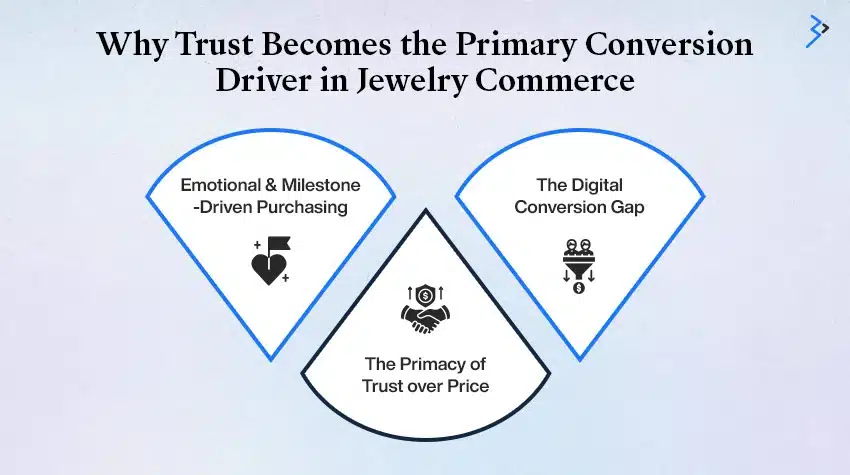
Unlike most retail categories, jewelry purchases are rarely transactional. They are milestone-driven, emotionally charged, and often associated with long-term value retention. Customers approach these purchases with a mindset shaped by risk evaluation rather than impulse. This fundamentally alters how digital experiences are assessed.
Research from Bain & Company consistently highlights trust, authenticity, and brand credibility as core drivers of decision-making in luxury and high-value purchases, often outweighing price considerations altogether.
At the same time, industry data from Statista indicates that while online jewelry sales continue to grow globally, conversion rates remain lower than those of other ecommerce categories due to perceived risk and uncertainty during the evaluation process.
In jewelry commerce, trust results from how information is presented, pricing is handled, transactions are protected, and relationships continue post-purchase.
Where Standard Ecommerce Falls Short and How Adobe Commerce Builds Trust
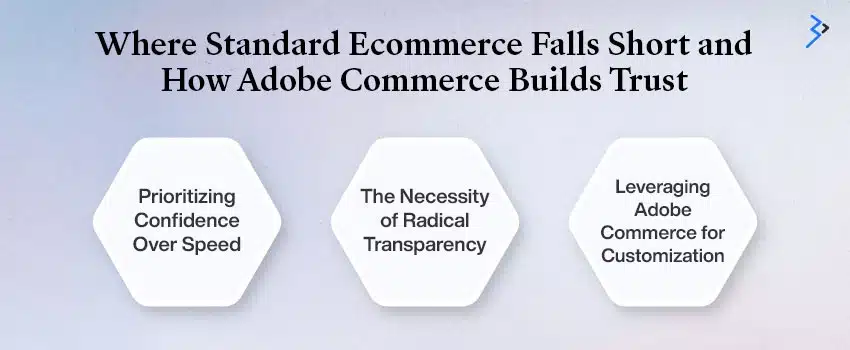
Most ecommerce platforms are designed for mass-market purchases, where fixed pricing, limited product details, and linear checkouts are enough. High-value jewelry buying is different. Value is subjective, complex, and driven by confidence, not speed.
Diamond buyers need transparency around cut, clarity, color, carat, and certification. They expect clear pricing logic, secure fulfillment, verified documentation, and long-term service assurance. When these expectations aren’t met, transactions don’t fail abruptly; hesitation builds because the experience doesn’t answer enough questions to justify the commitment.
Adobe Commerce provides the enterprise-grade foundation to address these gaps, but its real strength lies in customization. Default ecommerce settings assume simple SKUs and quick decisions, assumptions that rarely hold for fine jewelry. When tailored for deep product storytelling, dynamic pricing, and extended engagement, Adobe Commerce becomes more than a transaction engine. It becomes a trust-building system designed to support every high-stakes decision in the jewelry buying journey.
Designing Product Experiences That Reduce Uncertainty Early
The product detail page is one of the most influential touchpoints in the jewelry buying journey. It is where curiosity turns into evaluation, and where uncertainty either grows or diminishes.
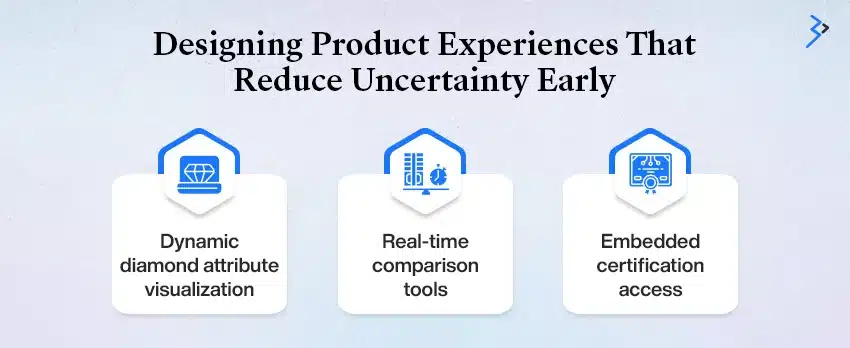
Custom Adobe Commerce reduces early-stage hesitation by enabling:
- Dynamic diamond attribute visualization: Cut, clarity, color, carat, and fluorescence are displayed interactively, helping customers understand how each attribute affects value.
- Real-time comparison tools: Side-by-side comparisons clarify pricing differences and eliminate the need for external research or offline assistance.
- Embedded certification access: Grading reports from authorities such as GIA or IGI are integrated directly into the product experience, reinforcing authenticity and transparency. Rapaport identifies certification clarity as one of the strongest trust signals in online diamond commerce.
Read More-: AI-Powered Personalization: Integrate Adobe Commerce with Real-Time CDP
When customers can clearly understand what they are purchasing and why it is priced the way it is, confidence builds naturally.
Pricing Transparency as a Strategic Trust Lever
Diamond pricing is inherently complex, influenced by multiple attributes and market dynamics. Static pricing models often fail to reflect this complexity, leading to skepticism among informed buyers.
Custom pricing logic in Adobe Commerce enables real-time price calculation. It uses stone features, metal rates, and market conditions. This improves accuracy and shows fairness and consistency. When pricing matches industry logic, buyers see the brand as operating with integrity.
Transparency in high-value commerce is a strategic tool for building trust and differentiating brands, not just for maintaining margins.
Rethinking Checkout for High-Value Purchases
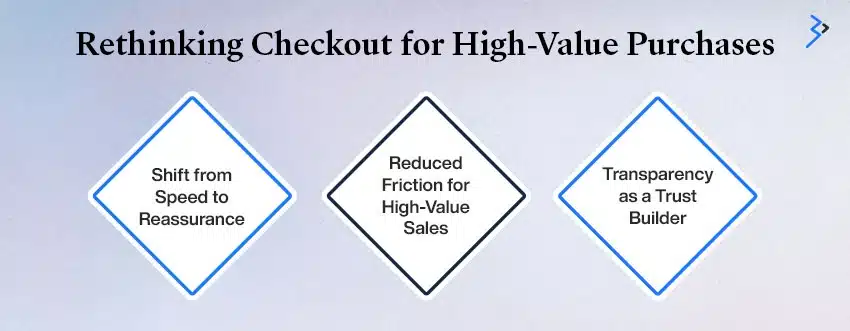
Checkout is often treated as a speed optimization problem. In jewelry commerce, it is better understood as a reassurance checkpoint.
Baymard Institute research indicates that nearly 70% of cart abandonment is linked to trust-related concerns, including unclear costs, payment anxiety, and insufficient transparency.
Custom Adobe Commerce checkout flows address these concerns. Flexible payment options like split pay, bank transfer, or assisted checkout reduce friction for significant transactions. Clear communication about taxes, insurance, and delivery builds confidence at decision time.
Fraud protection and risk management are essential trust builders. Security must assure customers without hindering their experience, underscoring the brand’s reliability at every step.
Post-Purchase Experience as an Extension of Trust
For diamond and jewelry brands, trust does not end at checkout. In many cases, it is tested most after the purchase is complete.
Custom Adobe Commerce workflows strengthen post-purchase trust by offering secure access to certificates, invoices, warranties, and insurance documentation. Customers benefit from ongoing visibility and access to critical purchase details through their accounts.
Post-purchase services such as resizing, upgrades, servicing, or buyback programs further reinforce long-term confidence. When these experiences are integrated seamlessly into the digital platform, ecommerce evolves from a transactional channel into a relationship platform.
Read More-: Reimagine Digital Storefront Experiences for Faster Growth with the New Adobe Commerce Optimizer
Security, Compliance, and Governance as Brand Signals

In high-value commerce, operational rigor contributes directly to brand perception. Customers expect discretion, professionalism, and strong data protection as part of the overall experience.
Jewelry brands using Adobe Commerce can implement robust security with role-based controls, limiting sensitive data exposure and ensuring regulatory compliance. This operational rigor reassures customers and enhances the brand’s reputation for care and reliability.
Deloitte’s research on luxury digital transformation emphasizes that customers increasingly view data security and privacy as indicators of brand quality and reliability.
Robust governance goes beyond compliance; it signals to customers that their trust is warranted.
Measuring Trust Through Commercial Outcomes
While trust is intangible, its impact is measurable. Jewelry brands that invest in trust-driven commerce often see higher conversion rates for high-value products, lower cart abandonment, and increased average order value. As customer confidence grows, repeat purchases and lifetime value rise, reinforcing trust as the long-term engine of digital jewelry commerce.
The Road Ahead for Digital Jewelry Commerce
Selling jewelry online isn’t about pushing harder; it’s about building trust and reducing customer doubt. High-value buyers want confidence, not pressure.
Here’s what’s shaping the future of digital jewelry commerce:
- AI-assisted diamond recommendations– helping customers find the perfect piece without second-guessing.
- Virtual consultations– letting buyers get expert advice directly within the online shopping experience.
- Augmented reality (AR) tools– giving customers a realistic view of jewelry tied to real inventory.
Omnichannel integration is key. A seamless experience between your digital store and physical showroom makes research and purchase feel connected and effortless.
For jewelry brands exploring these trends, practical steps include:
- Piloting Artificial Intelligence recommendation tools for select products.
- Hosting small-scale virtual consultation events to measure engagement.
- Collaborating with technology partners to integrate AR features.
- Collecting and acting on customer feedback before scaling.
According to McKinsey, luxury brands that embed trust signals throughout the buyer journey outperform peers in conversion and retention.
With platforms like Adobe Commerce development services, you can experiment with these innovations while maintaining brand integrity and governance, making it easier to evolve without compromising control.
Conclusion: Trust Is Built Into the System
Digital commerce for diamonds and fine jewelry does not fail because customers lack intent. It falters when platforms fail to support the level of confidence required for high-stakes decisions.
Authenticity, pricing clarity, transaction security, and post-purchase assurance must work together as part of a unified experience. Custom Adobe Commerce implementations enable brands to embed these elements into the system rather than relying solely on messaging.
For jewelry brands competing in high-value segments, trust is not a marketing claim. It is an architectural principle.
Partnering for Trust-Driven Jewelry Commerce
Delivering trust-centric digital experiences in the diamond and jewelry space requires more than standard ecommerce expertise. It demands a deep understanding of product complexity, pricing logic, certification workflows, and enterprise governance.
Brainvire partners with diamond and jewelry brands to deliver custom Adobe Commerce solutions built for trust, transparency, and long-term value. From advanced product modeling to secure checkout and post-purchase engagement, we help brands move beyond generic ecommerce to create experiences that reflect the actual value of their products. Our approach combines strategic consultation, tailored Adobe Commerce capabilities, and ongoing optimization to drive measurable results. Explore our capabilities today!
FAQs
Digital jewelry commerce refers to selling jewelry through online platforms while creating a seamless, trustworthy customer experience. For high-value items like diamonds, it’s crucial to reduce doubt, provide expert guidance, and integrate technologies such as AI and AR. This builds confidence, improves conversions, and strengthens brand loyalty.
AI tools can analyze customer preferences, suggest diamonds or jewelry that match their style and budget, and reduce decision-making uncertainty. Personalized recommendations enhance trust, increase engagement, and make the buying journey feel more tailored, especially for high-value jewelry purchases.
AR enables customers to visualize jewelry on themselves or within real-world contexts through digital overlays. When connected to actual inventory, it provides accurate size, scale, and appearance, helping bridge the gap between online and in-store experiences while reducing hesitation around high-value purchases.
Virtual consultations give customers direct access to experts without having to visit a showroom. These interactions help answer questions, provide reassurance, and personalize recommendations. They increase engagement, build trust, and offer brands insights into customer preferences, all of which can improve conversion rates and loyalty.
Trust signals include verified reviews, clear product information, certification details, and secure checkout processes. Displaying these throughout the customer journey reassures buyers about authenticity and quality. Luxury brands that consistently embed trust signals see higher conversion rates, stronger retention, and improved overall customer satisfaction.
Related Articles
-
 The Future of Unified Retail Commerce – Blending Online & In-Store with Adobe Experience Cloud
The retailing world is evolving. Gone are the days of a simple brick-and-mortar store or an e-commerce site. Customers of today do not view channels or see a brand. They
-
Get to Market Faster and Sell Smarter with Adobe Commerce Cloud
The reality of running an online business in today’s modern world is the endless competition, the dynamic customer needs, and the constant need to be highly nimble. It used to
-
Beyond the Prescription: How Adobe Experience Manager is Transforming Healthcare for Patients and Providers
Have you ever wondered how we can order groceries, book flights, or manage our finances in just a few taps today? Naturally, patients expect the same ease from healthcare providers: