Your Playbook to Winning the Headless vs. Traditional ROI Showdown in 2025
-

Pratik Roy

The noise around digital transformation is deafening, but the core question is simple: Where does capital flow to deliver the highest long-term return?
As an eCommerce expert, we can tell you this: The foundational technology you choose today will determine your brand’s agility, competitive edge, and profitability well into the next decade. The era of the monolithic, “all-in-one” platform is over. The future of global enterprise retail belongs to Headless Commerce.
Why? Because the customer has evolved, and your legacy system hasn’t. Shoppers today demand hyper-personalized, lightning-fast experiences everywhere, from native mobile apps and websites to social feeds and emerging touchpoints like voice.
This architectural shift isn’t just a tech upgrade; it’s a strategic imperative adopted by titans like Nike, Sephora, and Amazon. By 2025, mastering this transition will define market leaders.
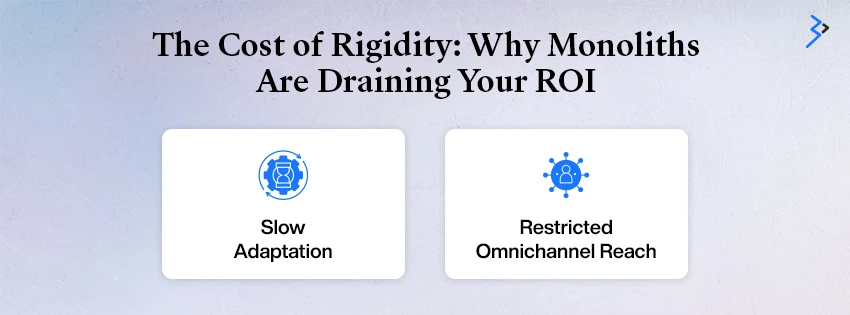
The Cost of Rigidity: Why Monoliths Are Draining Your ROI
For years, Traditional eCommerce platforms were the default: unified, stable, and seemingly simple. They house the front end (the visual experience) and the back end (inventory, pricing, orders) in a single, tightly coupled, monolithic system.
While this structure offers Faster Go-to-Market for startups, it suffocates large-scale innovation. Every time your marketing team wants to test a new UX feature or your product team wants to integrate a new AR try-on, your developers face a crippling challenge:

You can’t change the facade without disrupting the foundation.
For a global enterprise, this rigidity translates directly into:
- Slow Adaptation: Innovation is shackled to the vendor’s roadmap, delaying your ability to launch critical features like Artificial Intelligence recommendations or voice commerce until your competitor does it first.
- Restricted Omnichannel Reach: Expanding beyond the web into native apps, smart displays, or kiosks is technically complex because the presentation layer is hardwired to the backend logic.
The result is a devastating opportunity cost. Your system may be cheap to run initially, but its inability to keep pace with consumer expectations makes it the more expensive choice in the long run.
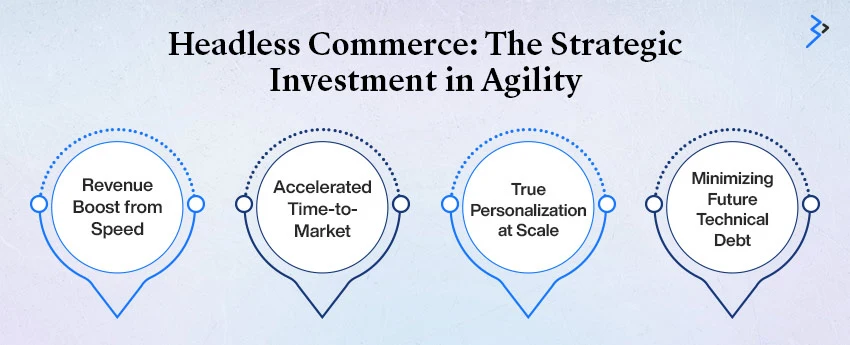
Headless Commerce: The Strategic Investment in Agility
Headless Commerce is the antithesis of the monolith. It decouples the front end (“the head”) from the commerce logic (“the body”), connecting them through seamless APIs.
It is like transforming your digital infrastructure from a single, rigid building into a powerful, centralized brain (the backend) that powers dozens of independently functioning, lightweight bodies (your sales channels).
The ROI Equation: Speed, Conversion, and Future-Proofing
Global enterprises are adopting this model because the returns are immediate and compounding:
- Revenue Boost from Speed: Modern shoppers will not wait. A Deloitte study proved that a mere 0.1-second (100-millisecond) improvement in mobile site speed can result in an 8.4% increase in conversion rates for retail sites. Jobera further noted that Headless architectures are inherently lighter and faster, directly translating to measurable conversion uplift and a 23% reduction in bounce rates.
- Accelerated Time-to-Market (TTM): In a headless environment, your front-end and back-end teams operate completely independently. They can run parallel innovation tracks, eliminating bottlenecks. Companies adopting this approach report a significant reduction in time-to-market for new digital experiences. When speed is capital, that agility is priceless.
- True Personalization at Scale: Decoupling helps you integrate best-in-class Customer Data Platforms (CDPs) and AI engines directly into the frontend experience. You gain the freedom to craft hyper-personalized journeys that truly drive customer loyalty and Lifetime Value (LTV).
- Minimizing Future Technical Debt: Headless is an insurance policy. If your Content Management System (CMS) or Search provider becomes obsolete, you can swap out that single component without a costly, full-platform rebuild.
Summarizing The Difference:Traditional vs. Headless Commerce
Here is a quick breakdown of how the two architectures impact key business outcomes:
| Feature | Traditional (Monolithic) | Headless (API-Driven) | Strategic Impact on ROI |
| Agility / TTM | Slow. Changes require modifying both front and back ends. | Fast. Teams innovate independently via APIs. | Faster TTM for new features. |
| Omnichannel | Limited. Difficult to support new channels (Voice, IoT). | Unified. Single backend powers all touchpoints. | True brand consistency across every device. |
| Performance (Speed) | Slower. Heavy dependencies and full-stack rendering. | Superior. Lightweight, API-first front ends load instantly. | Directly drives +8.4% conversion per 100ms speed improvement. |
| Customization | Low. Restricted by platform themes and templates. | Unlimited. Full freedom over the user experience (UX). | Enables hyper-personalization to boost LTV. |
| Future-Proofing | Low. Requires costly, full replatforming every few years. | High (Composable). Allows swapping individual components (CMS, search). | Eliminates massive technical debt and future rebuilds. |
Real-World Case Studies: The Headless Mandate in Practice

The shift from rigid monolithic systems to agile, API-driven architectures is not theoretical. It’s the competitive foundation of the world’s leading digital retailers.
Sephora: Unifying the Online and In-Store Experience
Sephora is the gold standard for omnichannel retail. A 2022 Sephora Newsroom Archive discusses how they faced the challenge of integrating their highly personalized Beauty Insider loyalty data and virtual try-on features with their core commerce logic across web, app, and physical store kiosks.
- The Composable Solution: Sephora migrated to a MACH-based (Microservices, API-First, Cloud-Native, Headless) architecture, with the help of Commercetools. This shift moved them away from a legacy system that couldn’t handle the complexity of unifying in-store and online shopping experiences.
- The Impact: The API-first approach lets a single source of product and customer data (the “body”) power all customer touchpoints, ensuring a consistent brand experience. This flexibility helps them rapidly implement frictionless features, such as same-day delivery options and personalized recommendations based on in-store purchase history, at “MACH Speed.”
Amazon: The Original Architect
While Amazon doesn’t market its structure as “headless commerce” in the same way newer vendors do, its entire infrastructure is the ultimate example of a decoupled, service-oriented architecture.
- The Core Principle: Amazon’s retail platform is built on hundreds of tiny, independent microservices (like a pricing service, an inventory service, and a payment service), all communicating via APIs. The user interface (the “head”) is completely separate and can pull data from these services in real time.
- The Impact: This modularity gives Amazon its defining advantages: infinite scalability to handle global traffic spikes (like Prime Day) and the flexibility to launch new features (like Amazon Go stores or Alexa voice ordering) without ever disturbing the core transactional system, as reported in a 2021 Amazon Web Service blog. Amazon is the proof point that modularity and decoupling are the only path to sustained digital dominance.
The Future is Composable: Maximizing the 2025 ROI

The market trend isn’t just stopping at headless; it’s accelerating towards Composable Commerce.
Composable is the most advanced evolution of the headless idea. It means breaking down the back end itself into small, interchangeable, best-in-class components (Microservices) for specific functions: one for payments, one for inventory, one for search.
Coherent Marketing Insights projects that the global headless commerce market will reach US$7.16 billion by 2032, with a CAGR of 22.4% from 2025. This growth signals that future investment is overwhelmingly flowing into modular, composable architectures.
Why Composable Guarantees Maximum ROI
- Zero Vendor Lock-in: You can replace any single piece of technology at any time without disrupting your entire business. This maximizes your control and guarantees future-proofing.
- The Right Tool for the Job: Instead of settling for an average tool built into a monolith, you choose the world’s best provider for every single function, from fulfillment to fraud checks.
Conclusion: The Final Verdict
For small startups focused purely on a fast, cheap launch, Traditional Commerce may suffice.
However, for mid-to-large enterprises with high traffic, global markets, and the mandate to deliver device-agnostic, personalized experiences, Headless and Composable Commerce clearly outperform Traditional eCommerce in ROI.
The higher initial investment is not an expense. It is a strategic spend that is quickly recouped through accelerated TTM, higher conversion rates due to speed, and lower long-term maintenance costs.
Your technology decision today is a decision about your brand’s future velocity. Partner with Brainvire experts, who specialize in building high-performing, scalable, ROI-driven headless, composable solutions tailored to your global mandate.
Frequently Asked Questions:
Headless Commerce separates the front end (user interface) from the back end (commerce engine). This enables you to deliver faster, more flexible, and more customized experiences. Traditional eCommerce ties both layers together, simplifying setup but limiting creativity and speed.
Yes, initially. Headless Commerce requires more development and setup costs. Still, it often delivers a higher long-term ROI through faster site performance, better customer experiences, and the ability to scale without complete rebuilds.
A business should consider switching when it starts expanding into multiple markets, wants greater design flexibility, or needs to offer seamless shopping experiences across web, mobile, and emerging channels such as voice or AR.
Headless Commerce significantly boosts conversion rates by tackling speed and friction directly. By decoupling the presentation layer, headless delivers sub-second load times crucial for modern shoppers. Its API structure enables seamless integration of AI and CDPs for real-time, personalized content and product recommendations. Furthermore, a single back end ensures a consistent brand experience across all touchpoints (web, app, in-store), eliminating friction and building the trust customers need to complete their purchase.
Composable Commerce is the evolution of Headless. It separates the front and back ends and allows brands to build their tech stack using modular components, like LEGO blocks. This approach makes it easier to update, scale, and optimize systems for maximum return on investment (ROI) and future preparedness

Related Articles
-
 Two eCommerce Store Mistakes That Drive Visitors Away Instantly
When it comes to online shopping, it is extremely difficult to provide a delightful shopping experience to all visitors, as the expectations and requirements vary from person to person. As
-
4 Real Life Business Use-Cases of Chatbots
Talking About 4 Real Life Business Use-Cases of Chatbots, Chatbots have penetrated into many aspects of businesses today. Here’s a common example – have you ever visited a business website?
-
11 Topmost Ecommerce Trends to Follow in 2021 and How to Include Them in Your Strategy
“If you always do what you always did, you will always get what you always got.” -Albert Einstein Evolution is a fundamental principle. Ecommerce is no different in this aspect.