Capitalizing on On-Demand Delivery in 2026: Two Profitable Models for Middle East & European Restaurant Markets
-

Pratik Roy
The restaurant industry is at a strategic inflection point. Across the Middle East, North Africa, and Europe, on-demand food delivery has quietly crossed a threshold; it is no longer a supplementary revenue channel. It has become the primary growth engine rewriting how profitable restaurant groups are built, scaled, and valued.
For C-suite leaders in this space, the question is no longer whether to invest in delivery infrastructure. It is the model that delivers the highest return and how quickly you can move before the competitive window closes.
The Market Opportunity Is Too Large to Overlook
Here’s what the data is actually telling us.
In the Middle East & North Africa:
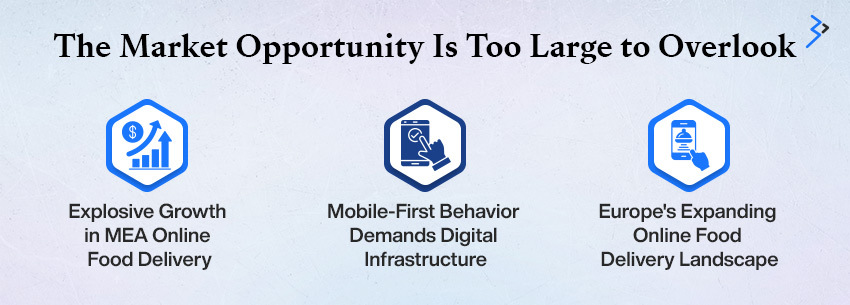
According to BlueWeave Consulting’s Middle East and Africa Online Food Delivery Market Report, the MEA online food delivery market was estimated at USD 13.46 billion in 2023 and is projected to grow at a CAGR of 21.62%, reaching USD 52.4 billion by 2030 — one of the fastest growth trajectories of any consumer market globally.
As reported by Mordor Intelligence in their GCC Foodservice Market Report (January 2026), the GCC foodservice market alone was valued at USD 62.18 billion in 2025 and is projected to reach USD 122.19 billion by 2031 at a CAGR of 12.07%, with Saudi Arabia commanding 47.27% of regional sales.
As reported by BlueWeave Consulting, over 70% of food delivery orders in the UAE and Saudi Arabia are placed via mobile devices, underscoring that digital-first infrastructure is a non-negotiable baseline.
In Europe:
According to Renub Research’s Europe Online Food Delivery Market Report, Europe’s online food delivery market stood at USD 31.24 billion in 2024 and is projected to reach USD 70.02 billion by 2033 at a CAGR of 9.38%.
As estimated by Statista’s Market Forecast for Online Food Delivery in Europe, the continent’s broader online food delivery revenue — including grocery delivery — is placed at USD 157.86 billion in 2025, with the meal delivery user base expected to surpass 289 million users by 2030.
Taken together, these two regions define a combined multi-hundred-billion-dollar opportunity for restaurant operators who move with strategic intent.
Why Most Restaurants Are Leaving Money on the Table
Before examining the two profitable models, executive leadership must understand the structural profitability trap that is quietly rotting margins across the sector.
The Third-Party Platform Margin Problem
Most restaurant operators partnered with Talabat, Deliveroo, Uber Eats, Careem Now, Just Eat, or Glovo as a path to revenue growth. In the short term, it works; volume increases. But the long-term financial picture is far less flattering.
| Cost Type | Standard Range |
| Commission per order (advertised) | 15% – 30% |
| True all-in cost (commissions + fees + promotions) | 30% – 40% |
| Average restaurant profit margin (dine-in) | 10% – 15% |
| Net margin on a third-party delivery order | Often negative |
(Source: KitchenCost data cited by Rezku Blog, “Third-Party Delivery Fees in 2026”, April 2026; CloudKitchens Blog, “How much do food delivery apps cost restaurants?”).
A concrete example depicts the problem clearly: a meal that generates a 15% profit margin when served in-house can produce a net loss of 7.6% once delivery platform fees are applied. (Source: orders.co, “Are Delivery App Commissions Cutting Into Your Profits?”).
The uncomfortable truth for C-suite leaders: commissioning orders through third-party aggregators is often more akin to a customer acquisition cost than a sustainable revenue model. The platforms have scale; your restaurant has the product. The model, as currently structured, transfers value from operators to platforms at scale.
The two models outlined below are how forward-thinking operators are reversing this equation.
Model 1: The Ghost Kitchen (Cloud Kitchen) Model
What It Is
A ghost kitchen, which is also known as a cloud kitchen, dark kitchen, or virtual restaurant, operates exclusively as a delivery-only kitchen with no dine-in area. The restaurant exists as a brand on delivery apps and its own digital ordering channels, but has no physical customer-facing premises beyond the production kitchen itself.
This model has proven particularly powerful in high-density urban markets across the Gulf and major European cities, where real estate costs are high, and delivery demand is concentrated.
The Financial Case
The numbers make a compelling boardroom argument:
- Ghost kitchens generate average profit margins of up to 20%, significantly higher than traditional dine-in restaurants. According to Gitnux, “Ghost Kitchen Statistics” (2025).
- Ghost kitchens see roughly 15% higher profit margins compared to traditional dine-in setups. A report by Gitnux.
- According to Gitnux, 60% of restaurant owners who adopted ghost kitchen models reported increased sales.
- The average order value from ghost kitchens is approximately 12% higher than from traditional restaurants. Report by Gitnux.
Why It Works in MENA and Europe
In MENA, the model is already gaining regulatory recognition and institutional legitimacy. Dubai Municipality mandated a dedicated “virtual restaurant” registration category by mid-2025.
Qatar’s Ministry of Public Health introduced cloud kitchen licensing guidelines that, while adding compliance costs, have made the format more attractive to institutional investors. Kuwait implemented platform commission caps at 15% in February 2026, directly improving unit economics for cloud kitchen operators. Mordor Intelligence, GCC Foodservice Market Report
Saudi Arabia’s Vision 2030 is integrating thousands of restaurant seats into mixed-use developments. Simultaneously, AI-powered cloud kitchen platforms are routing orders to delivery-only virtual brands, compressing startup costs and cutting order turnaround times. (Source: Mordor Intelligence).
In Europe, the cloud kitchen model is driving the fastest-growing segment of the market. The restaurant-to-consumer segment is growing at a CAGR of 18.5%, fueled by restaurants developing their own direct-ordering channels and delivery-first brands. (Source: MarketDataForecast, Europe Online Food Delivery Market).
Strategic Considerations for C-Suite Leaders
Advantages:
- Dramatically lower capital expenditure (no front-of-house fit-out, no prime real estate).
- Ability to test new brands or cuisines at low risk.
- Operational data from day one, every order is digital and trackable.
- Multiple virtual brands can operate from a single kitchen, multiplying revenue per square meter.
Risks to manage:
- Brand building is harder without physical presence; marketing investment must compensate.
- Quality control across aggregator platforms needs strict operational standards.
- Regulatory compliance requirements are evolving rapidly across both regions.
Model 2: The Direct Ordering Channel (D2C Delivery) Model
What It Is
The Direct-to-Consumer (D2C) delivery model involves a restaurant building its own branded digital ordering infrastructure, a proprietary app, website ordering system, or integrated loyalty platform, and migrating customers away from third-party aggregators for repeat orders.
The aggregators remain relevant for discovery. But the strategic play is to acquire customers through the platforms, then convert them to your own channel for lifetime value.
The Financial Case
The margin impact of even a partial shift to direct ordering is significant:
- Restaurants that build direct ordering channels can achieve 10–20% higher profit margins per order compared to third-party platform orders. Report by: NIX United, “Food Delivery App Fees Are Killing Your Profit”, March 2026.
- The profit margin difference between third-party and direct orders can reach 30–40 percentage points, a gap that determines whether a restaurant thrives or merely survives. (Source: ActiveMenus, “The Hidden Costs of Third-Party Delivery”, August 2025).
| Metric | Third-Party Platform | Direct Ordering Channel |
| Commission per order | 15–30% (+ hidden fees up to 40%) | Zero or minimal (SaaS fee) |
| Customer data ownership | Platform retains all data | The restaurant owns all data |
| Repeat customer margin | Eroded by recurring commission | Fully retained |
| Brand loyalty building | Limited | Full control |
| Marketing to existing customers | Not possible | Direct CRM capability |
Why It Works in MENA and Europe
In MENA, the super-app and platform ecosystem (Talabat, Careem, Jahez) is dominant, but not invulnerable. Americana Restaurants, operating 2,590 outlets including KFC and Pizza Hut across the GCC, reported that 44% of its revenue now comes from home delivery, with a significant portion driven through brand-specific digital channels. (Source: Mordor Intelligence, GCC Foodservice Market Report).
Consumer behavior is also shifting. In Saudi Arabia, the food authority now mandates calorie counts on menus, encouraging digital menu refreshes that create natural touchpoints for direct ordering engagement. Social platforms TikTok, Instagram, and Snapchat are now central to restaurant discovery in the region, creating owned marketing channels that feed direct orders. (Source: Syrve MENA / Hotel & Catering, January 2026).
In Europe, regulatory pressure is actively accelerating the direct ordering trend. Commission disputes and labor regulations have pushed operators toward proprietary ordering systems. Mobile applications development already account for 65.8% of the total market share in European online food delivery. (Source: MarketDataForecast) The infrastructure to serve direct mobile-ordering customers already exists; the strategic work is to incentivize migration.
Strategic Considerations for C-Suite Leaders
Advantages:
- Own your customer data, critical for CRM, loyalty programs, and personalized marketing.
- Build a defensible competitive moat through customer relationships, not just product.
- Long-term margin recovery compounds as repeat order percentage grows.
- Eliminates platform dependency risk (algorithm changes, commission increases).
Risks to manage:
- Upfront technology investment and customer migration effort required.
- Discovery still largely platform-dependent for new customer acquisition.
- Loyalty program design requires careful data science to maximize LTV.
Choosing the Right Model or Both
The most sophisticated operators in MENA and Europe are not choosing between these two models. They are sequencing them.
| Strategic Stage | Recommended Approach |
| Market entry / new brand launch | Ghost kitchen on aggregator platforms |
| Building market share | Ghost kitchen + limited direct ordering |
| Customer base established | Accelerate direct ordering migration |
| Scale | Multi-brand ghost kitchen + owned D2C platform |
The ghost kitchen gives a low-cost entry point and a revenue base. The direct ordering channel is where the long-term enterprise value is built. Together, they create a delivery-first restaurant business that controls its margin structure, owns its customer relationships, and scales across geographies with minimal capital commitment.
Key market signals support this two-phase approach: globally, nearly 75% of all restaurant traffic now happens off-premises (including delivery and takeout), and 37% of adults order delivery at least once a week. (Source: National Restaurant Association, 2025 Off-Premises Research, cited by Sauce.com) The off-premises economy is not a trend. It is the default.
Conclusion
The on-demand delivery market in MENA and Europe is not waiting for operators to catch up. The ghost kitchen model offers a capital-efficient path to immediate delivery revenue. The direct ordering model is where the sustained, high-margin business is built. The operators who move on both, and who invest in the digital infrastructure to connect them, will define the competitive landscape of restaurant delivery in 2026 and beyond.
The window for early-mover advantage is open. The question for C-suite leaders is simple: Are you building the infrastructure to capture it, or funding your competitors’ growth through platform commissions?.
Executing on either model, or both, requires more than a good strategy. It requires the right technology infrastructure to manage operations, customers, inventory, and data at scale.
Brainvire brings together the capabilities restaurant and food service businesses need to compete in the on-demand delivery era.
Their Retail Omni-Channel ERP covers inventory, warehouse management, CRM, and the full operational stack that delivery-first businesses depend on. For operators looking to convert delivery volume into customer intelligence, Brainvire’s open-source, customizable, and license-free CRM for eCommerce provides a full Customer 360 view that powers loyalty, retention, and repeat-order growth.
Their Managed Analytics as a Service delivers 150+ ready-to-use business reports integrated with ERP, so leadership teams have real-time visibility into margin performance, order economics, and customer behavior without building internal data teams from scratch. And for restaurant groups scaling across multiple markets, Brainvire’s custom dashboards and data visualization tools surface the operational insights needed to make fast, confident decisions.
Frequently Asked Questions
It works for both established brands, which can launch ghost kitchens as delivery-only extensions to test new concepts or enter new cities with minimal capital. In contrast, new entrants use them to build market presence without the overhead of a physical location.
There’s no fixed timeline, but operators who consistently incentivize direct orders, through loyalty rewards, exclusive deals, and personalized offers, typically begin seeing meaningful repeat-order migration within 6 to 12 months.
Yes, but strategically, they remain the most effective discovery and acquisition tool for reaching new customers, but should not be the primary profit channel. The smart play is to acquire through platforms, then convert repeat customers to your own direct ordering system.
Regulatory compliance is the most immediate risk, as countries like Qatar, Dubai, and Kuwait have introduced or updated ghost kitchen licensing rules in 2025–2026. Beyond compliance, maintaining consistent food quality and brand visibility without a physical presence requires strong digital marketing and operational discipline.
When you own the customer relationship and their ordering history, you can target them with personalized promotions, build loyalty programs, and reduce re-acquisition costs — all of which compound into significantly higher lifetime value per customer compared to anonymous, platform-mediated transactions.

Related Articles
-
 Importance Of Web Security For The Ecommerce Industry During COVID-19 Pandemic
Industries have certainly strengthened their web security to steer clear of cyberattacks. But the truth is they are far from being immune to these online threats! If this wasn’t enough,
-
 How to emerge as a distinguished brand with a USP
Ecommerce has become an indispensable part of the global retail framework. In light of the recent global pandemic, ecommerce is expanding to new types of products, firms, and customers. This
-
 From Cart Abandonment To Slow Load Times: Streamlining The E-commerce Experience
The success of any eCommerce solution company depends on streamlining the ecommerce experience through a well-designed and user-friendly website in today’s competitive market. Various factors, including Cart Abandonment Solutions, Mobile